" Anweisung an den Schmerz "
I arrive at the dreamwork by a side door. Not by sleep, not by images thrown up in the dark, but by a long travel of waking reflection—existential, slow, at times humiliatingly clear. The Watchman is what I meet there: a figure that looks like a drawing, like a concept, like a small icon placed on the shoulder of a larger body. Yet it behaves like the first real dream-figure of the Rauhnächte, because it marks the threshold where my inner life becomes spatial again, where it can be staged, observed, and—most importantly—worked with.
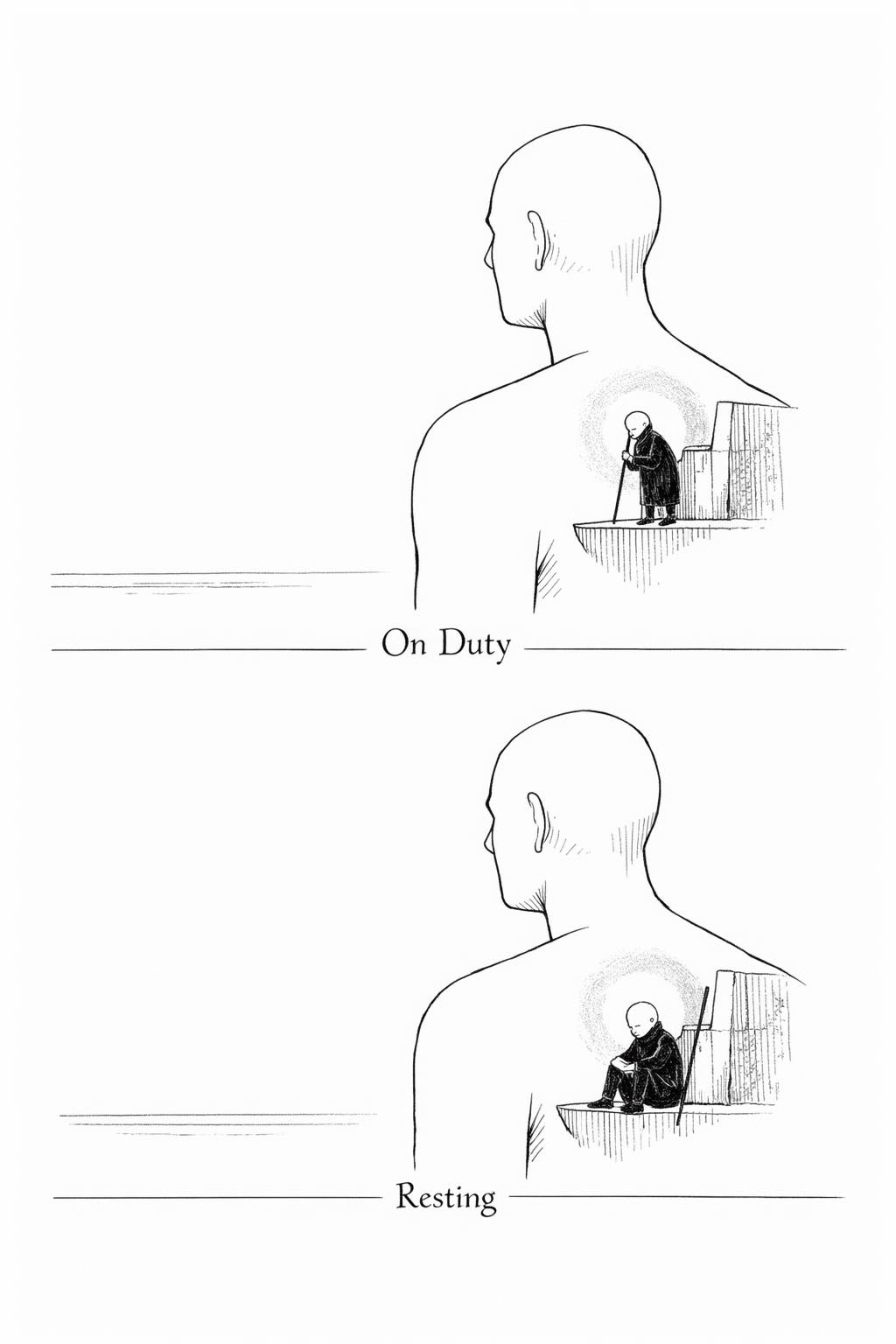
In this image the Watchman is not a metaphor; it is a function. He stands on the edge of me, as if the self were a landscape with a perimeter. He is stationed at a ledge, a place where something could fall, where the world could break in, where I could misstep. The word “On Duty” names a condition I recognize immediately: vigilance that is older than my current circumstances, vigilance that does not always ask permission. It has a moral flavor—duty, responsibility, readiness. But the body of the Watchman is small. The scale difference matters. It tells me that even when the vigilance feels total, the part of me doing it is a small worker, not a god. A tired caretaker with a stick and a post. A sentinel who never received the message that the war is over.
Then the second panel: “Resting.” The Watchman sits down. He doesn’t leave. He doesn’t quit. He simply folds into stillness while remaining on site. This is the hinge that opens the door to the dreamworld. Because it shows me a third thing that waking thought rarely manages: a mode in which attention remains present without being weaponized. Not the absence of responsibility, but the softening of it. A permission to be held by the larger body rather than holding everything alone.
This is how the dream labor begins for me: by distinguishing between guard and ground. Between the part of me that scans and the part of me that can contain scanning without collapsing into it. The Watchman gives me a way to treat vigilance as a character instead of as the whole truth. He becomes speakable. I can approach him. I can ask what he fears will happen if he rests. I can notice how quickly “duty” turns into posture, and posture into identity. And I can start to loosen that chain—not by argument, but by staging: by giving the Watchman a place, a size, a ledge, a rhythm.
What matters is that this is not yet “a dream,” and still it behaves like dreamwork. It is an antechamber: a graphic threshold reached after a long inward journey, where my psyche begins to externalize its roles in a form I can see. The Watchman is the first role I can locate. He is the first proof that I am not identical with my alertness. And because he can be “on duty” and “resting” without leaving the post, I am offered a new kind of continuity—one that does not require anxious propulsion to remain real.
So when I say Rauhnächte, I don’t mean only the nights. I mean this practice of entering the inner terrain through images, even found images, even “not-dreams,” and treating them as instruments. The Watchman is my opening instrument. He lets me start the year with a discipline that is gentler than self-control: an attentive companionship with my own inner worker, and the slow re-training of vigilance into presence.