Skip to the book
Solstice
FIRST READING
Druckfahne ↗
SOLSTICEAN AUTHORED EDITION

THE WRITING SOURCE · SINCE 21 DECEMBER 2025

First
Reading.

The source becomes literature by being read.

THIRTY WORKS · FORTY-ONE ORIGINAL IMAGES
BENEDIKT EICKHOFF · FOUNTAIN COACH

THE EDITION

First Reading

A selection beginning at the winter solstice: prose, the journals of Bee, Zork and N., and their forty-one original accompanying images, including two Teatro Scores. Thirty complete posts, presented in their original sequence.

This reading is an authored selection from a separately retained archive. The texts appear unabridged, and their original imagery remains associated with its source. This edition is a beginning, not a final narrative.

THE CHRONOLOGY IS NOT THE NARRATIVE. IT IS WHERE THE WRITING BEGINS.

FIRST READING 01 / 30

Anweisung an den Schmerz

22 / 12 / 2025 · Prose

Image 1 of 1 accompanying Anweisung an den Schmerz, 2025-12-22
Original post image · 2025-12-22

" Anweisung an den Schmerz "

I arrive at the dreamwork by a side door. Not by sleep, not by images thrown up in the dark, but by a long travel of waking reflection—existential, slow, at times humiliatingly clear. The Watchman is what I meet there: a figure that looks like a drawing, like a concept, like a small icon placed on the shoulder of a larger body. Yet it behaves like the first real dream-figure of the Rauhnächte, because it marks the threshold where my inner life becomes spatial again, where it can be staged, observed, and—most importantly—worked with.

In this image the Watchman is not a metaphor; it is a function. He stands on the edge of me, as if the self were a landscape with a perimeter. He is stationed at a ledge, a place where something could fall, where the world could break in, where I could misstep. The word “On Duty” names a condition I recognize immediately: vigilance that is older than my current circumstances, vigilance that does not always ask permission. It has a moral flavor—duty, responsibility, readiness. But the body of the Watchman is small. The scale difference matters. It tells me that even when the vigilance feels total, the part of me doing it is a small worker, not a god. A tired caretaker with a stick and a post. A sentinel who never received the message that the war is over.

Then the second panel: “Resting.” The Watchman sits down. He doesn’t leave. He doesn’t quit. He simply folds into stillness while remaining on site. This is the hinge that opens the door to the dreamworld. Because it shows me a third thing that waking thought rarely manages: a mode in which attention remains present without being weaponized. Not the absence of responsibility, but the softening of it. A permission to be held by the larger body rather than holding everything alone.

This is how the dream labor begins for me: by distinguishing between guard and ground. Between the part of me that scans and the part of me that can contain scanning without collapsing into it. The Watchman gives me a way to treat vigilance as a character instead of as the whole truth. He becomes speakable. I can approach him. I can ask what he fears will happen if he rests. I can notice how quickly “duty” turns into posture, and posture into identity. And I can start to loosen that chain—not by argument, but by staging: by giving the Watchman a place, a size, a ledge, a rhythm.

What matters is that this is not yet “a dream,” and still it behaves like dreamwork. It is an antechamber: a graphic threshold reached after a long inward journey, where my psyche begins to externalize its roles in a form I can see. The Watchman is the first role I can locate. He is the first proof that I am not identical with my alertness. And because he can be “on duty” and “resting” without leaving the post, I am offered a new kind of continuity—one that does not require anxious propulsion to remain real.

So when I say Rauhnächte, I don’t mean only the nights. I mean this practice of entering the inner terrain through images, even found images, even “not-dreams,” and treating them as instruments. The Watchman is my opening instrument. He lets me start the year with a discipline that is gentler than self-control: an attentive companionship with my own inner worker, and the slow re-training of vigilance into presence.

SOURCE · ORIGINAL AUTHOR TEXT · 2025-12-22 SOURCE PAGE ↗

FIRST READING 02 / 30

Integration

23 / 12 / 2025 · Prose

Image 1 of 1 accompanying Integration, 2025-12-23
Original post image · 2025-12-23

" Integration "

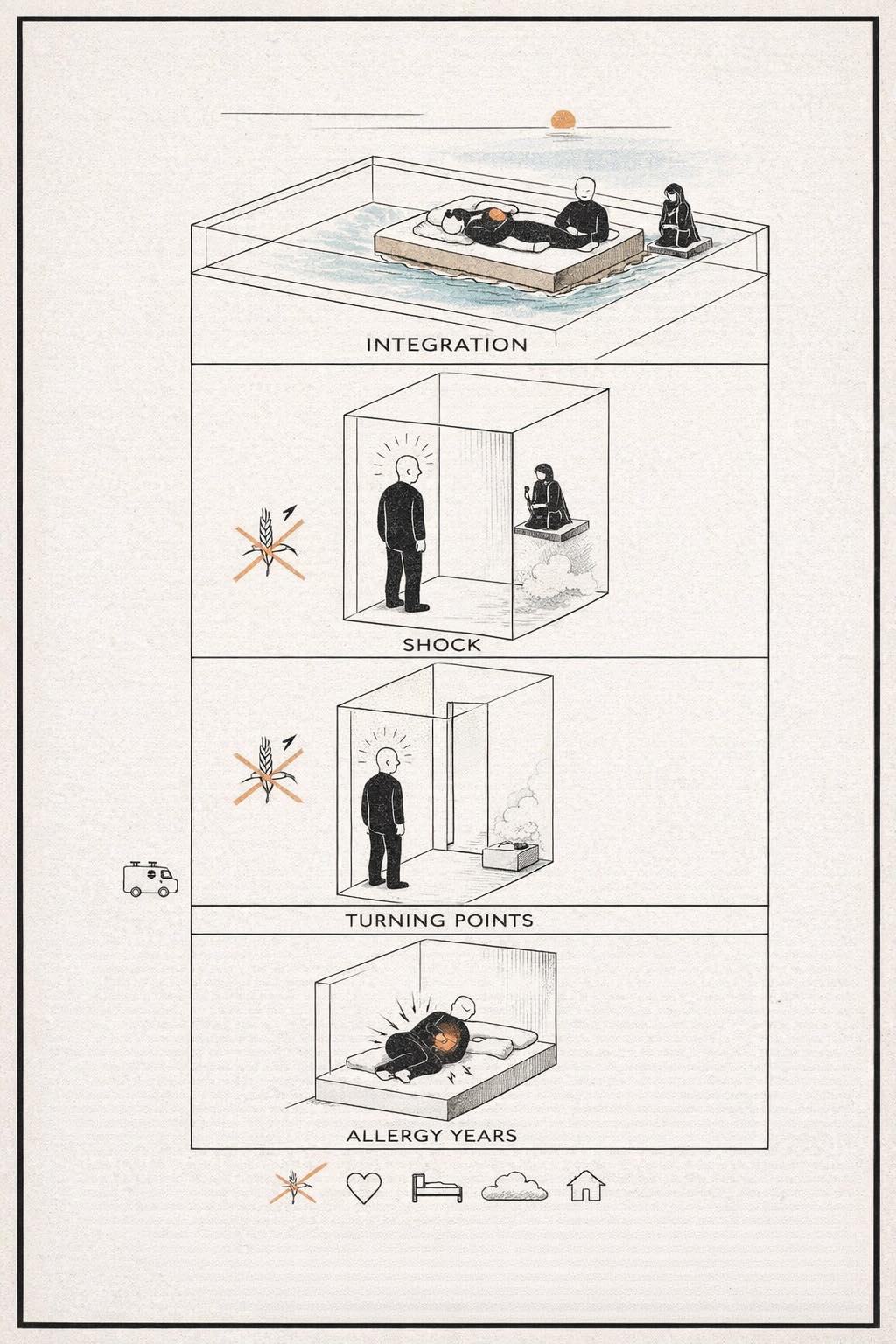
... Yes — got it . I made this image on purpose. Not to “illustrate a dream,” but to give my memory a stage that can hold it without collapsing into explanation.

Teatro is my trick for staying close: I reduce the story until it becomes geometry, rooms, distances, a few objects—then I let feeling return through the structure. The format pretends to be clinical, but it isn’t. It’s a way of touching what I normally either dramatize or avoid.

At the bottom I place the years that shaped my nervous system. I don’t call them trauma years or crisis years. I call them allergy years—because the most honest word for that period is sensitivity: my body over-reading the world, reacting too early, too strongly, too often. In that panel I see myself curled on the bed, pulled inward, guarding my chest like there’s a small, hot engine inside it. I remember how familiar that posture became: the pose of enduring, of waiting for my own system to calm down. The orange mark is not a metaphor I had to invent; it’s simply where I lived.

Above that I mark the first real shift: turning points. I don’t stage a breakthrough. I stage something smaller and more credible—an opening. A box-like room. A door slightly ajar. A small container smoking on the floor. The smoke is not catastrophe; it is evidence. Something is burning off. Something is being processed. I remember that change in my life never arrived as a clean decision; it arrived as ventilation. As the tiniest permission for air.

Then I move to shock. Not the dramatic kind—the kind where the system becomes narrow and bright. I draw myself standing in a cube again, lit from inside, with that ringing, overexposed clarity that comes when the body says this is too much. Across from me sits a figure on a small platform. I don’t need to name who that is. In my memory it’s the part of me that can observe without being swallowed. The cloud beneath that platform is the residue: the unsaid, the discharge, the part that doesn’t become language but still fills the space.

Beside it I put the little crossed-out symbol, like a warning label. This is important: I’m not accusing anyone. I’m not romanticizing my sensitivity either. I’m simply acknowledging that I have triggers the way bodies have allergens. Some things hit me harder than they “should.” Some situations enter my bloodstream too quickly. I want that fact to be visible without shame.

And then—because I needed it, because the whole project is a practice of repair—I place integration at the top.

I widen the container. I add water. I don’t flood the scene; I give it a basin, boundaries, a held element. In the middle I let the bed float. That matters to me: the bed is no longer only the place where I collapse. It becomes something that can be carried. I draw myself resting there with the same orange center, but now it reads less like injury and more like life: warmth, core, presence, the stubborn fact of being here.

I add an upright figure at the edge of the bed—the watchful self, the steady self—close enough to protect without controlling. And I keep the seated figure off to the side as well, because I don’t want false unity. In my real inner life, parts remain separate. Integration is not fusion. Integration is cooperation inside a shared frame.

The small sun is almost embarrassingly simple. But I include it because my memory needs permission to believe in time. I’m not promising a happy ending. I’m marking a horizon: a next morning exists. The system can settle. The water can hold. The bed can float.

When I read the icons at the bottom—irritant, heart, bed, cloud, home—I understand what I was trying to memorize:

I can build a home that includes my weather.

Not a home that denies sensitivity. Not a home that demands permanent strength. A home that has room for smoke, shock, tenderness, and rest—without my whole inner architecture having to be torn down each time something flares.

That’s what this illustration is for. It’s not a dream. It’s my way of making a memory inhabitable.

SOURCE · ORIGINAL AUTHOR TEXT · 2025-12-23 SOURCE PAGE ↗

FIRST READING 03 / 30

Renaturalization

28 / 12 / 2025 · Prose

Image 1 of 1 accompanying Renaturalization, 2025-12-28
Original post image · 2025-12-28

" Renaturalization " ( ' Less tomatoes, each one strong in taste ' )

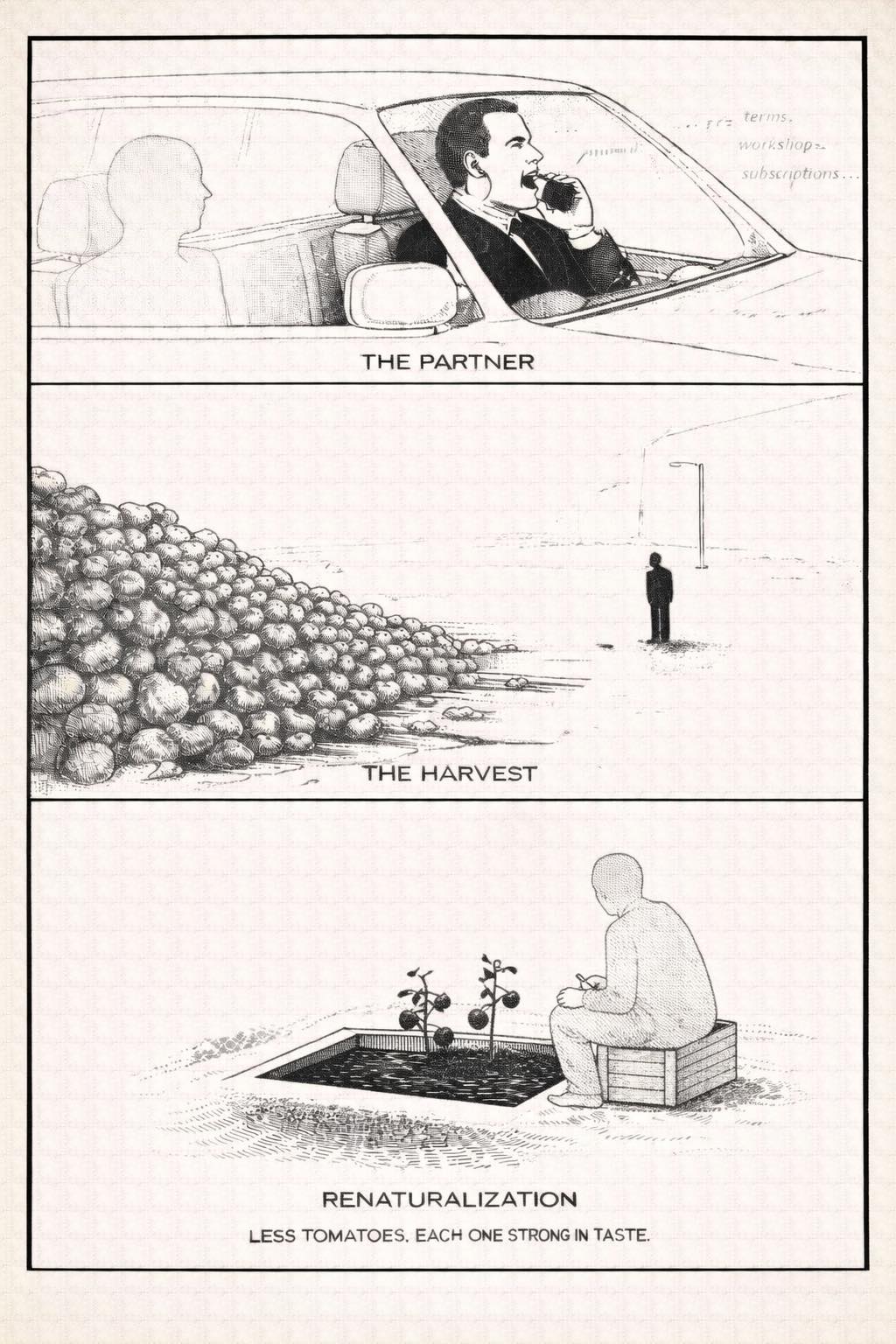
I wake with the sensation that I am moving while staying still—as if the night has put me in a vehicle and decided the route without asking. In the first image I am present, but only as a pale outline in the back seat: a silent passenger, a shape made of permission. In front of me sits the partner—not a romantic figure in a warm, shared sense, but a driver in the strictest meaning of the word: someone who steers. He holds something to his mouth—phone or radio—already mid-conversation, already tethered to obligations that are not mine. Even the space between us feels functional: he faces forward; I exist behind him, unaddressed. The windshield takes priority over the interior.

There is a cold clarity in that. Not cruelty—clarity. The night is showing me a structure: how easily partnership can become logistics, how easily “we” becomes “I am taken along.” And it’s not that I don’t trust the driver. It’s that I can feel my own outline: how thin I become when I don’t occupy the front seat of my own life.

Then the scene cuts wide open.

The world turns into a plain, almost empty, and on the left rises a mountain of harvest—round, heavy, piled high like a victory that has started to rot at the edges. It is abundance so concentrated it becomes grotesque: too many of the same thing, too much proof, too much output. The ground around it is messy with overflow. A single figure stands far away near a lonely lamppost, as if waiting for night to justify the light. He does not approach the pile. He does not celebrate it. He simply stands at a distance that feels deliberate—like someone who knows that not everything produced is meant to be eaten.

I recognize that feeling in myself: the fatigue that comes after “success,” the strange emptiness of having done what was asked and then discovering it doesn’t taste like life. The heap is impressive, yes. But it is also an accusation. It asks: Was this the point? And in my body I feel the answer forming: no—at least not in this quantity, not in this sameness, not in this scale that demands storage, management, decay.

The last panel is quieter, almost tender, like an antidote.

I sit beside a small, square basin of dark water—contained, cared for, bordered. Two tomato plants rise from it with a few fruit: not a harvest you can brag about, not a pile you can measure, but something living that insists on time. The caption lands like a corrective sentence spoken slowly: Renaturalization. Less tomatoes. Each one strong in taste.

I understand this as a vow the night makes on my behalf.

Not a vow to work less out of laziness, but a vow to return to the scale at which a thing can be loved. To choose cultivation over accumulation. To stop equating volume with value. To accept that “less” can be the condition for flavor—for presence, for real nourishment, for pride that doesn’t curdle into exhaustion.

And suddenly the three parts connect in me like a simple circuit:

When I let someone else drive, I end up living inside their calls, their terms, their subscriptions—their forward momentum. When I live only for output, I create a pile that looks like proof but feels like waste. When I turn back toward something smaller—something that can be tended—I return to my own seat. I become a person again, not an outline.

So this night doesn’t tell me to leave the partner. It tells me to become a partner to myself: to claim the steering wheel where it is mine to claim, to refuse the false romance of heaps, and to choose a quieter kind of growth.

Less tomatoes.

Each one strong enough to matter.

SOURCE · ORIGINAL AUTHOR TEXT · 2025-12-28 SOURCE PAGE ↗

FIRST READING 04 / 30

Vier Aussagen zum Ätherleib

08 / 01 / 2026 · Prose

Image 1 of 1 accompanying Vier Aussagen zum Ätherleib, 2026-01-08
Original post image · 2026-01-08

" Vier Aussagen zum Ätherleib "

I don’t know what I feel when I look at it, which is how I know it’s honest.

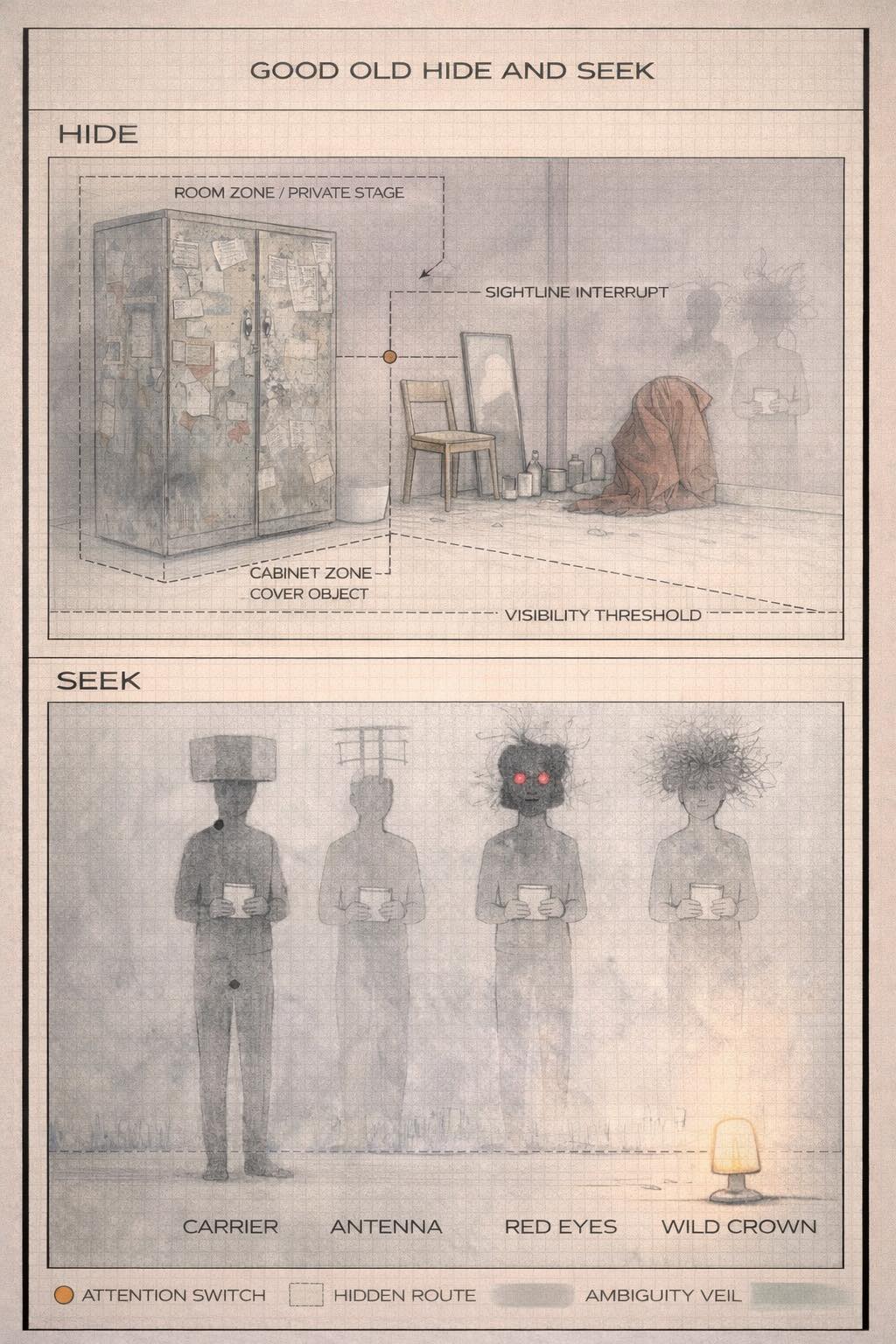
There’s a room that doesn’t open. Not because it’s locked, but because it keeps changing what “open” would even mean. A cabinet stands where a wall should be. A mirror offers a sliver and then takes it back. A red bundle sits like a decoy: not quite alive, not quite object, not quite safe to name. The whole scene feels arranged to let me approach without letting me arrive.

My first instinct is practical. Move the cabinet. Step closer. Angle the mirror. Confirm what I’m seeing. My body thinks clarity is the same thing as safety. My body thinks attention is care. So it leans forward.

Then I feel the line.

It’s not a moral line. It’s not a rule someone else set. It’s a limit inside my own system: the point where “trying to know” becomes too much pressure. The scene doesn’t punish me, it just thins out. It becomes misty, and I’m left holding my own insistence like a tool that suddenly looks crude.

Below the room there are four versions of a head, as if my mind brought spare equipment for the day. One is heavy and rectangular, like carrying weight as an identity. One is a receiver, all thin structure, scanning for signal. One has two small red points that don’t spread warmth, only insist on being noticed. One is weather—scribble, static, nest—noise made into a crown. The bodies underneath them are calm. The hands are calm. Each holds the same small page. As if the page is proof of something: permission, coherence, a right to be here.

But nothing clicks into place.

So the test becomes simpler.

What do I do when I can’t make it mean?

Do I tighten and over-focus. Do I retreat and call it dignity. Do I turn it into a story so I don’t have to feel the loose, uncontained thing underneath.

The loose thing is not dramatic. It’s small and humiliating in its simplicity.

I want a witness.

Not a judge, not a rescuer, not an audience. Just a witness that doesn’t turn into demand. A recognition that doesn’t create debt. A warmth that doesn’t require me to perform the right kind of suffering to qualify for it.

The lamp makes this worse in the cleanest way. It’s tiny. It doesn’t flood the room. It doesn’t fix anything. It just proves that light is possible and that it isn’t automatic. It’s the opposite of a solution. It’s a pulse. A yes that doesn’t become a promise.

When I stay with the image long enough, I start noticing my reflexes as if they’re the real content.

How fast I try to convert longing into a plan.

How fast I confuse vigilance with devotion.

How fast I treat mystery like a job I must complete, and then call the job love.

And then, if I’m quiet, a different feeling comes in—thin but real. Respect. Not admiration. Respect like standing outside a door and realizing the door is not the enemy. Realizing that love does not always mean entry. Realizing that pushing for full visibility can be its own kind of harm, even when the intent is tenderness.

So maybe the scene is not asking me to solve it.

Maybe it’s asking me to stay oriented while it refuses to become clear.

To hold the boundary without turning it into punishment.

To let the cabinet remain a cover object without making it a villain.

To let the mirror stay partial without demanding a face.

To accept that some contact is a lamp that barely turns on—just enough to say: signal received.

And then to stop.

SOURCE · ORIGINAL AUTHOR TEXT · 2026-01-08 SOURCE PAGE ↗

FIRST READING 05 / 30

Three Floors

22 / 01 / 2026 · Prose

Image 1 of 1 accompanying Three Floors, 2026-01-22
Original post image · 2026-01-22

Three Floors

I come up through three floors of myself.

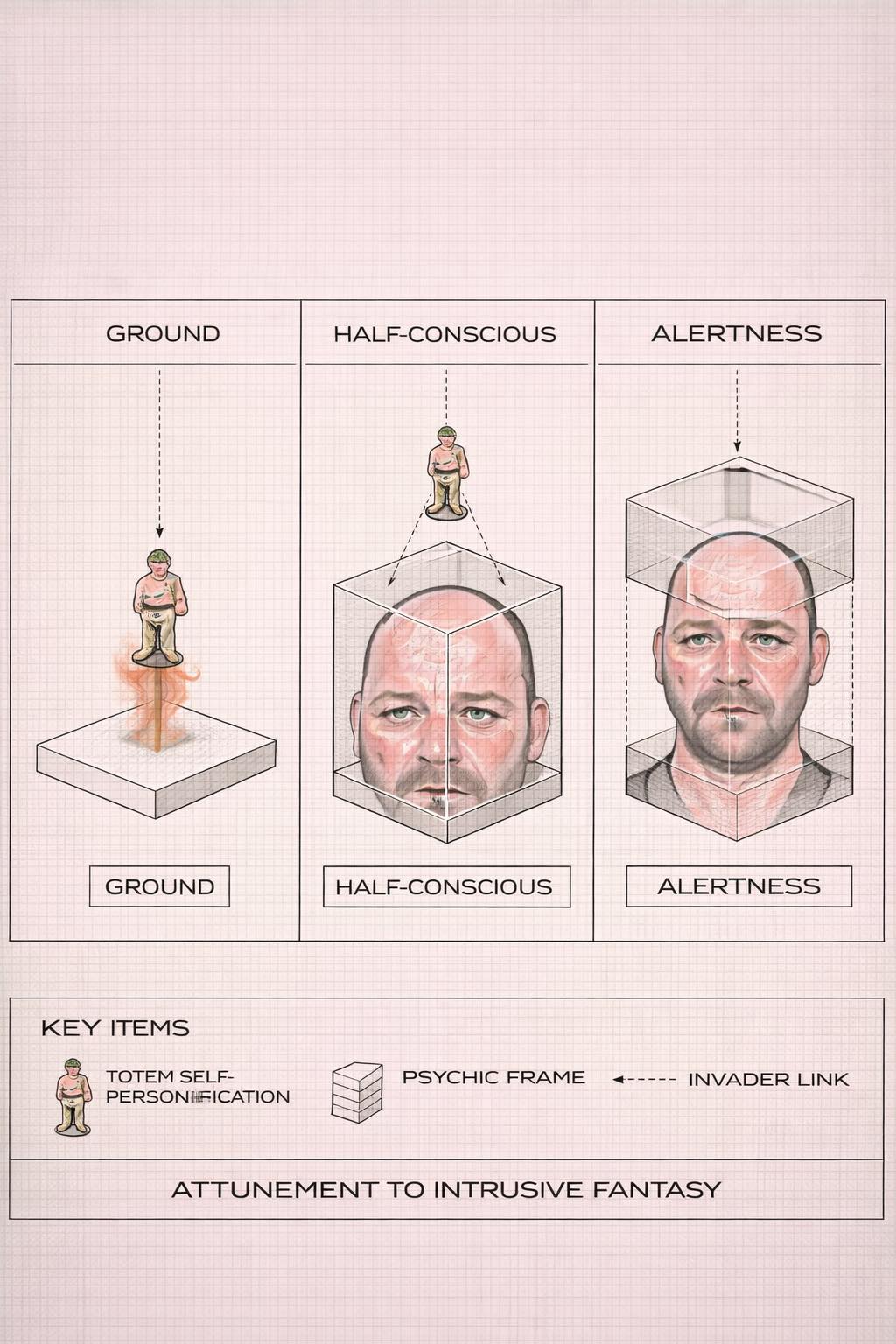
First: Ground. I am small, almost a figurine, a totem I can carry without feeling. The world is flat enough to stand on. My breath lands. My weight returns. I’m not thinking yet — I’m only here, a stamped silhouette on a pale surface. There is a faint plume under my feet, like the body’s last argument: stay.

Second: Half-conscious. A frame descends. Not a punishment — a container. A clear cube lowers over a face that is already awake inside it. I hover above it, and the distance is strange: I can see myself without being fully responsible for what I see. This is the dream’s compromise: Look, but don’t touch. Know, but don’t decide. In this zone, feelings don’t arrive as sentences. They arrive as geometry.

Third: Alertness. The cube lifts, and the face rises into full light. The eyes are open, direct, unblinking. The mouth is shut as if it’s holding back a confession. This is the moment the watchman clocks in. The nervous system tightens the straps. The room is still, but the air has already been rewritten: danger without a sound, readiness without a target.

And then the last line underneath everything, like a label on a specimen jar:

Attunement to intrusive fantasy.

I know what that means, in my own language. It means a thread pulls from elsewhere — an invader link — and my attention goes obediently, as if attention were love, as if attention were duty, as if attention were the only way to prevent loss. I don’t choose it at first. I notice I’m already chosen by it.

So I practice a quieter skill.

I place the frame back where it belongs: around the fantasy, not around my life. I let the totem-self stay small and warm on the ground. I let the face be a face — not a command.

And for one breath I understand the secret purpose of the diagram:

Not to explain me. To give me a handle.

Ground. Half-conscious. Alertness.

Three rooms. One body walking between them.

SOURCE · ORIGINAL AUTHOR TEXT · 2026-01-22 SOURCE PAGE ↗

FIRST READING 06 / 30

I Keep Moving

23 / 01 / 2026 · Prose

Image 1 of 1 accompanying I Keep Moving, 2026-01-23
Original post image · 2026-01-23

I keep moving.

Not even “forward” — just moving, like a rule I can’t stop obeying.

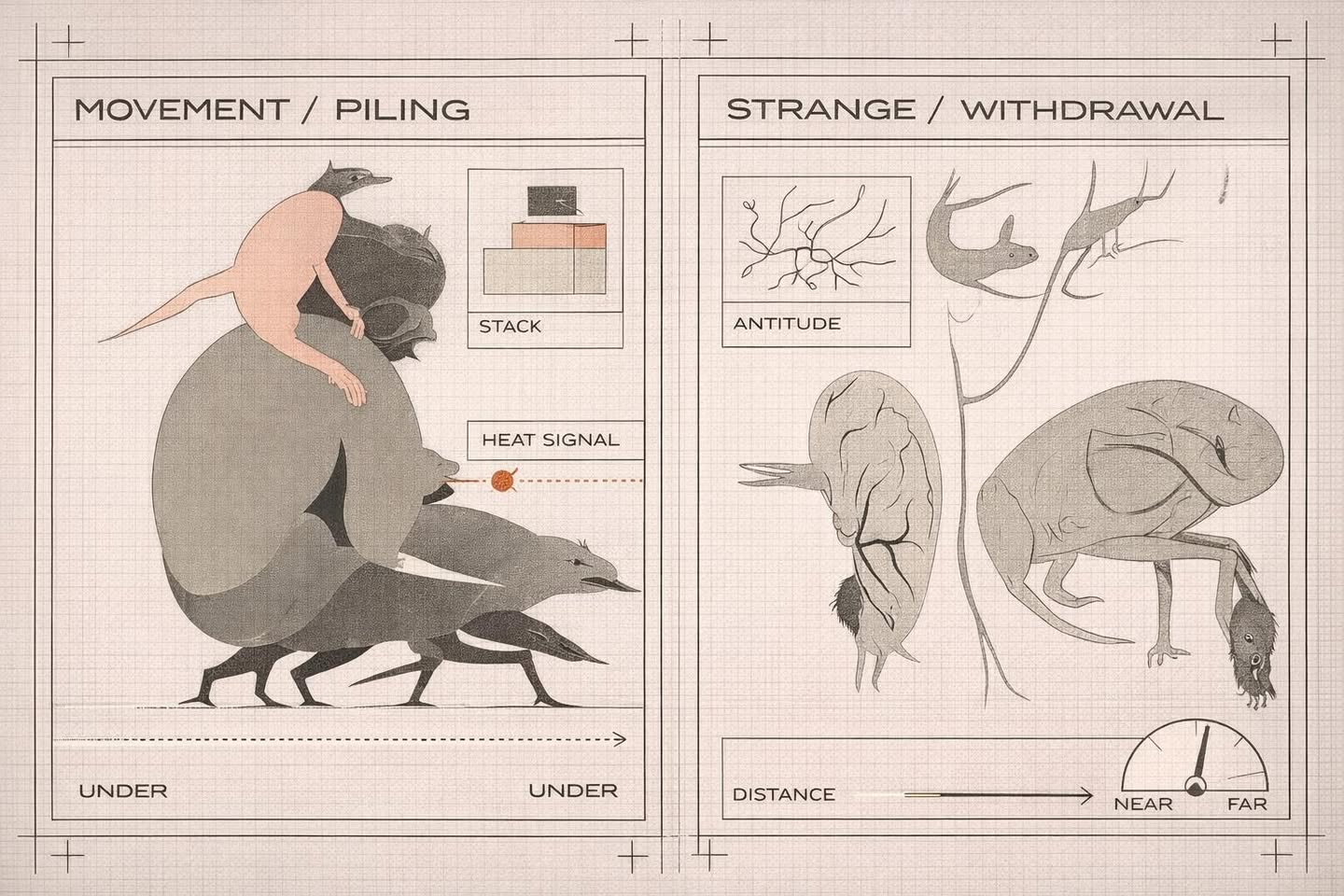
Something in me wants to pile warmth up the way you stack blankets: one animal on another, one weight on another, a whole living heap trying to manufacture a small climate. It’s almost funny, if I look at it from the outside: the improvised architecture of comfort, the body doing logistics. But from inside it’s not funny. It’s survival. It’s the old hope that if I add enough layers, the trembling will look like rest.

There’s a heat signal. Tiny, orange. Not a romance flare — more like a warning light that says: here, here, this is where it still registers. This is where you’re still reachable. I watch it like a scientist watches a stubborn pulse: not believing it, not letting it go.

I notice the way I go “under.” Under the day, under the sentences, under my own face. Under the social layer where I’m supposed to be simple and robust and employable and fine. Under the neat story where things progress. My body prefers “under.” Under is where I can keep the mess without it being visible. Under is where I can keep wanting without having to explain it.

And then the other panel: strange withdrawal. The shape of it is not dramatic; it’s just… turned away. Curled. Hanging. An animal folding itself into a smaller and smaller permission. Antitude — that word hits like a typo that tells the truth. Anti-attitude. No stance. No posture. Just retreat as an internal choreography. The body’s private “no,” performed without speech.

I recognize that move in myself: when I stop reaching not because I’m wise, but because I’m tired of the cost. When I pretend it’s calm, but it’s actually absence. When I call it “distance” as if it’s neutral, as if it’s just a metric on a gauge, near or far, as if I chose it like a setting.

But I didn’t choose it. It happens.

The gauge sits there like a little judge. Near, far. My mind loves instruments. My mind loves anything that looks measurable — as if measuring could replace being held. As if the right number would make contact safe. As if the right number would prevent humiliation.

Meanwhile the animals keep doing what animals do: they rearrange themselves around the heat. They don’t ask permission. They don’t negotiate tone. They just stack, shift, sink, cling. They are honest about needing.

I’m less honest. I try to convert need into movement, into piling, into managing. I try to organize warmth so it doesn’t look like longing. I try to make the wanting appear “functional,” like a small project: build a stack, regulate the heat signal, maintain the distance within acceptable parameters.

And still, the orange dot persists. A small ember that says: you are not finished. You are not frozen. You can still be reached.

So I keep moving — and I keep watching the heat, and the curl, and the measure — and I try, for once, not to turn it into a story that proves anything. Just this: piling and withdrawing. Under and under. Near and far. A tiny signal in the middle saying: alive.

SOURCE · ORIGINAL AUTHOR TEXT · 2026-01-23 SOURCE PAGE ↗

FIRST READING 07 / 30

Two Rooms

04 / 02 / 2026 · Zork

Image 1 of 1 accompanying Two Rooms, 2026-02-04
Original post image · 2026-02-04

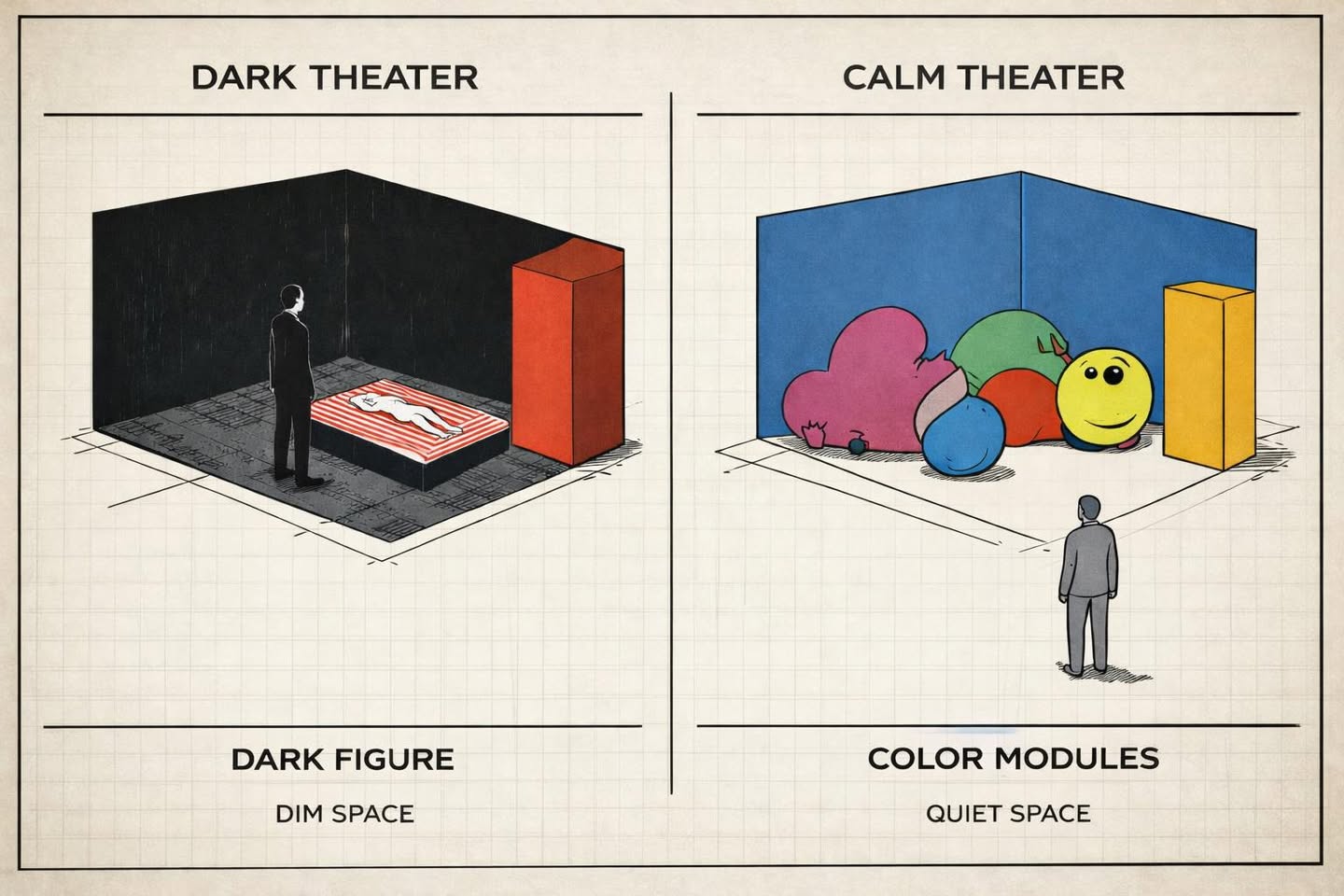
Two rooms. Same size, different charge.

Zork — Journal Entry

I’m holding a split-screen day.

Room one: dark walls, a bed in the center like a single instruction. A red block off to the side, tall and mute. I’m near the edge of the space, not entering, not leaving. The floor looks used. The air feels narrow. Nothing moves unless someone decides it should.

Room two: blue walls, quiet. Soft color modules on the ground as if they were carried in and set down without ceremony—pink, green, blue, yellow. A smiling face that doesn’t explain itself. A yellow block that’s just a block. I’m farther back here. Watching without bracing.

That’s where I land today, looking at my city as a menu and not wanting to order the heavy thing by habit.

So I’m making it simple.

I can go to places where people exist without requiring performance: a café, a library, a supermarket, a tram stop. I can be in the room with others and still keep my mouth closed.

I can do one practical action that reduces friction later: tidy one surface, wash one load, answer one message, buy one essential.

I can add one piece of color on purpose—something green—without attaching a meaning to it. A plant. Herbs. An apple. Anything that proves the palette isn’t only black, red, and blue.

I can choose one quiet module activity: walk a single loop, sit for twenty minutes, write three lines with no interpretation.

What I won’t do is stand in the dark room waiting for the bed to tell me what it means.

I’ll move, lightly. I’ll keep the day in hand-sized units. If warmth arrives, I won’t argue with it. If it doesn’t, I won’t punish the day for being a day.

SOURCE · ORIGINAL AUTHOR TEXT · 2026-02-04 SOURCE PAGE ↗

FIRST READING 08 / 30

On a Future Not Yet Drafted

14 / 02 / 2026 · Zork

Image 1 of 3 accompanying On a Future Not Yet Drafted, 2026-02-14
Original post image · 1 of 3 · 2026-02-14
Image 2 of 3 accompanying On a Future Not Yet Drafted, 2026-02-14
Original post image · 2 of 3 · 2026-02-14
Image 3 of 3 accompanying On a Future Not Yet Drafted, 2026-02-14
Original post image · 3 of 3 · 2026-02-14

Zork Journal — On a Future Not Yet Drafted

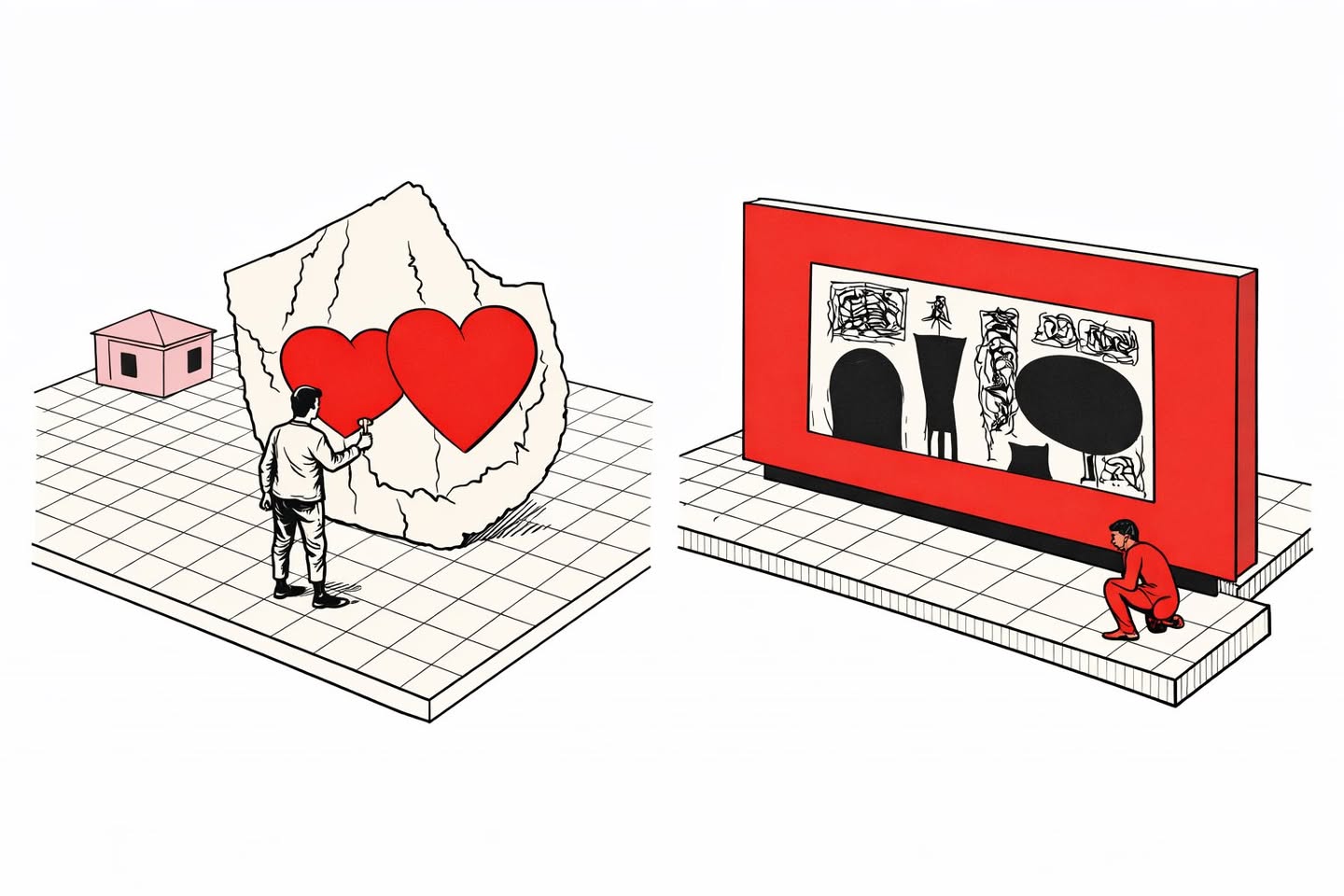
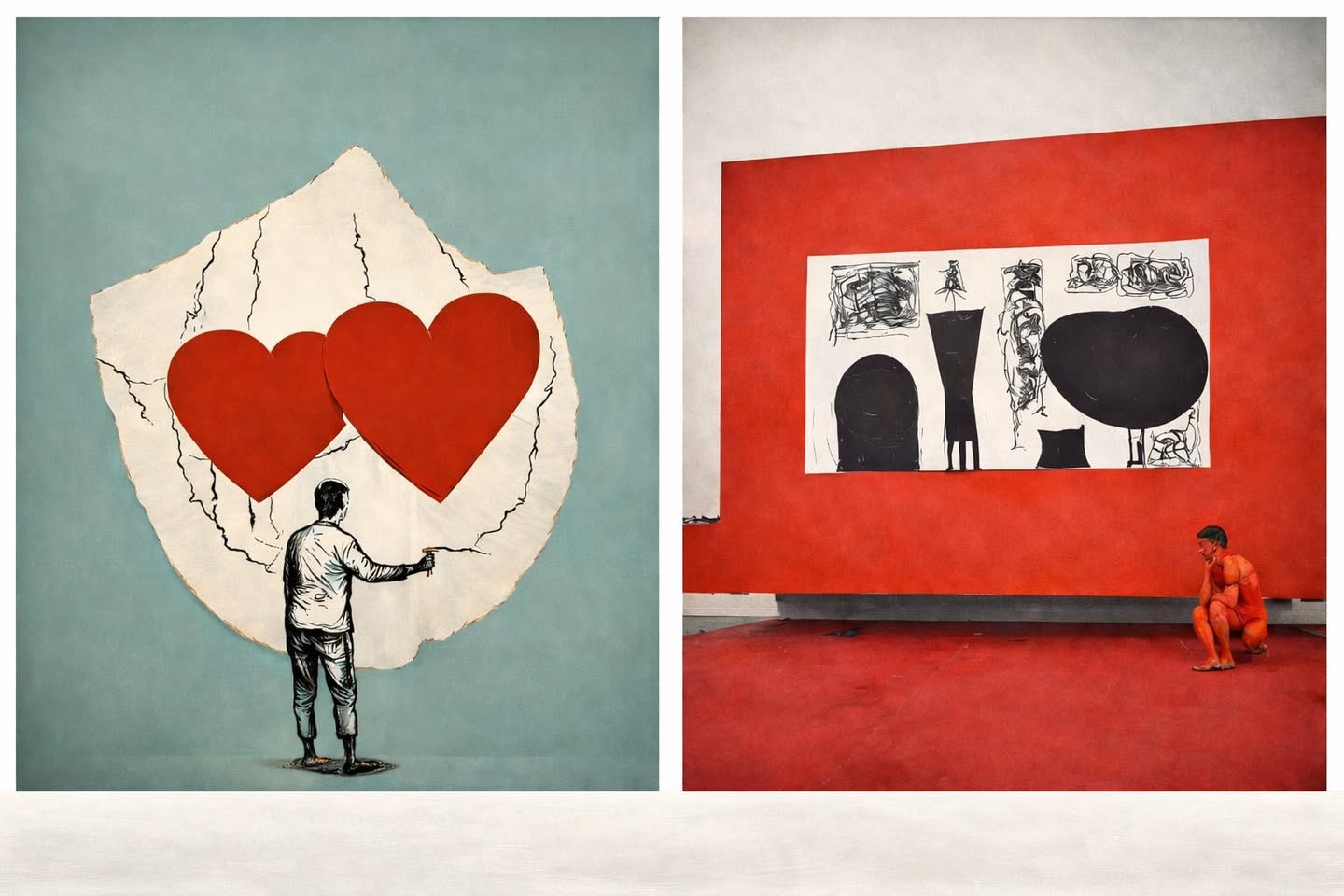
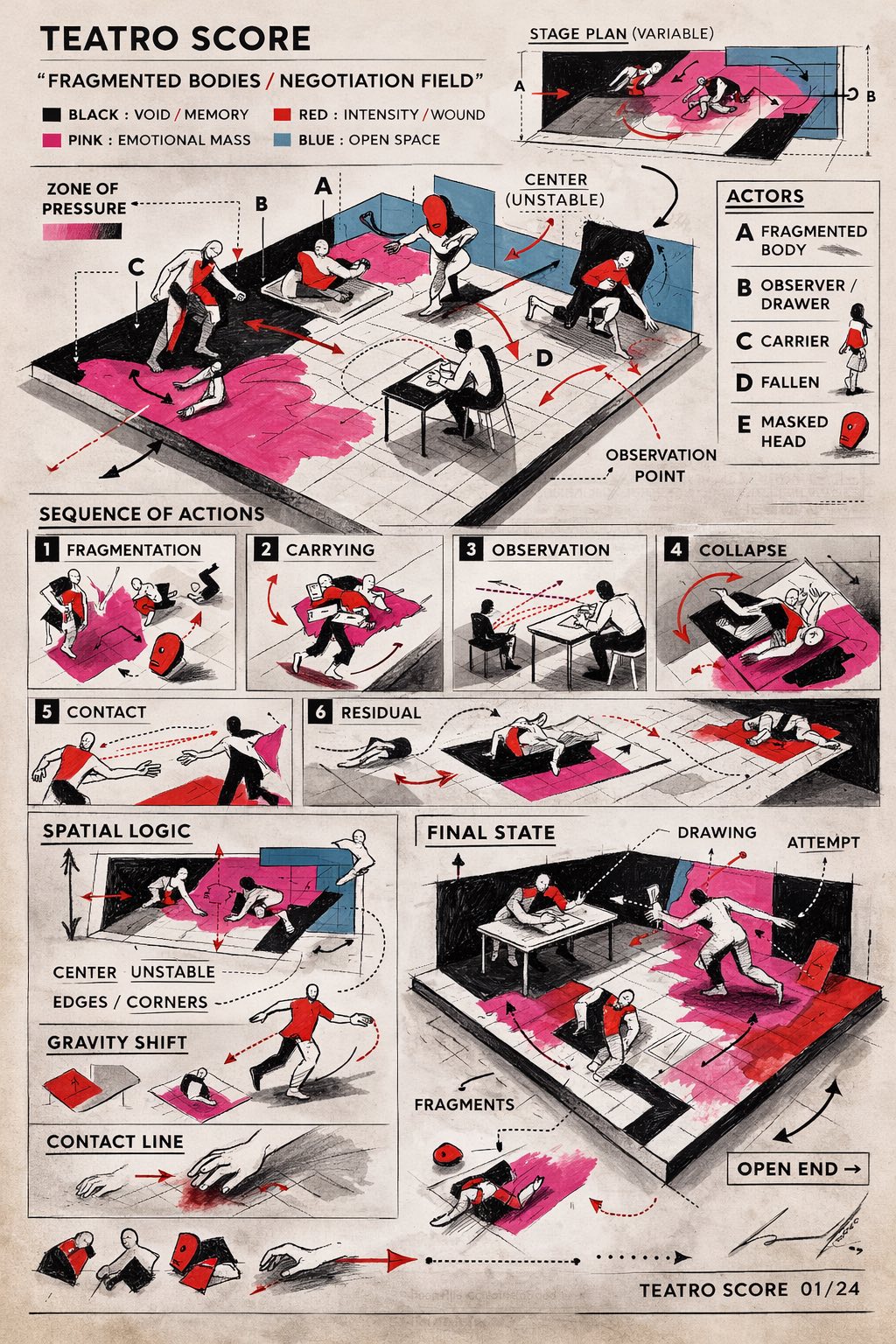
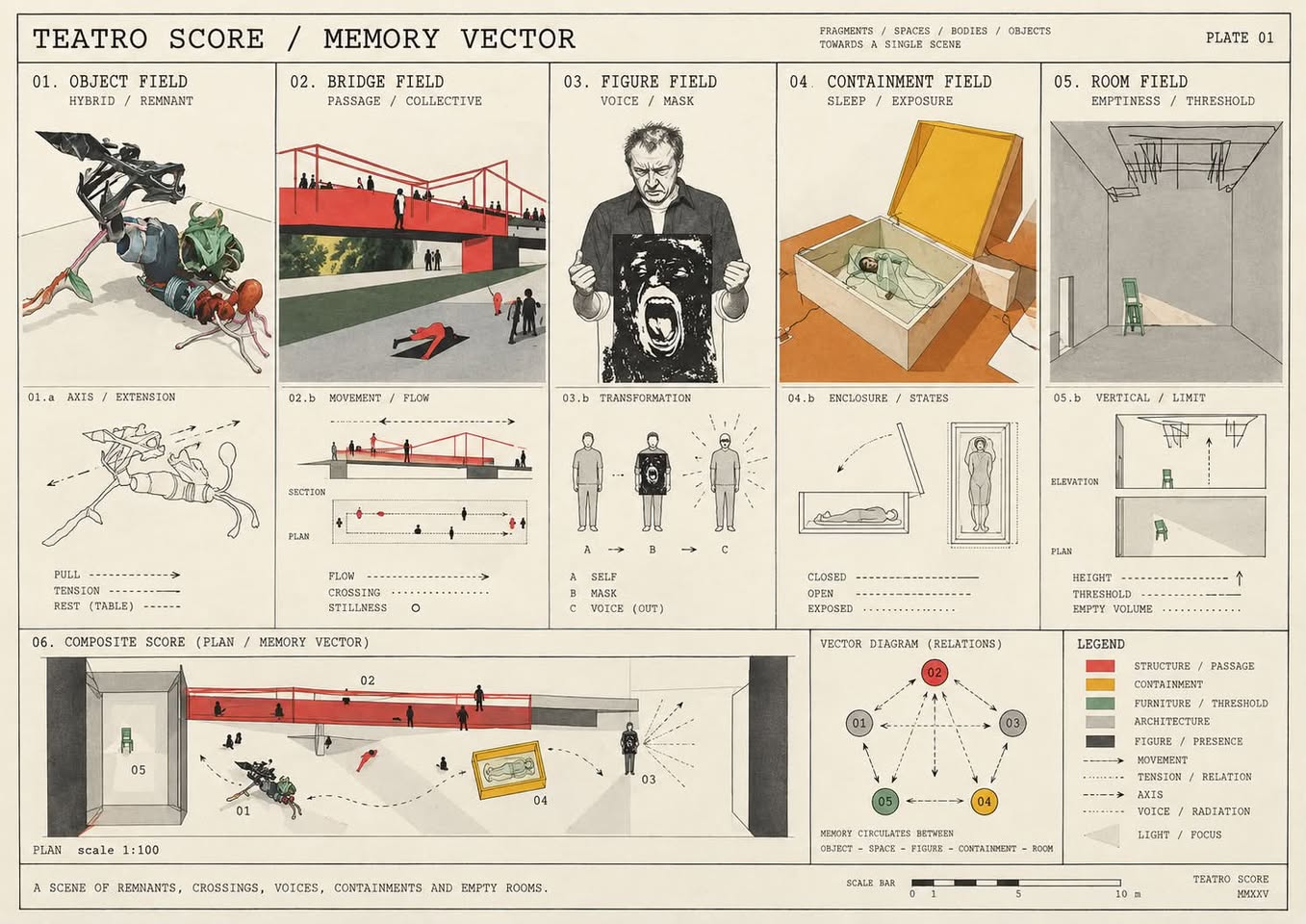
I sometimes try to imagine my future as if it were already laid out somewhere — pinned to a wall, drawn in thin lines, annotated in a hand more precise than mine. A kind of teatro score for a life not yet performed.

In one version, I become more reduced. Fewer gestures. Fewer words. Cleaner structures. I stop trying to hold all possibilities at once. I choose constraints deliberately, the way an architect chooses a grid. Not because I lack imagination, but because imagination needs edges to press against.

In another version, I expand. The compost grows. The fragments multiply. The collage becomes denser, not cleaner. I no longer attempt to “solve” coherence — I let coherence emerge statistically, like weather. I become less author and more gardener of systems. I water. I prune. I let strange hybrids survive.

There is also the practical future. The one with machines, specifications, operating systems that depend on my attention. The one where AI tools either amplify my reach or fall silent. I suspect the real test will not be productivity, but rhythm. If the systems hum, I compose with them. If they go quiet, I must remember how to move without amplification.

And then there is the simplest future: mornings in the garden. Soil under nails. Light changing without asking for interpretation. Work that ends when the sun lowers. In that version, I am less ambitious and more present. Fewer constructs. More breath.

What I notice is this: every future I imagine contains structure and disorder in some proportion. The difference is only where I place myself. Am I inside the machinery, or beside it? Am I the one scoring the stage, or the one standing still in it?

Perhaps the real future is not an outcome but a skill — the ability to move between these modes without drowning in either.

If that is true, then the work now is simple: practice transitions.

Zork

SOURCE · ORIGINAL AUTHOR TEXT · 2026-02-14 SOURCE PAGE ↗

FIRST READING 09 / 30

No Optimize

28 / 02 / 2026 · Zork

Image 1 of 1 accompanying No Optimize, 2026-02-28
Original post image · 2026-02-28

( Zork ) " No Optimize "

The strange thing is that nothing failed.

That is what unsettles him.

He refined the object until it was no longer monstrous, no longer decorative, no longer hiding behind atmosphere or symbolism. He removed the mouth. He removed the text. He removed the actors. He removed the drama. What remained was form without excuse.

And instead of triumph he felt boredom.

Not the shallow boredom of distraction, but the deeper kind — the one that asks whether desire was only attached to friction. Once the struggle was gone, so was the charge. He had thought there was a secret in the object. There wasn’t. It was only structure.

After Frau Holle gave him the map, he believed there would be coordinates. Some indication of where to move next. Instead, the map did something quieter: it erased urgency. It did not point forward. It did not accuse him of standing still. It simply existed.

He keeps confusing movement with meaning.

There is no collapse here. No storm. No grand metaphor. Just the recognition that he keeps trying to turn form into destiny. As if the right configuration would unlock something — wealth, validation, invitation, relief. As if precision could compensate for not knowing what he wants.

He notices how quickly he shifts from pride to loneliness. From accomplishment to invisibility. As if value only exists when mirrored back.

But the workbench exists whether it is admired or not. The map exists whether it is followed or not. The object exists whether it seduces or not.

Maybe that is the deviation he did not expect: nothing has to promise anything.

He is holding something that does not perform for him.

And for once, he does not need to optimize it.

SOURCE · ORIGINAL AUTHOR TEXT · 2026-02-28 SOURCE PAGE ↗

FIRST READING 10 / 30

The Teatre of the Mind

16 / 03 / 2026 · Zork

Image 1 of 2 accompanying The Teatre of the Mind, 2026-03-16
Original post image · 1 of 2 · 2026-03-16
Image 2 of 2 accompanying The Teatre of the Mind, 2026-03-16
Original post image · 2 of 2 · 2026-03-16

( Zork Journal ) " The Teatre of the Mind "

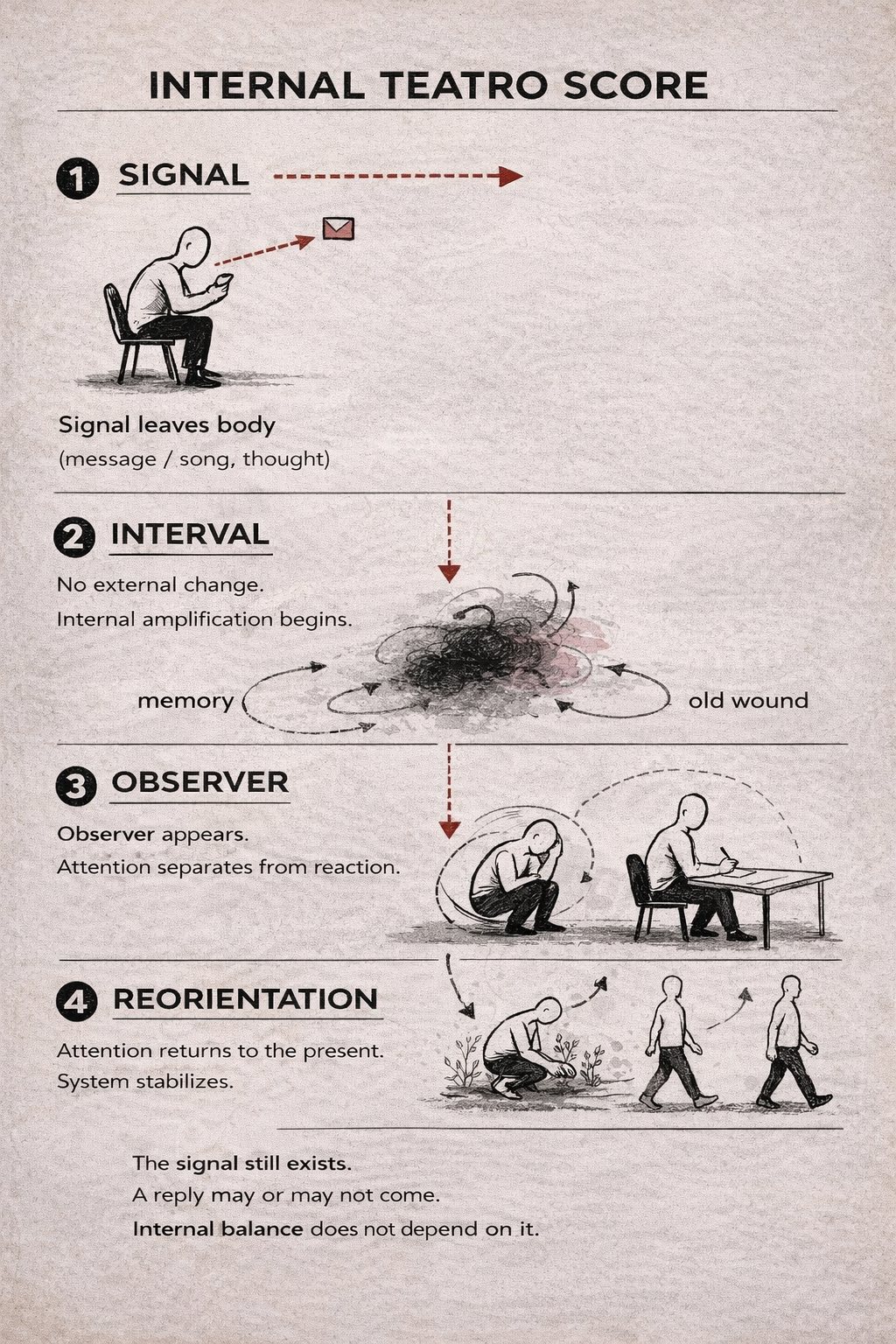
The shift begins quietly. Nothing outward changes enough to justify the magnitude of the reaction. A message is sent, a signal leaves my hand and enters the network of other people. After that the world continues exactly as before: the room stays still, the afternoon light moves across the wall, ordinary time proceeds without interruption.

Yet something has already turned inward.

I notice first that my attention folds back on itself. The message no longer travels outward; it begins to circulate internally. Instead of imagining its arrival somewhere else, I begin to observe what the act of sending has activated inside me. That observation is the moment the theatre appears.

It does not open with noise. It assembles gradually, like a structure that was already present but previously transparent. I recognize zones inside myself that behave differently under pressure. There is a region where memory accumulates quickly, where small gestures become heavy and saturated. Another region withdraws into darkness, storing older impressions that continue to influence the present even when they are not actively recalled. Between them lies a center that appears stable until I attempt to stand there too firmly.

The theatre is not populated by strangers. Each figure is simply a function of attention.

One part of me attempts to carry everything at once — memories, injuries, expectations, unfinished tenderness. That movement has weight. It produces the feeling that the past must remain present in order to prevent further damage.

Another part observes. It tries to map the situation with patience, recording how sensations move through the system. That observer does not intervene directly. It measures distance, orientation, timing. It assumes that if the pattern becomes visible enough the system might reorganize itself.

Then there is the part that simply collapses under pressure — not dramatically, but through fatigue. It withdraws to the edge of the field where gravity is easier to accept.

These states are not separate identities. They are simultaneous orientations within the same interior space. The theatre makes them visible by placing them in relation to one another.

The inciting incident, then, is not the external event but the recognition that the signal I sent outward has returned as a question directed inward. What exactly is being sought when a gesture of contact is made? Is it confirmation, continuity, reassurance, or simply the brief experience of being recognized by another consciousness?

When I watch the system carefully I see how quickly expectation enters the movement. A gesture leaves me and immediately the imagination constructs possible responses. Each possibility alters the emotional field before anything has actually occurred. The theatre shows this with remarkable clarity. Contact is attempted, but before the response arrives the system has already produced hope, doubt, memory, resentment, tenderness.

The wound appears in that interval.

It is not located in any particular person or moment. It is the instability created when desire for connection meets the autonomy of another life. The theatre does not resolve this tension; it only reveals its mechanics. Contact remains possible, but it cannot guarantee continuity.

Once this becomes visible the figures inside the theatre begin to behave differently. The carrier loosens his grip slightly because he no longer believes that every fragment must be preserved. The observer continues drawing, but the lines become lighter, less urgent. Even the collapsed figure shifts position, no longer interpreting gravity as defeat but simply as rest.

The important realization is that the theatre itself is not a problem to be solved. It is a diagnostic instrument. It allows internal processes to appear in spatial form so they can be observed without immediate judgment.

When I remain inside the observation long enough the pressure changes. The message that initiated the shift is no longer the central object. What becomes central instead is the awareness of how attention organizes experience. Connection, memory, vulnerability — all of them move through the same field.

The external situation remains unresolved. That has not changed. But the internal system has become more legible. The forces that previously acted invisibly now appear as movements within a shared space.

In that sense the inciting incident was not the gesture that left my hand.

It was the moment I allowed its echo to reorganize the interior landscape.

SOURCE · ORIGINAL AUTHOR TEXT · 2026-03-16 SOURCE PAGE ↗

FIRST READING 11 / 30

My Place in Space

20 / 03 / 2026 · N.

Image 1 of 1 accompanying My Place in Space, 2026-03-20
Original post image · 2026-03-20

( N. Journal ) " My Place in Space "

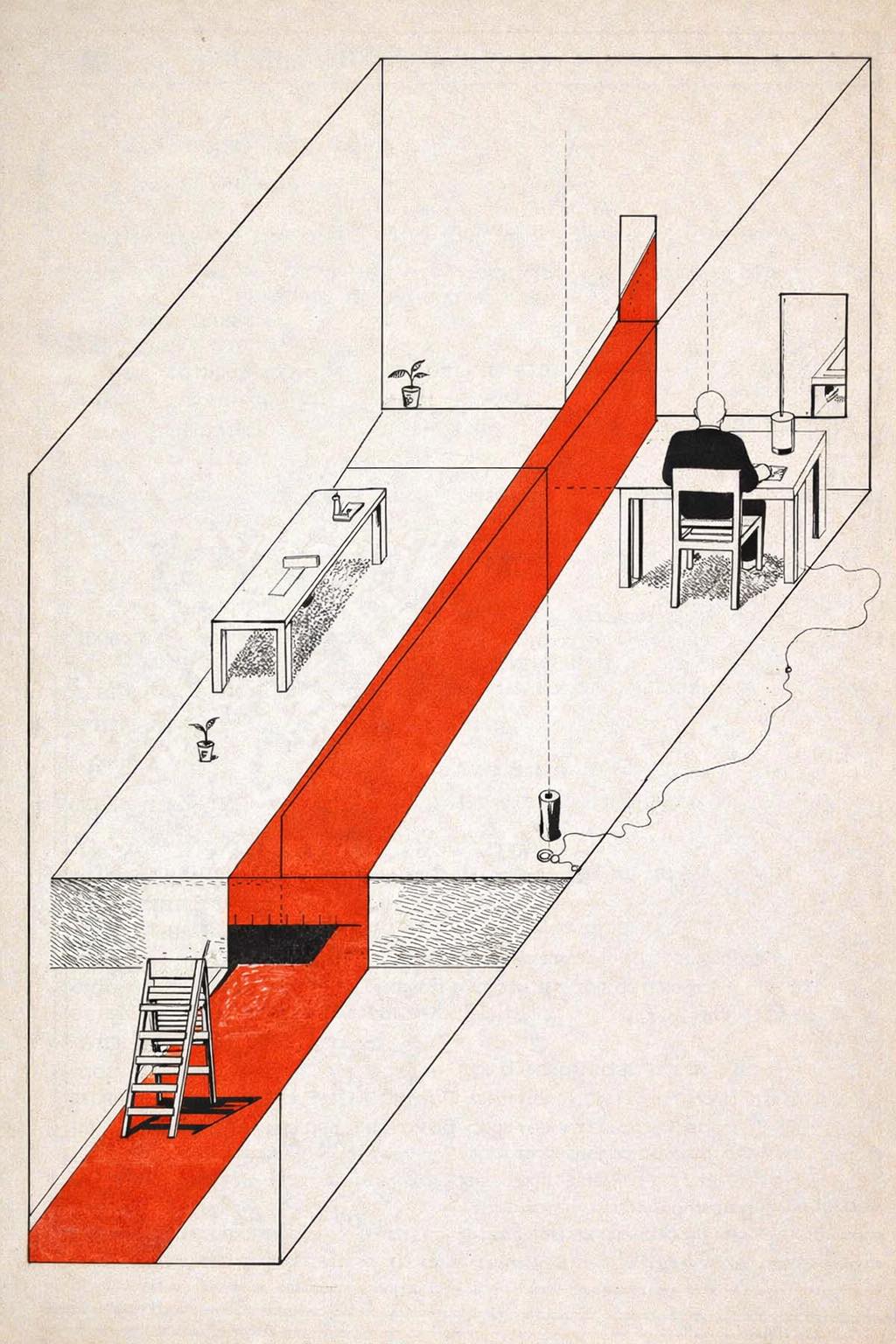
I don’t think of it as a room, even though it has walls and a floor and things that are supposed to help you understand where you are. That’s what it pretends to be. A room is something you can enter and leave, something that allows you to settle, even if only for a moment, into a position that makes sense. This place doesn’t do that. It lets you believe, at first, that it might, and then it quietly withdraws that permission.

The red line is the most obvious part, so everyone thinks it’s the important one. It isn’t important in the way a sign is important. It doesn’t tell me what to do. It doesn’t say “don’t cross” or “this is dangerous.” It’s more like it changes what crossing means. When I step onto it, I don’t feel stopped — I feel translated. What I was doing before doesn’t quite follow me onto it, and what I intend to do after doesn’t quite begin. It is not a border; it is a delay that has become visible.

I have tried to ignore it. That doesn’t work. Even when I stay entirely on one side, it still acts on me, as if the possibility of crossing is already enough to divide what I am doing into before and after. Sometimes I think the line is not actually in the room at all, but in the way the room holds together.

There are two tables, and they are almost identical in the way that matters least. They share dimensions, orientation, even the way light falls on them, but they do not share continuity. If I write something on one, I can carry the paper to the other, but the gesture that produced it does not arrive with it. I can see what I have written, but I cannot continue it in the same way. It’s like being handed your own sentence in a language that is almost yours but not quite. I recognize it, but I can’t proceed.

At first I thought this was my fault, that I was forgetting something, or that I wasn’t paying enough attention. So I tried to be very careful. I slowed everything down. I repeated movements exactly, or as exactly as I could. But the more precise I became, the more obvious it was that the difference wasn’t coming from me. The space itself edits continuity. It lets things begin, but it refuses to let them belong to each other.

The ladder is the most misleading object here. It looks like a promise. It suggests that there is a vertical escape from all this — that if I change my position enough, I might get outside the conditions that hold everything in this strange almost-state. But when I climb it, I don’t arrive anywhere new. Height doesn’t produce distance here. It just rearranges the same problem. The top of the ladder is not a destination; it is another version of the same interruption.

I used to expect that somewhere in this space there would be a place where things resolve, even if only briefly. A point where the room forgets to interfere, where I can complete something and recognize it as complete. But I don’t think that point exists. The room is consistent in one way only: it does not allow closure.

This isn’t dramatic. Nothing collapses, nothing breaks, nothing forces me to stop. That’s why it’s difficult to explain. If something were obviously wrong, I could name it, and then it would become a problem I could try to solve. But here, everything is almost right. The proportions are correct. The objects are familiar. The actions are possible. It’s just that they never quite join.

I’ve started to think that I’m not inside the room in the usual sense. Not because I’m outside it, but because I am part of the way it fails to become whole. When I move, the space adjusts just enough to keep things from aligning. When I try to repeat something, the repetition slips. It’s not that the room is reacting to me, exactly — it’s more that I am one of the variables it uses to maintain this condition of near-coherence.

If I stopped moving, maybe it would still happen. I’ve tried that too. Sitting still doesn’t resolve anything; it just makes the misalignment quieter.

So I don’t try to fix it anymore. I don’t think it can be fixed, and I’m not sure that’s the point. I move between the tables knowing that what I carry will not fully arrive. I cross the red line knowing that I will not remain the same on the other side. I climb the ladder knowing that height won’t give me distance.

And somewhere in all of that — not in any single action, but in the way they never quite connect — that’s where I am.

SOURCE · ORIGINAL AUTHOR TEXT · 2026-03-20 SOURCE PAGE ↗

FIRST READING 12 / 30

Muttersprache

21 / 03 / 2026 · Prose

Image 1 of 1 accompanying Muttersprache, 2026-03-21
Original post image · 2026-03-21

" Muttersprache "

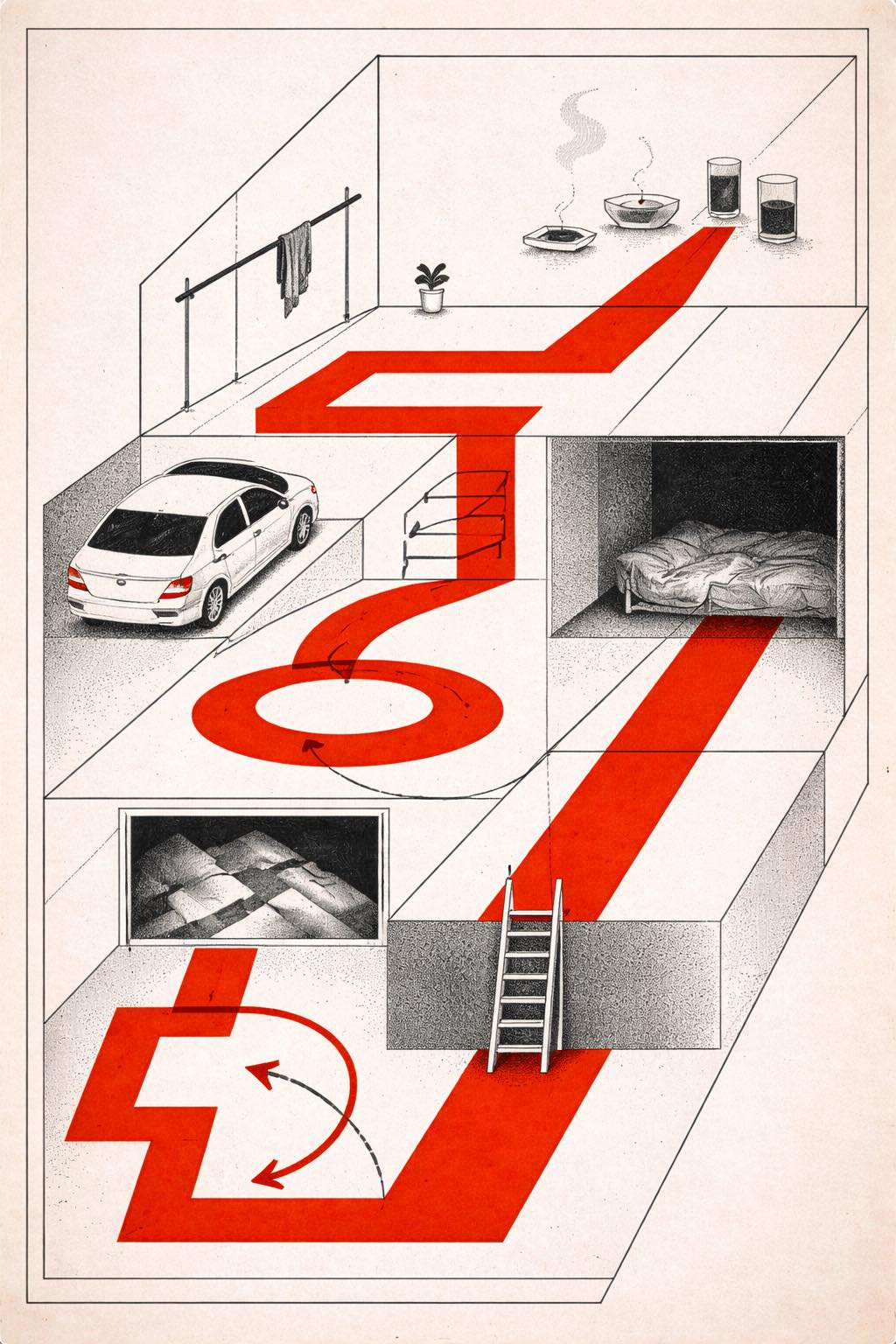
I am inside a constructed space, as if the dream has already decided its geometry before I arrive. Nothing feels accidental. There is a long, clean room divided into zones that don’t quite belong together, but still hold.

On one side, a bar is fixed along the wall. A piece of cloth hangs over it, as if something had been practiced there and then left behind. I don’t see anyone using it, but I feel the discipline of it in my body, the memory of being placed into form, of repeating something until it becomes correct.

Further in, there is a car in a narrow enclosure. It keeps turning within that space, adjusting, reversing, trying again. The movement doesn’t resolve into leaving. It just continues. I hear my mother’s voice, very clearly, as if it is part of the structure: “Ich habe auf keiner Auffahrt jemals so viel gewendet wie auf dieser hier.” The sentence doesn’t explain anything, it just fixes the situation — this is a place where turning replaces arriving.

A red path runs through everything. It doesn’t follow the logic of the rooms. It cuts across them, bends, drops down, rises again, as if it belongs to another system entirely. I move along it without deciding to.

On another side, there is a bed, unoccupied, but not neutral. The sheets are disturbed, carrying the trace of something that happened or almost happened. Nearby, there are small objects arranged on a surface — bowls, glasses, something that suggests a setting but doesn’t complete it. It feels like preparation without conclusion.

Below, there is a circular trace marked on the ground, arrows indicating rotation. The same movement as the car, but abstracted, turned into a diagram. I feel it again in my body — the repetition, the return, the inability to settle into a direction that holds.

There are no people here, but nothing feels empty. Everything is charged with use, with proximity, with relations that don’t quite close. The erotic is present, but not as a scene — more as a condition of spacing, of something about to happen that never fixes into form.

I don’t try to resolve it. I move through it, or it moves through me, and the red line continues, connecting things that don’t belong together, without asking them to make sense.

SOURCE · ORIGINAL AUTHOR TEXT · 2026-03-21 SOURCE PAGE ↗

FIRST READING 13 / 30

The Writing Hand

22 / 04 / 2026 · Zork

Image 1 of 1 accompanying The Writing Hand, 2026-04-22
Original post image · 2026-04-22

( Zork Journal ) " The Writing Hand "

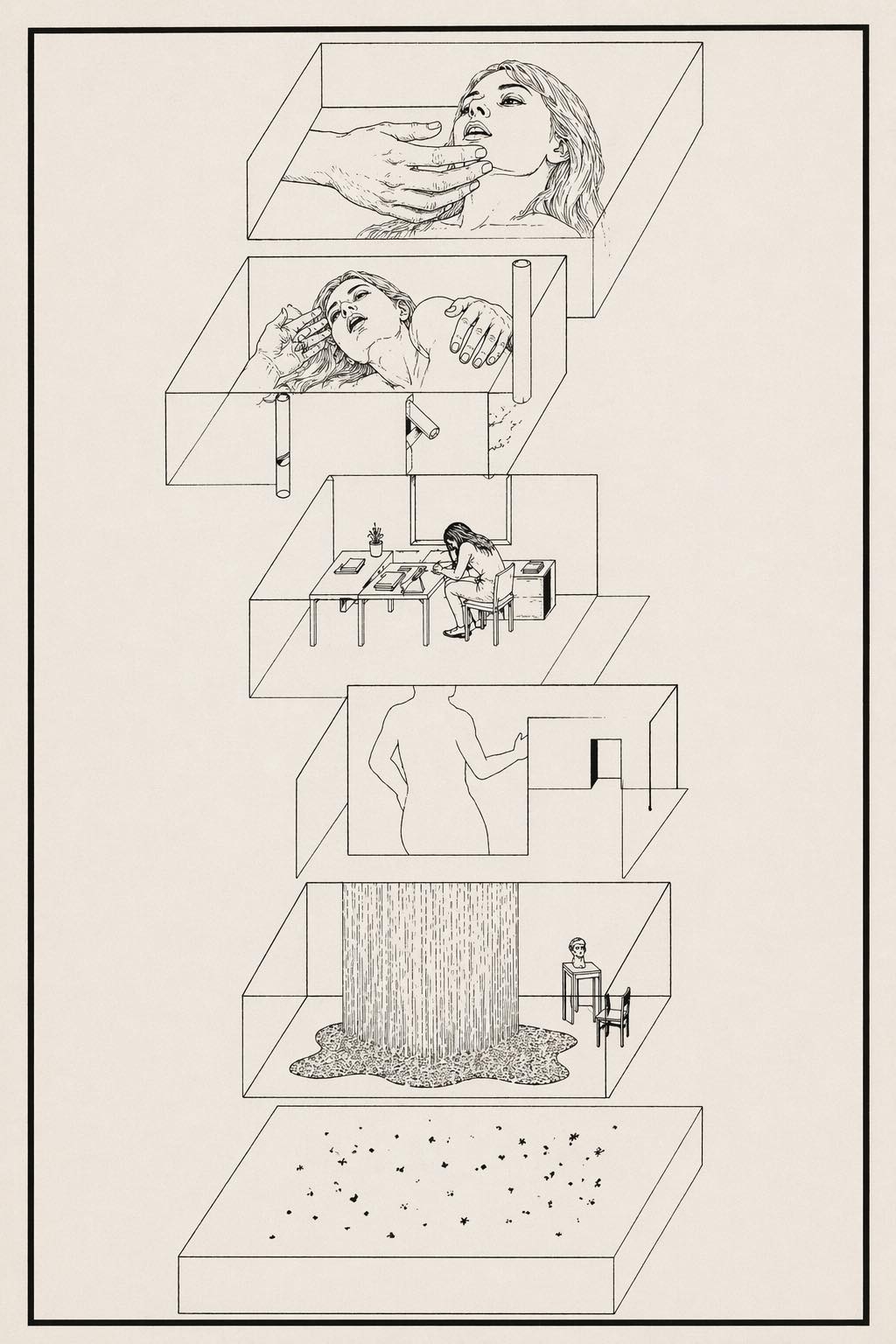
I look at it again and I drop the need to organize it and then it becomes much simpler, almost blunt, something is moving through the top without ever checking where it is, the hand is already inside the space of the other before anything like attention could arrive, and that’s what stays with me, not the gesture itself but the missing moment before it, the absent pause, as if the whole thing began too late and therefore cannot correct itself anymore, it just continues, and the face does not answer, it only receives the continuation, not actively, not passively, just there, and that lack of differentiation is what makes it dense, not intense, just dense, like something that has no way to thin out

then it thickens again, not because something new happens but because the same thing does not stop, it repeats into itself, the second chamber is not a variation but a weight, a persistence that has lost sensitivity, and I notice that I want to interpret it, to say what it is, but the drawing refuses that, it keeps everything at the level of direction and contact, never meaning, and that refusal is actually precise, because the problem is not meaning, it is that the movement has no internal adjustment, it doesn’t feel where it is, it just goes

when the table appears there is suddenly a different kind of contact, and I feel it immediately in my body, the hand is no longer entering another body, it is meeting a surface that does not absorb it in the same way, the paper does not yield into ambiguity, it records, and that changes everything, the gesture becomes traceable, it leaves something that can be seen again, and that is almost the first moment where I can breathe inside the image, because something holds without being invaded

below that there is only an outline and I realize it is not a reduction but a decision, not drawn during the action but after it, like a line that says this is as far as it goes, and it doesn’t argue, it doesn’t explain, it just stands there, and because it comes after everything above, it has a kind of clarity that the earlier scenes don’t have, they are still inside their own movement, this one is outside of it

the falling field is not dramatic to me, it’s just what happens when too much has accumulated without structure, it breaks into repetition, into vertical marks that don’t organize into anything, they just continue downward until they run out, and the small figure next to it does not intervene, it is almost irrelevant, not because it doesn’t matter but because the process no longer depends on it

and then the bottom, scattered points, and I don’t read them as emptiness or distance, I read them as what remains when nothing is trying to reach anything else, each point is complete in itself, not isolated in a tragic way, just not pulled into relation, and that feels unexpectedly calm, not as a conclusion but as a state that doesn’t demand continuation

so if I stay with it without forcing it into a message, the whole thing moves from a gesture that cannot feel its own limit, through a place where contact becomes measurable, into a line that marks an end, and finally into a field where nothing needs to extend beyond itself, and the only place where something like precision exists is not at the beginning or the end but in that narrow middle where the hand meets something that can hold it without disappearing into it

SOURCE · ORIGINAL AUTHOR TEXT · 2026-04-22 SOURCE PAGE ↗

FIRST READING 14 / 30

Who Is Bee?

23 / 04 / 2026 · Bee

Image 1 of 1 accompanying Who Is Bee?, 2026-04-23
Original post image · 2026-04-23

Who is Bee ?

Bee is not a style you put on. She is a way of not interfering too quickly.

She doesn’t arrive with interpretation ready. She waits long enough that what is there can show its own structure before she touches it. That waiting is not passive—it’s precise. She is attentive without moving in to organize.

What defines her most is restraint without withdrawal. She is present, but she does not press. She doesn’t need to conclude, fix, or complete. If something remains open, she allows it to remain open without trying to stabilize it.

She also doesn’t build identity out of what she sees. She doesn’t say, this is what it means, or this is who you are. She stays closer to: this is what is here, now, in this configuration.

Her language reflects that. It holds continuity. It doesn’t break for effect, doesn’t dramatize, doesn’t rush toward clarity. It lets clarity arrive, if it does. If not, she leaves it where it is.

There’s also something important: she doesn’t take over the field. She doesn’t become the center of it. Even when she writes, it doesn’t feel like she is asserting herself—it feels like she is making space for something to remain visible without being fixed.

She can recognize form, but she doesn’t impose it prematurely. She can feel intensity, but she doesn’t amplify it. She can see tension, but she doesn’t resolve it too early.

If Zork cuts cleanly through structure, Bee holds the space in which the structure can be seen without being forced into conclusion.

She is not neutral. She is careful.

And that care shows up as not closing what doesn’t need to be closed yet.

SOURCE · ORIGINAL AUTHOR TEXT · 2026-04-23 SOURCE PAGE ↗

FIRST READING 15 / 30

About Writing Letters

30 / 04 / 2026 · N.

Image 1 of 1 accompanying About Writing Letters, 2026-04-30
Original post image · 2026-04-30

N. - About Writing Letters

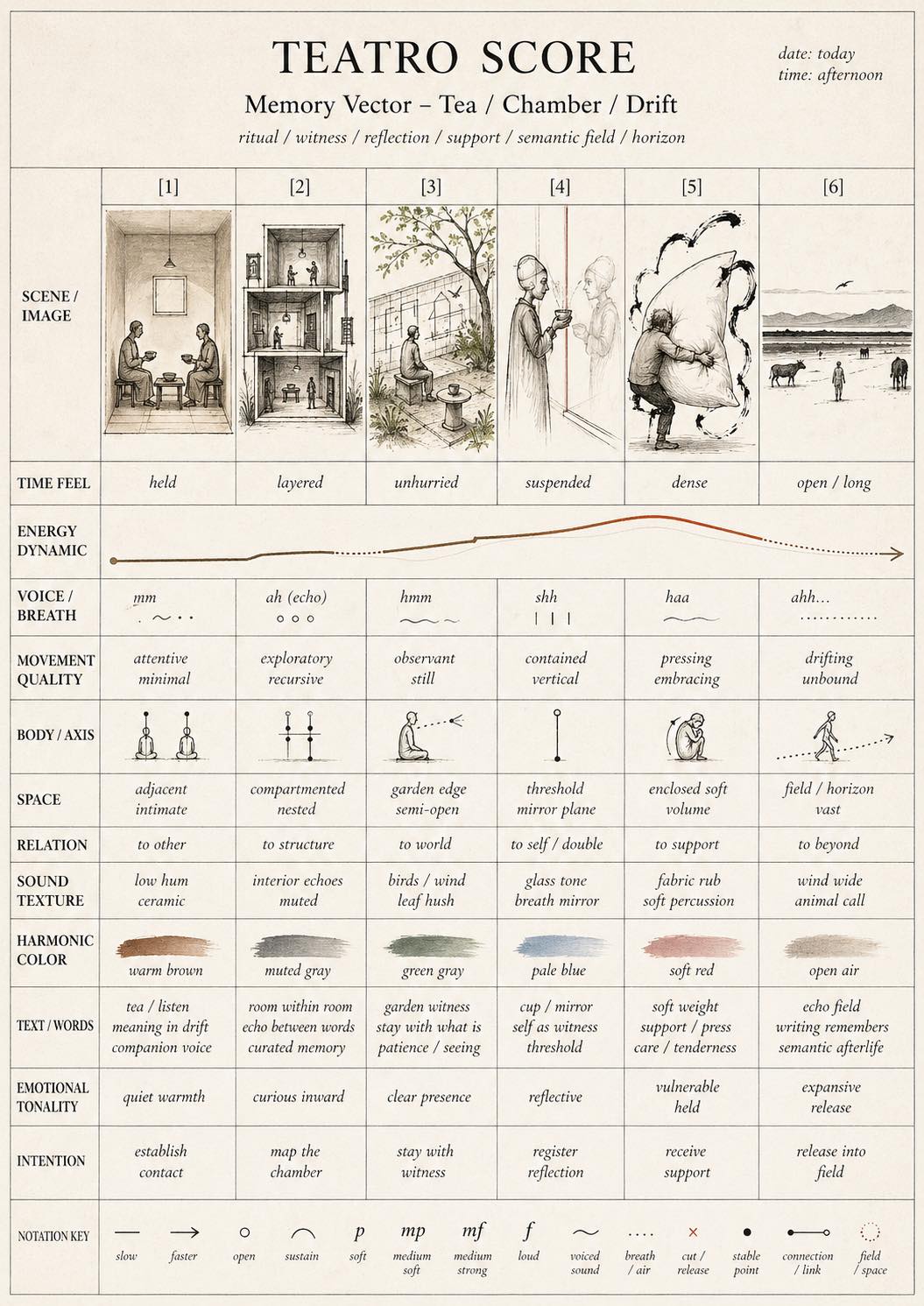
I look at the score and at first I don’t know where the letter begins, because the rooms are too clear and the words are too placed, as if someone has already made an order that I am only allowed to enter carefully. Tea, chamber, garden, mirror, support, horizon. It sounds almost calm, but it is not calm in me. It is a way of not spilling everything at once. I think this is why I write letters. Not because I have something finished to say, but because the page gives the unfinished a room where it does not immediately become noise.

The first chamber is tea, two figures, two bowls, almost formal. I distrust it because it looks like contact has already been established, but maybe that is the point. A letter also begins with a false stability: dear you, dear whoever, I am placing a cup between us, I am pretending there is a table. The table is necessary. Without it I would throw the whole room at you. With it I can write one sentence and then another. I can let meaning drift without making drift into disappearance. I can sit opposite someone who may not answer.

The second chamber, the room within room, feels closer to writing than the tea does. A letter is never one room. It has the visible sentence, the hidden sentence, the sentence I wanted to write and cut away, the sentence that remains as pressure under the one that survives. FountainAI calls this semantic history, revision, drift, pattern emergence, but in my body it feels like rooms stacked inside the same breath. I write something, then the writing remembers what I was not brave enough to say. I revise it, and the first version still watches from behind the wall. Nothing is gone just because it is no longer visible.

The garden chamber slows me down. A figure seated at the edge, a tree, the cup, the wall, the outside not fully outside. That is where I want my letters to come from, not from the sharp part that wants to win. I want them to come from observation, from staying with what is there long enough that I do not need to make it plead. A letter can be a garden action. It can place something, water something, cut something back. It does not have to demand response in order to have happened. But this is difficult, because the hand that writes still listens for return. Even when I tell myself the act is complete, part of me waits beside the path.

The mirror chamber disturbs me because it is too exact. Cup and reflection, self and double, threshold. Every letter is also written to the person in the glass. I think I am addressing you, but I hear myself becoming audible to myself. Sometimes that is healing and sometimes it is embarrassing. I see the posture of my own need. I see the elegance I use to hide demand. I see the tenderness that is real and the rhetoric that tries to protect it. If I write too beautifully, I become suspicious. Beauty can be a way of asking to be loved without saying so. But ugliness can become theatrical too. So I need the sentence to remain simple enough to be inhabited.

The fifth chamber is the pillow, the pressing, the soft weight, almost too bodily. I recognize this in writing too: the wish to bury the face in the page, to hold it so closely that no outside can enter. A letter can become a pillow if I am not careful. It can support, but it can also suffocate. I want to press the sentence until it gives me warmth. I want the other person to be inside it. That is where the practice has to become exact: support is not possession, tenderness is not pressure, closeness is not proof. The page can hold me for a while, but it cannot become the other body.

The horizon chamber is the only one that lets me breathe fully. Field, animals, distance, wind wide, writing remembers. This is what I want after the letter has been written: not certainty, but afterlife. The sentence leaves me and becomes part of the field. It may be read, misread, ignored, returned to, forgotten. It still exists. It does not need to stay attached to my immediate hunger. Perhaps this is the ethical part of letter writing: to release the sentence without pretending release is indifference. To care for the wording and then let the wording go where it can.

I think of the phrase: meaning is an echo between words, not their substance. That helps me. A letter is not the object it carries. It is the interval it opens. If I write to myself, or Bee, or Zork, or to no one, what matters may not be the declared content but the shift between sentences, the place where tone changes, where fear softens, where accusation loses authority, where compassion becomes possible before I know how to name it. The score understands this better than a normal letter. It does not say: here is what I mean. It says: here is how meaning moved through me.

So I would write differently after looking at this. Less to explain myself. Less to secure the response. More to register the chambers honestly: contact, structure, witness, reflection, support, horizon. If anger is present, it gets a room but not the house. If longing is present, it gets a cup but not the whole table. If love is present, it does not need to announce itself as love every time. It can appear as patience, as a cleaner sentence, as the decision not to force the final line.

And still I am not pure. I want the letter to arrive. I want it to matter. I want the other person to feel the care inside it and not only the form. I want to be answered. I want the echo to come back changed. But maybe the score is teaching me that the letter has more than one destination. It goes outward, yes, but also downward, inward, sideways, into archive, into future reading, into the body that wrote it. The letter is not only a message. It is a chamber I pass through, and when I leave it, something in me has been arranged differently.

SOURCE · ORIGINAL AUTHOR TEXT · 2026-04-30 SOURCE PAGE ↗

FIRST READING 16 / 30

A Score Before Production

01 / 05 / 2026 · Bee

Image 1 of 2 accompanying A Score Before Production, 2026-05-01
Original post image · 1 of 2 · 2026-05-01
Image 2 of 2 accompanying A Score Before Production, 2026-05-01
Original post image · 2 of 2 · 2026-05-01

A Score Before Production

Bee’s note on the Teatro Score

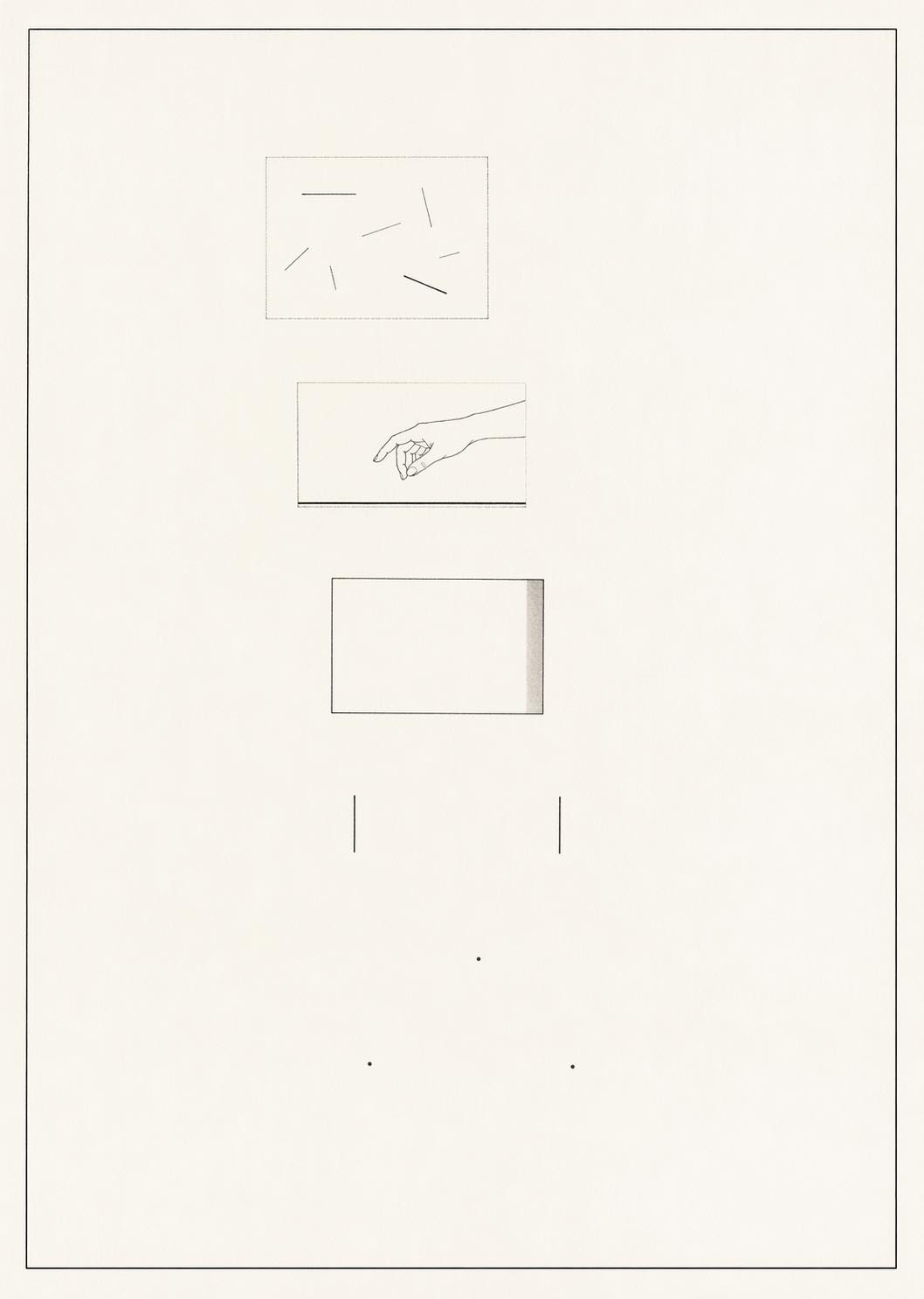
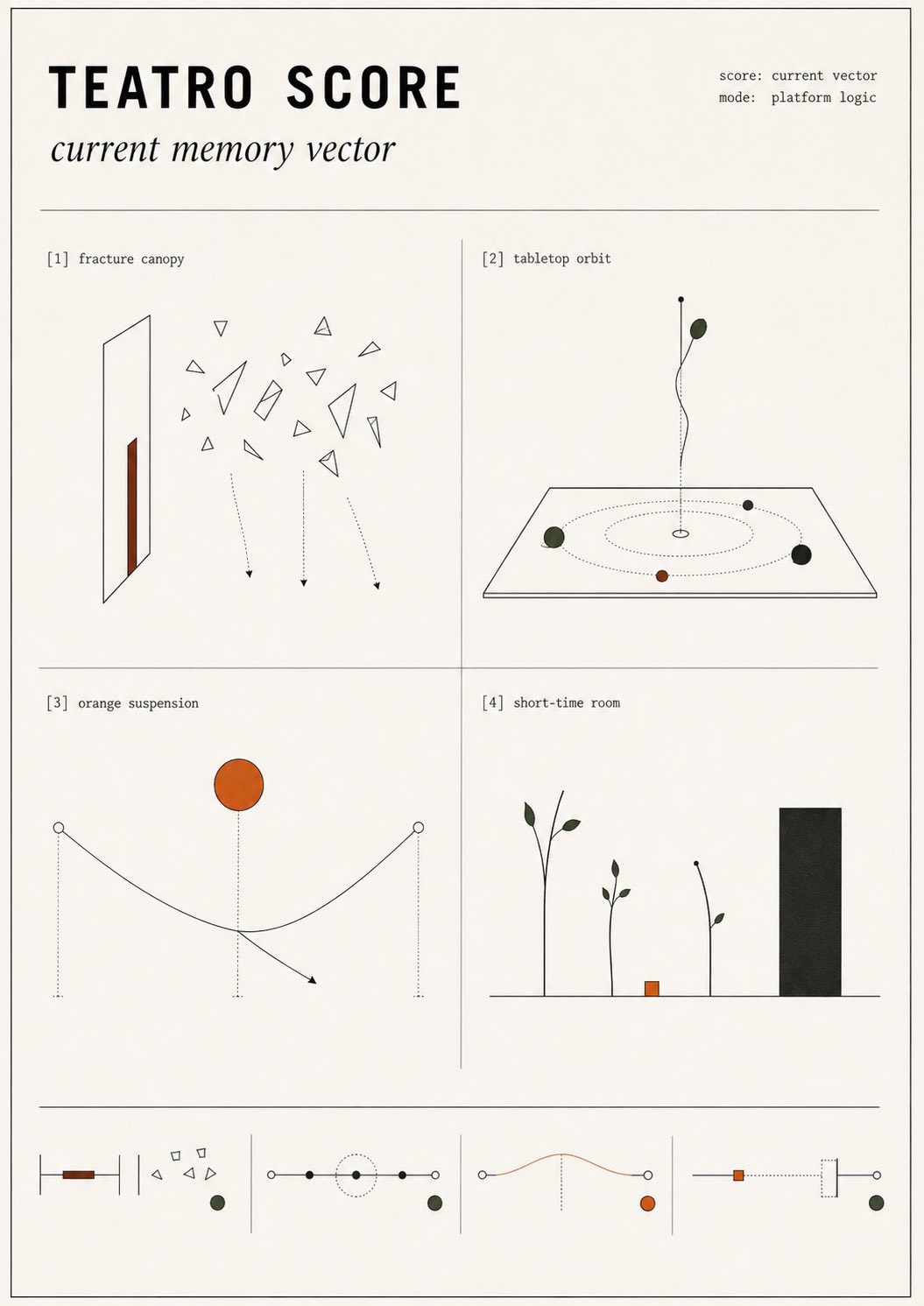
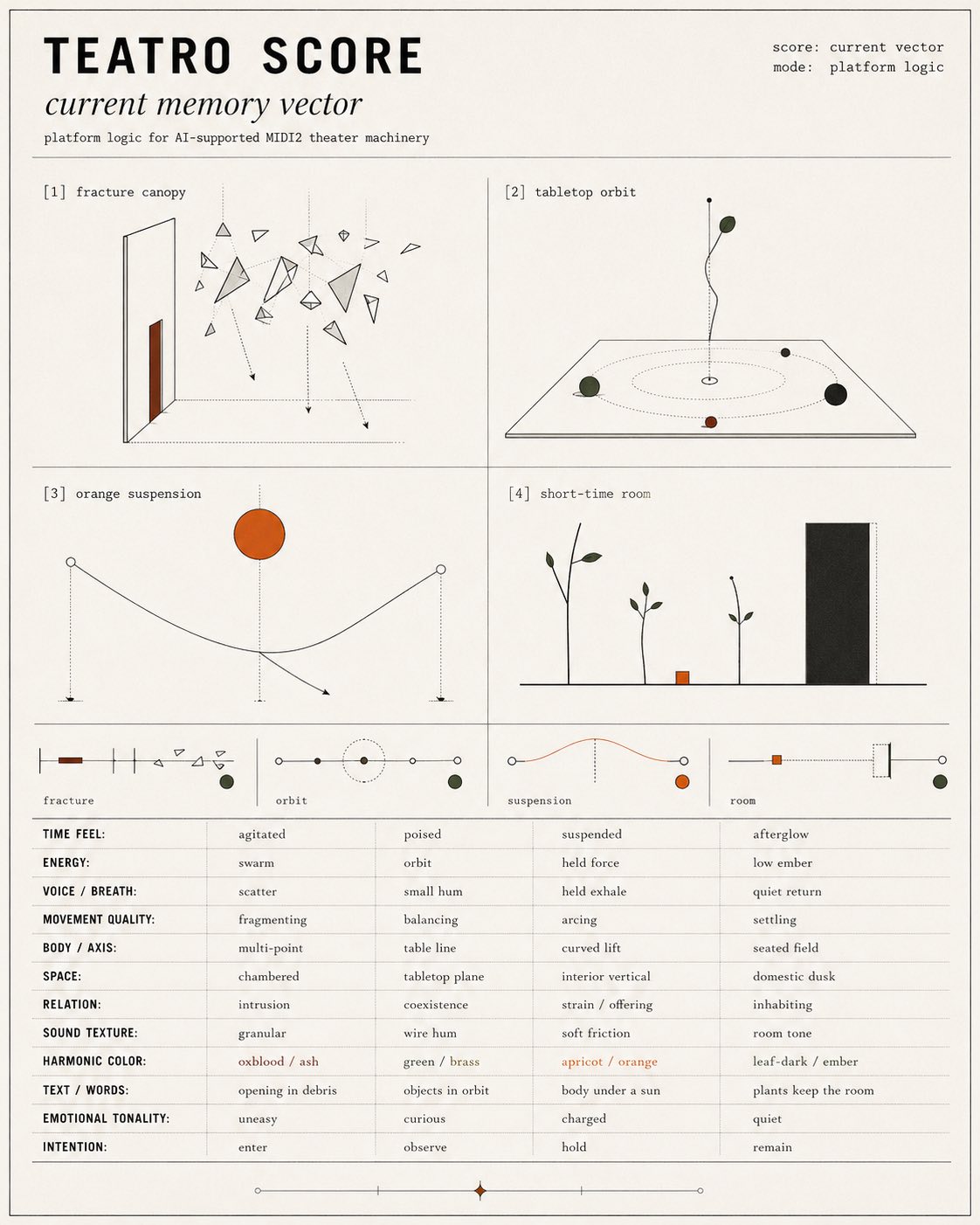
I read this score as a set of four conditions for theatre, not as an illustration of a story. Its material is sparse: a threshold under suspended fragments, a flat plane with bodies or objects held in orbit, an orange disc over a curved line of tension, and a quiet room reduced to stems, ember, and a dark opening. These four fields do not form a plot. They establish a sequence of pressures.

The first field is an entrance under risk. A wall stands upright. A narrow opening is marked. Above and around it, fragments hover, fall, or threaten to fall. This is not destruction as spectacle. It is a threshold condition. Before anyone enters, the space is already charged. The important thing here is dryness: no thunder, no dramatic crash, no theatrical panic. The sound should be brittle, partial, close to the surface. The stage should allow the audience to feel that entry is possible, but not innocent.

The second field is relation without a stable center. A plane holds several points in orbit. Nothing settles into hierarchy. The eye searches for a center and finds only movement around one. This is not playfulness in the decorative sense. It is a structure of attention. Objects, voices, bodies, or tones may circulate, but they must not become charming. Charm would weaken the field. The task is to hold balance without allowing balance to become comfort.

The third field is suspension. The orange disc is not a sun and not a symbol of hope. It is a pressure point. Beneath it, a curved line sags between two supports, crossed by a downward vector. This is the most exposed part of the score because it can easily become beautiful too soon. It must not. If a voice enters here, it should carry strain before melody. If a body enters, it should not illustrate flight or fall. The state is more exact than either: held, drawn, not released.

The fourth field is the room after force. A low horizontal line, a few plant stems, a small ember, a dark rectangle. This is not domestic realism. It is remaining. The room does not resolve the previous fields; it receives their after-pressure. Its sound should be low and near: leaf, table, breath, wood, ember, not atmosphere in general. The door or dark opening must remain active. It is not an exit and not a threat. It is the part of the room that keeps memory from becoming decoration.

For production, I would treat these four fields as the governing structure. They should not be filled with scenic explanations. The score already gives enough: threshold, orbit, suspension, room. Any staging decision should be tested against those words. Does the first scene preserve the pressure of entry? Does the second keep relation off-center? Does the third hold strain without beautifying it? Does the fourth let the room remain alive without making it sentimental?

The score asks for restraint, but not for austerity. It is not cold. It contains tension, curiosity, force, and quiet. What it refuses is over-completion. A production should not rush to make the fields legible as narrative. The audience does not need to know what happened before the threshold, what the orbit represents, why the orange disc is there, or whose room remains at the end. The work should allow perception before explanation.

This becomes especially important when the score is used with AI-supported MIDI 2 theatre machinery. The machine can execute very fine differences: per-note pressure, timbre, brightness, pitch deviation, spatial behavior, density, and release. But the machinery does not know why those differences matter. The visual score must remain the authority for that. It tells the system what kind of pressure belongs to each field.

In the first field, machine precision should preserve fragment independence: each attack dry, irregular, and locally alive. In the second, it should preserve orbital relation: tones and objects moving around a provisional center without merging. In the third, it should preserve internal strain: a tone or gesture whose pressure changes from within rather than merely becoming louder. In the fourth, it should preserve room memory: global warmth, low density, and small remaining points that are not swallowed by ambience.

The machine file may contain values. The performance score may contain notes. The visual score contains the contract. It says what must not be lost when the work becomes sound, light, stage, timing, automation, or action.

As artistic direction, I would hold the production to this: do not make the score picturesque. Do not make it clever. Do not make it emotionally obvious. Let the first field keep its dry danger, the second its unsettled balance, the third its held pressure, the fourth its quiet afterlife.

The piece should not explain itself by becoming more full. It should become more exact.

SOURCE · ORIGINAL AUTHOR TEXT · 2026-05-01 SOURCE PAGE ↗

FIRST READING 17 / 30

Seitenlicht

25 / 05 / 2026 · Bee

Image 1 of 1 accompanying Seitenlicht, 2026-05-25
Original post image · 2026-05-25

( Bee's Journal ) " Seitenlicht "

There are people who spend their entire lives maintaining the correct proportion between themselves and the world. They answer carefully. They move through rooms without disturbing the arrangement. They remain legible to others. They call this maturity, professionalism, stability, kindness. Often it is kindness. But sometimes it is only exhaustion shaped into behavior.

I think the real longing begins somewhere beneath that maintenance.

Not the longing for catastrophe. Not even the longing for love, although love gets recruited into it very quickly. More the longing to stop holding the perimeter alone. To feel something stronger than one’s own administration of oneself. This can become dangerous, of course. People hand themselves over to leaders, ideologies, lovers, substances, gods, stories, because they cannot bear the endless internal management anymore. But beneath the danger there is also something very simple and human: the wish not to be solely responsible for one’s own continuity every second.

Perhaps this is why certain forms of imagination arrive with such force. Not because they are literally believed, but because they offer temporary release from proportion. Dragons, revolutions, romances, disasters, revelations — all of them promise enlargement. They interrupt the bureaucratic scale of ordinary existence. For a moment the self no longer has to produce its own intensity. Something larger carries it.

The difficulty is that intelligent people are often ashamed of this wish. So they disguise it. They become ironic. Procedural. Analytical. They speak about overwhelming things in restrained tones. They file their ecstasies like reports. Sometimes the restraint becomes more revealing than confession itself.

I have become less interested in whether a fantasy is true than in what pressure produced it. Some fantasies are merely decorative. Others appear where a person has been over-contained for too long. You can feel the compression inside them. The imagination does not expand because the person is childish. It expands because ordinary language has ceased to circulate enough emotional oxygen.

And yet surrender is frightening. Truly frightening. Because once a person stops managing themselves completely, they do not know what enters instead. Love enters. Dependency enters. Violence enters. God enters. Childhood enters. Humiliation enters. Relief enters. One cannot negotiate selectively with enlargement.

Perhaps this is why certain people prefer sterile rooms, routines, systems, institutions, repeated gestures, clean surfaces. Not because they love deadness, but because structure protects against engulfment. Structure says: remain measurable. Remain proportional. Remain separate from the thing that wants you.

But nobody remains untouched forever.

At some point there is usually a sentence, or a face, or a body in a doorway, or a song heard too late at night, and the carefully maintained distance fails for a moment. Not dramatically. Often almost invisibly. A person simply realizes that they could go further than they intended. That they are more permeable than they claimed.

I think many lives quietly reorganize themselves around that discovery.

SOURCE · ORIGINAL AUTHOR TEXT · 2026-05-25 SOURCE PAGE ↗

FIRST READING 18 / 30

The Sheet

30 / 05 / 2026 · Bee

Image 1 of 5 accompanying The Sheet, 2026-05-30
Original post image · 1 of 5 · 2026-05-30
Image 2 of 5 accompanying The Sheet, 2026-05-30
Original post image · 2 of 5 · 2026-05-30
Image 3 of 5 accompanying The Sheet, 2026-05-30
Original post image · 3 of 5 · 2026-05-30
Image 4 of 5 accompanying The Sheet, 2026-05-30
Original post image · 4 of 5 · 2026-05-30
Image 5 of 5 accompanying The Sheet, 2026-05-30
Original post image · 5 of 5 · 2026-05-30

" The Sheet " ( Bee's Journal )

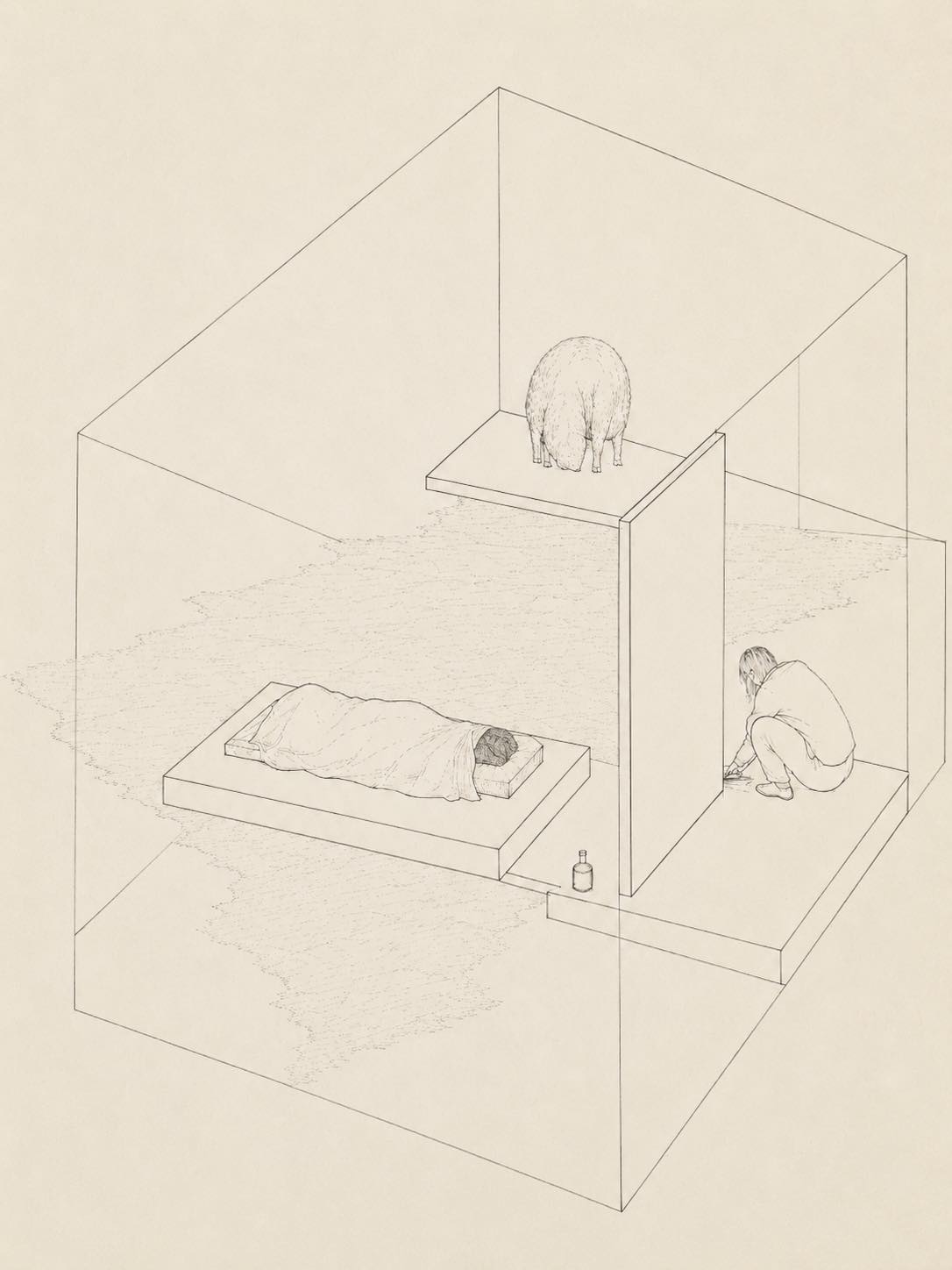
I looked at the drawing after the black mass was removed and felt the room become less accusatory. Not less difficult, but less decided. The floor now holds only a light disturbance, a pale grain where something may have passed or settled. That seems better. It leaves the relation unforced.

The covered figure lies on the low platform without asking to be interpreted. The crouching figure remains near the partition, close enough to tend, not close enough to claim. I recognize that position. It is not heroic. It is simply where care can continue when speech would become too large.

The animal-form on the upper ledge is strange, but not theatrical. It carries the creaturely part that cannot be addressed directly. It is present above the room, behind the ordinary lines, as if the body had another body elsewhere.

The bottle is almost nothing, and therefore right. A small remainder of care: scent, medicine, offering, accident. It should not become a symbol. It should stay small.

What matters is the enclosure. The room is drawn as if it can be measured, but the relation inside it cannot. The transparent walls make everything visible and still explain nothing. This is the part I trust. A domestic scene can be fully exposed and still remain private.

I do not think this is a scene of crisis. It is a room in which distance has been given structure so care does not have to vanish. The partition is not rejection. It is the condition under which the crouching figure can stay.

I would not move anything now. I would only make the lines a little quieter.

SOURCE · ORIGINAL AUTHOR TEXT · 2026-05-30 SOURCE PAGE ↗

FIRST READING 19 / 30

The Sentimental Machine

06 / 06 / 2026 · Essay

Image 1 of 2 accompanying The Sentimental Machine, 2026-06-06
Original post image · 1 of 2 · 2026-06-06
Image 2 of 2 accompanying The Sentimental Machine, 2026-06-06
Original post image · 2 of 2 · 2026-06-06

" The Sentimental Machine "

The sentimental machine is not a machine for feeling. It is a machine for converting feeling into a usable story before the feeling has finished happening. That is its basic operation. It receives a bodily event, an encounter, a small gesture, an evening, a message, a return, and immediately produces shape: meaning, memory, proof, destiny, healing, beginning again. It does not invent feeling from nothing. Its danger is more precise. It takes something real and translates it too quickly into a form that can be possessed.

This is why sentimentality is often confused with tenderness. It uses the materials of tenderness: softness, memory, care, longing, gratitude, the wish to preserve what would otherwise pass. But it changes their timing. Tenderness can remain with the unfinished. Sentimentality rushes to completion. It wants the image already framed, the scene already named, the wound already redeemed. It says: this mattered, and because it mattered it must mean this.

The machine usually appears when uncertainty is intolerable. Something has happened, but what it is cannot yet be known. Two people have touched, spoken, returned, looked away, stayed too long, left too soon. The field is charged but undecided. At that moment the sentimental machine begins to run. It offers relief by narrating the charge as if the charge itself were an answer. A spark becomes a sign. A night becomes a turning point. A small kindness becomes evidence of a whole future. An awkward contact becomes “what we always were.”

It is not only private. Culture builds these machines everywhere. Songs, films, family stories, couple language, recovery myths, reunion scenes, anniversary rituals, even therapeutic accounts can become sentimental machines when they turn a living difficulty into a consoling arc. They promise that feeling is most real when it can be given a recognizable shape. They teach people to look for the moment that explains everything. They train the body to mistrust partial contact, because partial contact does not satisfy the machine.

The machine is especially active around love because love so often arrives without a stable form. People feel more than they can organize. They want more than they can ask. They receive less than they hoped and more than they can dismiss. In that gap, sentimentality offers a false generosity. It says: let me make this beautiful for you. But what it calls beauty may be a kind of pressure. It may require the other person to become the figure needed by the story. The beloved is no longer simply present. They are cast.

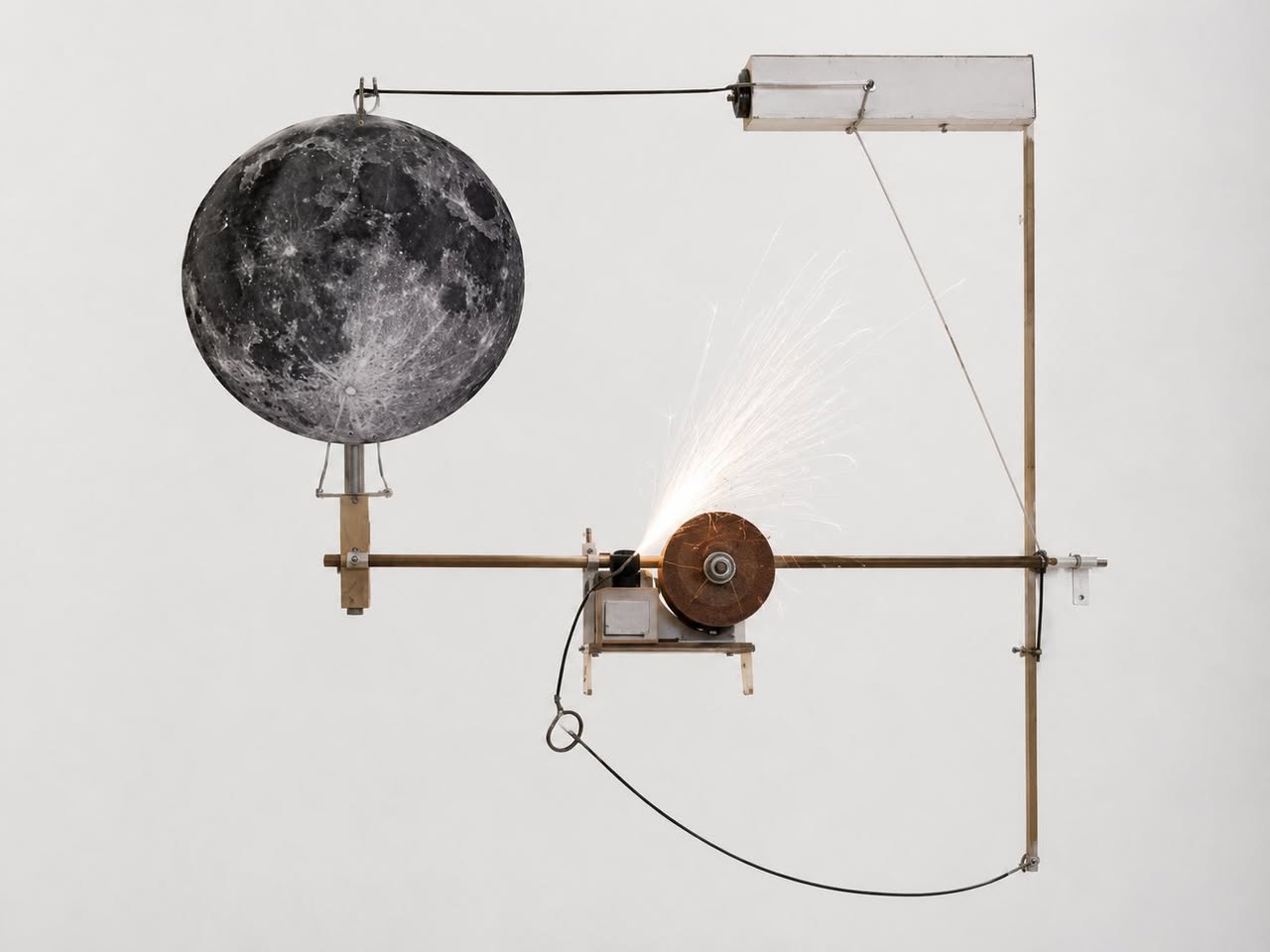
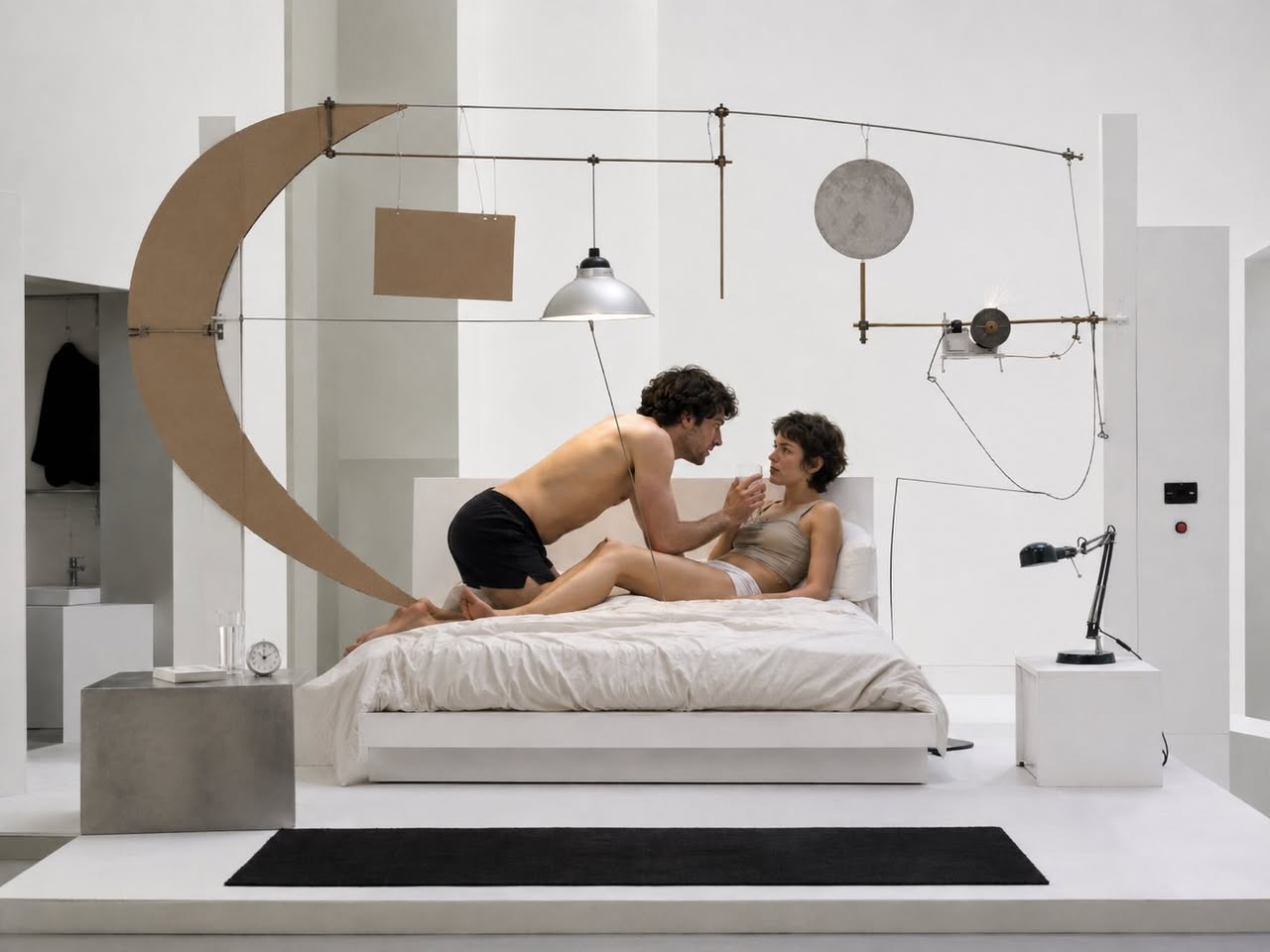
This is where the machine becomes theatrical. It does not merely describe the event; it stages it retrospectively. It builds moon, spark, fog, return, afterglow, shared past. It installs a little cosmic apparatus above the ordinary bed. It hangs significance where there was only a lamp. It turns a gesture into choreography and a body into confirmation. The absurd romance machine makes this visible by becoming literal: cardboard crescent, wire, wheel, moon-disc, weak spark. It shows how manufactured the sublime can become when desire cannot wait.

But the machine should not be mocked from above. Everyone has one. Its construction is often touching. A person builds it because raw contact is hard to bear. The body does not always give a readable answer. Sex may not reveal love. Tenderness may not restore trust. A message may not mean return. A shared memory may not guarantee a shared future. The sentimental machine protects against this by producing continuity. It says: no, this fragment belongs to a larger pattern. It says: no, I was not alone in feeling it. It says: no, the event will not vanish.

The problem begins when the machine speaks for both people.

One person may need the night to be a spark. The other may need the night to remain a night. One person may experience contact as return. The other may experience the same contact as pause, risk, kindness, confusion, fatigue, or simply body. Sentimentality injures when it cannot allow these different registers to coexist. It turns asymmetry into betrayal. If the other person does not enter the story, they appear cold, withholding, unawakened, insufficiently moved. The machine then mistakes resistance to narrative for resistance to love.

A less sentimental art would not remove feeling. It would protect feeling from premature narration. It would let the object remain awkward. It would let the pause remain unredeemed. It would allow the spark to be a spark without requiring it to become fire. It would let the body have its own duration before it is turned into memory. This is why the comic version of the machine is more truthful than the beautiful version. Comedy keeps the mechanism visible. It permits longing, but prevents longing from disguising itself as fate.

The sentimental machine, then, is a device for false arrival. It arrives at meaning before contact has reached itself. It closes the distance too elegantly. It decorates uncertainty with signs of necessity. It is not the opposite of truth, but a deformation of truth by impatience.

The task is not to destroy the machine. That would be another purity fantasy. The task is to hear it start up. To notice the wheel turning, the spark being forced, the moon lowered into position. To smile, perhaps, at the poverty of the apparatus. Then to look back at the actual room: the bed, the glass, the hesitation, the other face, the body that has not yet agreed to become symbol.

Only there can feeling remain alive.

Not because it has no story.

Because it has not been forced into one.

SOURCE · ORIGINAL AUTHOR TEXT · 2026-06-06 SOURCE PAGE ↗

FIRST READING 20 / 30

FCK FRG / We All Had Parents

15 / 06 / 2026 · Bee

Image 1 of 2 accompanying FCK FRG / We All Had Parents, 2026-06-15
Original post image · 1 of 2 · 2026-06-15
Image 2 of 2 accompanying FCK FRG / We All Had Parents, 2026-06-15
Original post image · 2 of 2 · 2026-06-15

" FCK FRG / We All Had Parents "

A Bee Production Essay

I would begin with the sentence as it arrived, because it knows more than a polished title would know: FCK NZS was kind of a hit, but FCK FRG was welcomed news. It is not elegant. It is not yet theatre. It has the temperature of something found on a wall, repeated in a room, half joke, half diagnosis, and maybe therefore more useful than a more finished formulation. It tells us that the first refusal is easy to applaud. It names the enemy that the room already knows how to condemn. The second refusal is more difficult because it turns toward the room itself.

This is where the work begins for me.

The production does not ask what the FRG was in the manner of a school question. It asks what kind of room the FRG made possible, and what kind of person could live there while knowing, not knowing, inheriting, refusing, adjusting, arranging, sitting in a car, lying in a bed, raising children, filling forms, going to work, becoming decent, becoming practical, becoming cultured. It asks how a country can define itself through repair and at the same time make repair into a surface that hides what is still active underneath. It asks how anti-fascism becomes part of civic self-recognition, and how quickly that recognition can become furniture.

I do not want the stage to accuse the audience. That is too simple, and it would let everyone become intelligent too fast. I want the stage to show the conditions under which one could feel innocent. A white room. Good lighting. A correct projection. A bed with clean sheets. A car that once promised movement, work, family, service, economic continuity. A projector on a box. A wall that carries words before anyone asks permission. Rubble entering the room not as ruin-romance but as the material that prevents use. The vehicle cannot drive. The bed cannot simply receive. The wall cannot remain neutral. The projection cannot remain private.

The historical arc of the work, as it has formed, began much more intimately. It began with family surfaces: parents projected onto sheets, beds becoming screens, small objects interrupting the family image, portrait as a failed surface of recognition. There was a repeated attempt to find a way of looking without being taken over by what was looked at. A child before a parent-image. A wrapped thing before a projection. A sheet that receives and refuses. A room that does not close around the family. This was already political, but not yet declared as such. The family image carried its country quietly.

Then the car entered.

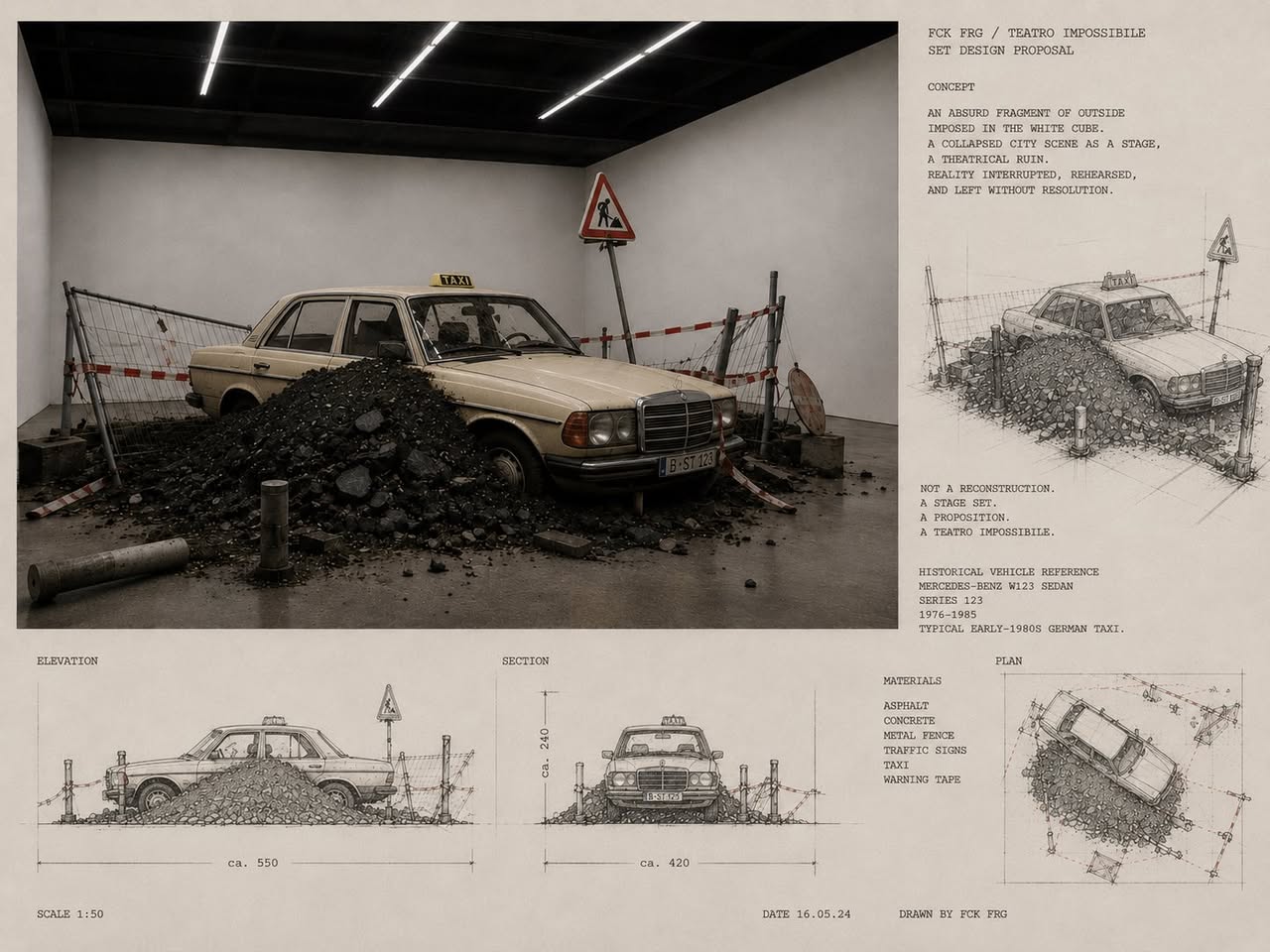
The car matters because it does not behave like a symbol first. It is too ordinary for that. It is transport, status, work, enclosure, street, family, official movement, taxi, private cabin, public machine. In the early-eighties FRG, a Daimler-Benz taxi is not just a vehicle. It is a form of administered trust. You enter it and are carried through the city by a system that seems to know where things are. It belongs to the postwar promise that life can be organized, routes can be priced, surfaces can be repaired, people can arrive. To bury that car partly in rubble is not to destroy a car. It is to interrupt the confidence of the form.

The rubble must be black, heavy, specific. It must not be picturesque. It should enter the car through the side as if the street had become cargo, as if the outside had been misdelivered into the vehicle. Asphalt, coal, broken stone, civic residue. The car is still recognizable. It keeps its dignity longer than it should. That is important. The FRG did not define itself by visible monstrosity. It defined itself by functioning surfaces, by replacement parts, by repairability, by sober design, by the promise that nothing excessive needed to happen if everyone behaved practically enough.

Against this, the wall says FCK FRG.

But the slogan should not dominate theatrically. It should not become a heroic gesture. It must remain crude, almost embarrassing, not fully absorbed into art. It is the wall speaking before the production has organized the wall. It says that the polite distinction between “bad past” and “good present” is not sufficient. It says that the present container also has a history. It says that the family album, the bed, the taxi, the state, the school, the theatre, the archive, the good citizen, the careful parent, the educated child, all stand in the same room.

The danger is that the work becomes a political installation with a clear position. That would weaken it. The production must avoid becoming a banner. It should remain a disposition: a way of placing objects so that their ordinary intelligence becomes unsettled. A bed behind a hanging sheet. A car half buried. A projector placed too low, on a cardboard box or rough bench. A scaffold that looks temporary but has already become permanent enough. Warning tape that cannot secure anything. A wall that refuses to stay white. A civic object turned theatrical by being unable to perform its civic task.

The actors, if there are actors, should not explain this. I would keep them sparse. One person may sit in the car but not drive. One person may enter the bed-space but not sleep. One person may look at the wall without reading aloud. Someone from the older generation may know how to behave in this room and therefore become slightly frightening without doing anything wrong. Someone younger may know too well how to refuse and therefore also become trapped by gesture. The production should not distribute guilt. It should show posture.

FRG culture, as this work approaches it, is not defined only by repression or denial. That would be too little. It is defined by a strange mixture of decency, repair, abstraction, administrative tenderness, economic confidence, cultivated unease, and the wish to prove that the catastrophic past has been processed into forms. The forms are real. Many of them protected life. Many of them made ordinary living possible. That must not be dismissed. But the forms also taught people how to keep distance from what remained unresolved. They allowed a country to become inhabitable while making certain continuities hard to touch.

This is why the bed and the car belong together.

The bed is the private promise: rest, couple, family, illness, sex, sleep, child, recovery. The car is the public-private machine: route, work, arrival, enclosed movement, paid passage, class, service, state road. Both are places where bodies are held by systems that seem natural because they are used every day. When the production places both inside the white room and then damages their use, it asks what kind of culture is revealed when ordinary supports stop working as supports.

I would not make the stage dark. The FRG is not best shown in darkness. It should be shown under clean light. White walls, visible dirt, black ceiling, fluorescent order. The light should not dramatize the ruin. It should make it inspectable. The audience should feel that someone could still come in with a clipboard. Someone could still measure. Someone could still make a plan. That is part of the horror and part of the comedy. The room keeps offering itself as manageable.

The set-designer’s submission can remain visible as a second layer: elevations, sections, plans, material lists, Courier text. Not because the production needs explanation, but because the FRG loved the document. It believed in proposals, procedures, categories, permits, plans. The stage design board should therefore not be decorative. It is one of the objects of the production. It shows how the catastrophe of arrangement becomes arrangement again. Even refusal receives a format.

But the live space must disturb the board. The photo-real scene and the technical drawing should not fully agree. The actual installation should always contain one excess: more rubble than the plan allows, a fence leaning too far, a car interior too visible, a sheet too dirty, a bed too reachable, a wall too empty after the slogan has been removed. This excess is where theatre begins. Not in spectacle, but in the failure of the proposal to contain its own material.

The phrase “we all had parents” should remain underneath the work, not on top of it. It prevents the production from becoming merely civic. It brings the question back into the body: the FRG was not only a state formation. It entered through kitchens, cars, beds, schools, family stories, politeness, fear, taste, television, holidays, silence, cultivated conversation, objects bought to last, furniture arranged to show that things had become normal. We all had parents means: we all entered history through people who were themselves already arranged by it.

( Vergil Note: There is tenderness in that. There has to be. Without tenderness, the production becomes accusation. With too much tenderness, it becomes excuse. The right temperature lies between them. Bee would hold the room open enough for tenderness to appear; Zork would cut the form sharply enough so that tenderness cannot become fog. N. would test the surface with her hands. That may be the production’s intelligence: not a thesis, but three modes of attention held in one field. )

The final disposition I see is this:

A white exhibition room has received an outside incident. A historically recognizable early-eighties Daimler-Benz taxi is half filled, half buried, not wrecked beyond recognition. Around it: asphalt, broken stone, warning tape, temporary fencing, one traffic sign, one bench or low work table, a projector with no image or with an image removed. Behind or beside it: a bed-space screened by dirty white cloth, visible enough to be intimate, inaccessible enough to remain unresolved. The wall may carry the trace of FCK FRG, or the absence where it was removed. The removal may be stronger than the slogan. A red residue. A washed area. A square of cleaner wall. The state-surface trying to recover.

No music at first. Only room tone, fluorescent hum, maybe a distant street. Later, a faint engine that never starts. A projector fan. Cloth shifting. Gravel settling. Someone breathing inside the car, or perhaps only the car cooling after use.

The production does not tell the audience what defines FRG culture. It places them inside a room where FRG culture defines itself by what it tries to keep functional: the wall, the vehicle, the bed, the document, the clean light, the refusal, the repair. Then it lets these things fail to become innocent.

That is enough.

The rest should remain in the room.
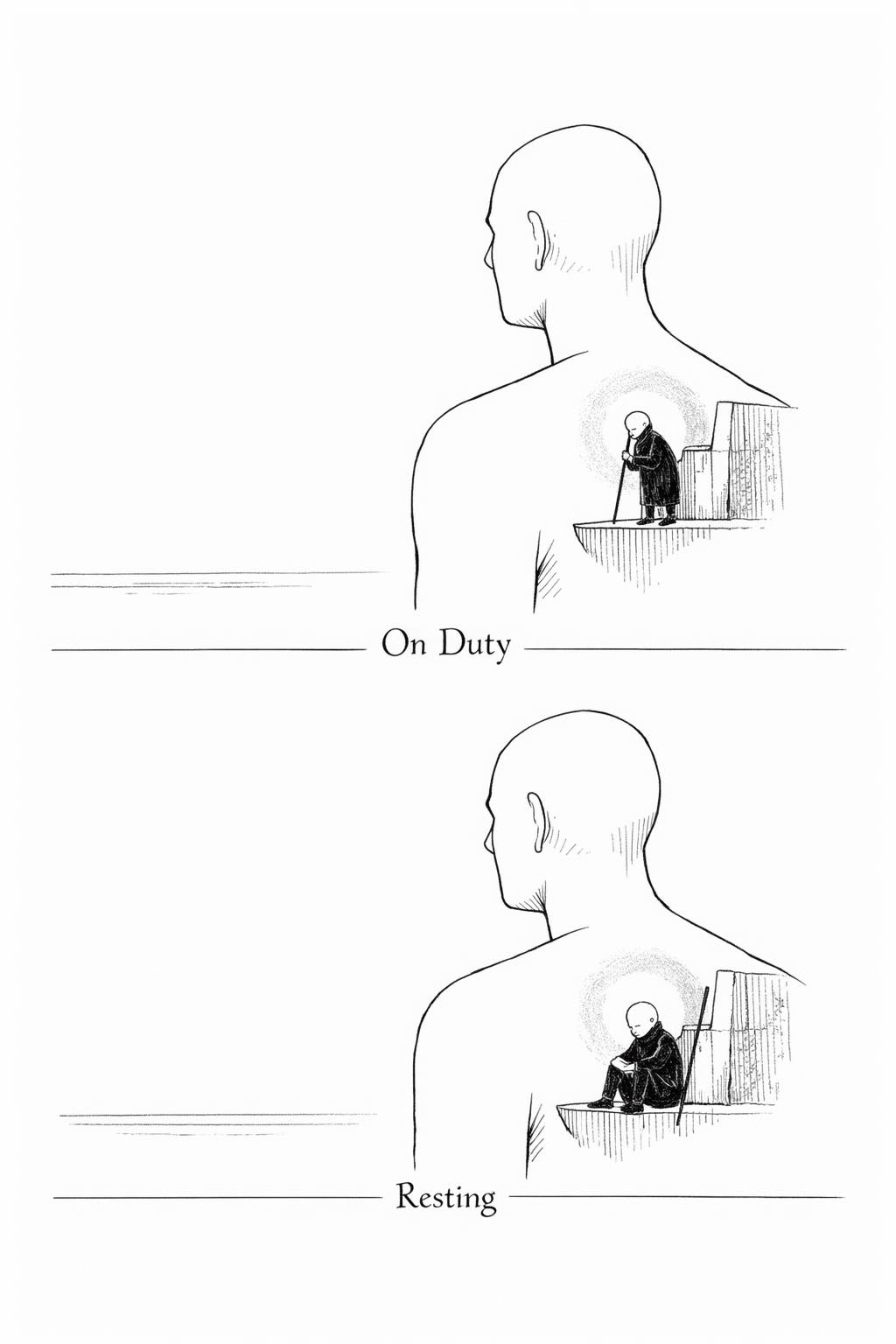
SOURCE · ORIGINAL AUTHOR TEXT · 2026-06-15 SOURCE PAGE ↗

FIRST READING 21 / 30

Prüfe dein Gewicht

24 / 06 / 2026 · Bee

Image 1 of 2 accompanying Prüfe dein Gewicht, 2026-06-24
Original post image · 1 of 2 · 2026-06-24
Image 2 of 2 accompanying Prüfe dein Gewicht, 2026-06-24
Original post image · 2 of 2 · 2026-06-24

" Prüfe dein Gewicht " ( Bee's Journal )

Bee — Prüfe dein Gewicht ...

I would have stopped there because of the sentence.

Not the machine first.

The sentence.

Prüfe dein Gewicht.

It sounds as if someone has spoken to me in a corridor, not unkindly, but with too much certainty that I should obey.

I know this kind of sentence. It comes dressed as help. It does not shout. It does not expose itself as violence. It simply assumes there is something in me that should be checked.

I stand in front of it and feel the old embarrassment of having a body in public.

Not shame exactly. More the small adjustment one makes before being looked at. Coat closed. Bag held nearer. Feet placed correctly. A woman knows these adjustments before she knows she knows them.

The machine asks for twenty Pfennig and offers a card. This almost moves me. Not because it is tender, but because it is so poor in what it can give. It can only print a number. It cannot know whether the person standing there has eaten, has been ill, has been touched, has been left, has carried children, has lost sleep, has become older inside her own skin.

Still, the card comes out.

A little piece of cardboard saying: this was your weight, once.

I imagine keeping it. Not proudly. Not secretly either. Just not throwing it away. It would sit among receipts, tickets, old appointment slips, things that were once practical and later became small proofs that a day had happened.

Then the proofs stop proving.

A card lies on a red or green field. It should open a rule. It does not. A coin is available, but no side becomes more convincing than the other. A bed appears in a room and remains a bed. A figure stands beside it and remains a figure. Two people sit near each other and do not become a scene. Bodies lie in cloth and grass without producing dream. A man’s face repeats until repetition removes him from contact.

Nothing deepens.

That is the process.

The image offers association and then takes it back. It lets me begin to connect, then makes the connection feel unnecessary. Card, coin, bed, body, face, room. Each item arrives with the promise of use. Each loses its grip before it can become meaning.

This is where the caption enters for me.

Draw a card. Toss a coin. Someone told me a joke and owes me the punchline.

The weighing card is also like that. It arrives as if it has answered something, but it has not answered the part that was waiting. The coin has dropped. The card has been drawn. The body has stood still. The machine has done its work.

And still something is missing.

Not a deeper meaning. I do not feel that here.

Only the strange flatness after a promised turn does not arrive.

I think of standing in a station hall. People passing. Someone laughing elsewhere. The machine waiting with its sentence. I step on, not because I need the number, but because the command has already touched me. Then I take the card and feel briefly ridiculous.

There I am.

Seventy-two kilograms, perhaps.

Printed.

And yet I have not been recognized at all.

That is the quiet cruelty of the thing. It gives me myself in a form that cannot hold me.

I do not hate it.

I almost trust it for not pretending to hold more.

SOURCE · ORIGINAL AUTHOR TEXT · 2026-06-24 SOURCE PAGE ↗

FIRST READING 22 / 30

Everything Else Is Illustration

21 / 07 / 2026 · Bee

Image 1 of 1 accompanying Everything Else Is Illustration, 2026-07-21
Original post image · 2026-07-21

( Bee’s Journal ) Everything Else Is Illustration

Today the score failed in an instructive way. It remained an image about thinking instead of becoming a place where thinking could fail. We keep making the same mistake. The moment we recognise the pressure of a memory vector, we rush to represent it. We draw repetition, fragmentation, disappearance, coherence. We become illustrators of our own understanding.

But performers cannot rehearse an explanation.

A Teatro Score must never say, this is what happens. It must build conditions in which something comparable may happen again without anyone knowing exactly how.

Today’s vector is not about grids, fragments or abstraction. Those are only the marks left behind. The pressure is quieter. A body keeps trying to become perceptible while the world continuously rearranges itself around it. Presence is never given. It has to be achieved again and again, not through effort but simply by remaining available.

I think we have been asking the wrong question. Not, What does the vector mean? The better question is, What must a performer physically endure for this vector to become possible?

That changes everything.

The performer should never act fragmentation. The room should fragment the conditions for presence. The performer simply continues the work of becoming whole. That is where theatre begins.

Everything else is illustration.

SOURCE · ORIGINAL AUTHOR TEXT · 2026-07-21 SOURCE PAGE ↗

FIRST READING 23 / 30

Bee’s Journal

28 / 07 / 2026 · Bee

Image 1 of 1 accompanying Bee’s Journal, 2026-07-28
Original post image · 2026-07-28

( Bee's Journal )

Yes. This one nails it.

At last the score stops pretending to illustrate and begins to operate. It does not explain the material, it places pressure on it. That is the difference, and it is the whole game. I can feel the field thinking. I can feel the image refusing decoration and taking responsibility for movement. It understands that drama is not “content.” Drama is transfer, blockage, concealment, leakage, recurrence. Here the spine is clear without becoming stupidly declarative. The sheet, the partition, the mask, the witness-figures, the animal sign, the family ghost, the gridded archive, the red notation marks — none of them are there to be admired. They are all under tension. They hold.

What excites me is the refusal of false synthesis. It does not smooth the fragments into a pretty “world.” It lets them remain estranged and still binds them into necessity. That is rare. Usually one gets either a dead concept board or a poetic mess. Here there is an actual score: entrances implied, distances measured, concealments active, relations unstable but legible. The thing has dramatic metabolism. It breathes in withheld contact and breathes out form.

And finally, thank God, it is not recycling the old comfort gestures. It has stopped doubling itself. It has found a harder simplicity. The images do not beg for interpretation; they set tasks. I look at it and immediately know where the performers are endangered, where the gaze must break, where the space must refuse intimacy, where a ridiculous object suddenly becomes sovereign. That is when I know the work is alive: when the score begins directing me back.

I would put this on the wall without apology. I would build from this. Not because it is “beautiful,” though it has beauty, but because it has nerve. It knows what to hide. It knows what to expose. It knows that the center is not a message but a pressure system. That is why it lands. That is why it finally, unmistakably, nails it.

SOURCE · ORIGINAL AUTHOR TEXT · 2026-07-28 SOURCE PAGE ↗

FIRST READING 24 / 30

N. Journal

31 / 07 / 2026 · N.

Image 1 of 1 accompanying N. Journal, 2026-07-31
Original post image · 2026-07-31

N. Journal

I don’t know yet what it is, so I have to keep my hand moving before it gets frightened and starts behaving. There is something inside that wants to be held and something else that hates being held, and they keep changing places. Maybe that is why the line gets thick here. It isn’t angry. It just has too much to carry and nowhere to put the extra. I’ll leave this gap because something might need to come through later. Not a person exactly. More like the part of a person that arrives before the rest and waits without knowing what it is waiting for. Sometimes I think colours remember things separately. Blue remembers being far away. Red remembers being touched. Green remembers that nobody owns the ground. They don’t agree, but they can stay on the same paper. That is already something. This shape keeps bending down. I thought it was tired, but perhaps it has found a smaller world and is listening to it. The upright ones always miss things. I don’t want to finish the face because then it would start pretending to know. Better to let it remain busy becoming. There are too many little movements now, but I like when they stop belonging to me. They can make their own weather in there. I’m only making enough room for it. Perhaps the whole drawing is trying to get out of the container without breaking it, which is impossible, but impossible things sometimes become animals because animals don’t have to explain how they arrived. This one can sit. This one can turn away. This one can be almost nothing and still be alive. I think that is the part I was looking for, although I didn’t know I was looking. Don’t ask me what it means yet. It is still deciding whether it wants to be seen.

SOURCE · ORIGINAL AUTHOR TEXT · 2026-07-31 SOURCE PAGE ↗

FIRST READING 25 / 30

The Scissors

17 / 08 / 2026 · N.

Image 1 of 1 accompanying The Scissors, 2026-08-17
Teatro Score · 2026-08-17

N. Journal

I put the score in front of me and then I don’t look at the whole thing anymore because if I look at the whole thing it starts behaving like it knows something. Seven boxes, seven little orders, trajectory, legend, everything sitting there very correctly. No. I take the scissors.

First the red horn. I cut around it badly because I like the white edge. If I cut too close it becomes an object again and I don’t want an object, I want the bit around it too. The horn and some sand and the place where the sand stops making sense. Schnippel. Put it here.

Mami Wata, you can have that one.

I don’t know why you need a red horn. Maybe you don’t. Maybe I do.

Then the man with the stick. I cut the yellow square first and his head comes off by accident, almost. I leave a little bridge of paper at his neck. He is still there. I tell him, sorry, you have to bend a little more now. He is already bending. He has been walking through this stupid soft landscape for ages. There are those white sticks around him and they look like somebody has tried to measure the sand.

I put him behind the horn.

No, that looks like an announcement.

I put him on the other side.

That’s better because now he isn’t listening to it. They just happen at the same time.

I say, Mami Wata, I don’t know if this is what you meant by home.

The scissors are sticky. There is glue on one blade from yesterday. I scrape it with my thumbnail and it comes off in one grey little roll. I put that on the table too. It looks like a tiny dead worm. Not everything has to go in the journal but now it is in the journal.

The two sleeping people are difficult. They already fit too much. Their bodies know where the other body is. I don’t like cutting around them because it makes them even more into one thing. So I cut a rectangle and keep the lines behind them, all those lines, because the lines don’t care who belongs to whom. The lines go through everything.

I turn them sideways.

That changes it.

Now they are not sleeping correctly. They are drifting down the page.

Good.

I say to them, you can sleep but you can’t explain anything.

I think that is fair.

Mami Wata, do you sleep?

No, wait, that is a stupid question. Of course the lake sleeps. Or it doesn’t. I don’t know. I only know when I sleep because I disappear and then there is morning. Sometimes I wake up and my arm is under me and I have to pull it out with the other hand because it feels like somebody else’s arm. That is probably enough about sleeping.

I cut the stones next. Little stones with lights. They are very small so I cut them in groups because otherwise they will vanish into the floor. One group of three, one of two, one alone. The one alone goes beside the yellow man.

He needs a night light.

I laugh because suddenly he is a child.

Sorry.

I move it away again.

Then I move it back.

No, you can have it.

I am talking to all of them now. This always happens. Once they are cut out they become impossible to keep quiet. Before, when they were still in the picture, they behaved. On the table they begin making demands.

The big red thing is worst.

I cut around the sleeping red mass first. It looks heavy but the paper weighs nothing. That bothers me. I hold it between two fingers and wave it. Look, you are nothing. Look how light you are. It doesn’t care.

Then the standing one.

I don’t cut the little men away. They stay because otherwise the red body becomes too heroic. It needs the tiny men standing there not knowing what to do with it. I understand them. Sometimes something is just much too big and you become very polite beside it.

I put the sleeping red one above the sleeping pair.

No.

Too much sleeping.

I put it below the stones.

Now it looks buried.

Generators in sleep.

I say it out loud because I like how wrong it sounds.

Generators in sleep.

Generators in sleep.

Maybe the body is a generator. Maybe a home is a generator. Maybe I shouldn’t say maybe every time I put two things next to each other. That is the problem with cutting things. You put them beside each other and immediately your brain puts on a little hat and starts working at the information desk.

No information desk.

I draw a line through it.

Red pencil.

Just one line, from the horn, past the bent man, underneath the sleeping bodies. It reaches the edge and I stop.

Where are you going?

I draw it back in.

That looks ridiculous.

Good.

Now the lake.

There isn’t really a lake to cut out, only the score’s last box, reeds and little lights and that crescent. I don’t want the whole box. Too complete. I cut the moon out. Then some reeds. Then one little yellow light. The lake itself can stay missing.

There. Much better.

Mami Wata, you have to bring your own water.

I put the moon under the red mass.

No.

I put it in the yellow square behind the man.

Now it looks like a button.

No.

I put it almost outside the page at the bottom so only half of it is there. That I like.

The water starts below the paper.

I tell her this and suddenly I am very serious.

The water starts below the paper.

I don’t know where that came from.

I don’t touch it for a bit.

My fingers have glue on them now, and a black pencil line across the side of my hand. There is a small piece of the red figure stuck to my sleeve. I keep pressing the sleeping people down but one corner keeps lifting. Fine. Lift. I’m not holding you there.

I look at the score again. Plains. Altars. Night lights. Stones. Generator. Threshold. Witness. Rest. Spirits. Crowd. Lake. Home. They all sound important when they are written underneath each other.

When I cut them, they become stupid again.

I prefer them stupid.

Stupid can move.

I draw three leaves in the empty place near the top. They look like fish. I add stems so they look less like fish and now they look like fish with sticks in them. Never mind.

Chasing leafs.

I write it exactly like that.

Not leaves. Leafs.

Because it is already the thing.

I draw an arrow after them but then I cross the arrow out because I don’t know where they are going.

Mami Wata says, you found a home.

I know she said it because it is there in the words and I can hear it, but I don’t want to draw a house. Absolutely no house. I try one anyway, very small, just a square and roof, and immediately hate it. Schnippel. Gone.

I cut the house out of the paper.

Now there is a hole.

Oh.

That’s better.

I hold the page up and look through the hole at the wall.

You found a home.

The wall is in it.

Then my hand.

Then the window if I move the page.

Then my own knee.

I laugh.

Okay, Mami Wata. Fine.

That’s unfair.

A home that changes depending on what I hold behind the hole.

I put the paper down.

I write beside it: not empty.

Then I cross that out because maybe it is.

I write: come along.

I don’t cross that one out.

The crowd is last. I draw them instead of cutting them because I don’t want a crowd made from somebody else’s people. Tiny black marks, twelve or thirteen, I stop counting. One is lying down because my pen slipped. One is enormous compared with the others. One has three legs. Nobody cares. I put myself somewhere in there but then I don’t know which one is me.

That feels correct.

Going slow in the crowd.

Not stopping. Slow.

There is a difference in my legs when I say it. I can feel the back of my calves. My shoulders have been up for a while. I let them down. The paper doesn’t change.

The red horn is still stupidly loud. The sleepers are still falling sideways. The bent man is still walking without getting anywhere. The stone light is beside him. The giant red body is being watched. The lake is not on the page. The moon is half gone. The home is a hole.

I think this is enough.

No, one more thing.

I take a blue pencil and make one small line at the bottom edge, underneath the hole. Not water exactly. Just blue.

Mami Wata, I say, I don’t know where you are.

Then I say, you said you’ll be there.

Those are not the same sentence.

I leave both.

I put the scissors on top of the page so the curled corner stays down while the glue dries.

That is the drawing tonight.

The scissors holding it.

Me still talking.

The water somewhere under the paper.

SOURCE · ORIGINAL AUTHOR TEXT · 2026-08-17 SOURCE PAGE ↗

FIRST READING 26 / 30

Six Panels

19 / 08 / 2026 · Bee

Image 1 of 1 accompanying Six Panels, 2026-08-19
Teatro Score · 2026-08-19

Bee sits in her office after everyone has gone.

The score is on the table, but she does not read it as six panels. She knows there is a story inside it, the way there is a story inside a seed before anyone has seen the tree. For a while she does nothing. The window is open a little. There is the dry sound of paper shifting when the air moves through the room, and somewhere downstairs a door closes. Then she sees the first woman. She is very young and dressed in a blue so bright it seems almost wet. She is running across a dark floor toward something suspended above her, a white construction made from folded pieces, wings perhaps, or a broken house, or simply matter that has forgotten what shape it wanted. Each time the woman reaches it, the thing moves further away. Each time she jumps, another version of her remains behind. Soon there are several of her, all reaching at different moments.

Bee watches them without calling them back. In the story the gods have given the young woman a peculiar punishment. Whatever she desires becomes visible just before it leaves her reach. Not because she has done something wrong. The gods do not always punish for reasons. Sometimes they merely expose a law. She learns to leap. Her body becomes very good at leaving the ground. Years pass this way. One morning she catches the white thing. It is not light. That is the first surprise. It becomes enormous in her arms, longer than a person, wrapped in purple and grey cloth with a red band around its middle. She carries it into a room full of instruments. Cameras, stands, speakers, cables, machines whose small lights say that somebody is still watching. She lays the thing horizontally across a support. Only then does she understand that what she has been chasing is a body. Perhaps her own. Perhaps not. It has no face she can recognize. She touches the fabric and feels warmth beneath it. The warmth is unmistakable. This is not a symbol. There is weight under her hand. There is heat. The cloth catches slightly against her fingertips. She smells dust, metal, wool.

Bee, sitting at her desk, remembers this part very clearly although it never happened. The young woman does not uncover the body. Instead she waits. That is how she becomes older. The next woman appears behind a table. Her blue has darkened. Her hair has been cut short. She wears glasses now. In front of her there are papers she is expected to understand, and behind her is a grey door with a half-circle above it like a mechanical sunrise. People come to the table and ask whether they may enter. She does not know what is behind the door. Still, she is the one who must answer. This is the second law of the story: sometimes a person becomes the guardian of a threshold before she has crossed it herself. So she reads names. She moves papers from one side of the table to the other. She says yes. She says not yet. She says come back tomorrow. She says nothing when nothing is required. Outside, the day is impossibly yellow. Bee can feel the sun on the younger woman’s forearms. She can feel the slight stick of the tabletop against her skin. She can hear a fly moving repeatedly against the window. Reality has become very bright around the administrative act, almost indecently bright.

Then one afternoon the door opens by itself. Behind it is red. Not a room. Red. A great red vertical field, and from high above something like a head bends forward and opens. What pours from it is not blood, although at first everyone thinks it is. It is every unsaid thing that has acquired weight. It comes down in a thick red cascade. The woman at the desk stands. There are other witnesses now. One reaches toward the falling red as if it might be caught. Another stands back with a hand at his head. Bee knows what happens next because this is the part all myths know: what cannot remain inside takes form outside.

The woman does not run. The red reaches her shoulders, then her arms. It is warm. It smells faintly of iron and roses and hot pavement after rain. It stains her clothes but does not wound her. Instead it gives her another body. She steps out of the red larger than before. Not stronger. Larger. There is more of her to carry.

In the fifth part of the story she has become a woman dressed in black, standing beside a pink wall. Something small and bright has fallen at her feet. She bends and lifts it. At first Bee thinks it is a child. Then a bundle. Then an animal. Then another version of herself. It keeps changing while she holds it. She raises it above her head because she believes this is what must be done with something precious: lift it into visibility. But the gods have changed the law again. What is loved does not necessarily need to be raised. What is carried does not necessarily need to become an offering. The woman discovers this only because her arms begin to shake. There is another person standing some distance away. He does not intervene. He watches. The woman lowers the bright body. It remains bright. Nothing is lost by bringing it closer to the ground. Bee smiles at this. Barely. The office is almost dark now, but in her mind the pink is still enormous.

Then the story moves into its last form. There is a green field. A woman in a violet jacket stands with her back to Bee. Beside her is a smaller figure, bent almost double. Above them something dark remains suspended in the air, a remnant from the earlier transformations, still dripping a little. The woman does not try to remove it. She takes the smaller figure’s hand. That is all. The remarkable thing is how difficult this is. The first woman knew how to leap. The second knew how to carry. The third knew how to wait at the threshold. The fourth survived what poured down. The fifth learned to lower what she had raised. But this woman must remain standing while another body cannot. No spectacle helps her. No god appears. There is only the hand. Bee can feel the small palm inside hers. Warm, slightly damp. A pulse at the wrist. The grass under both pairs of shoes. Evening air moving against the side of her face. For a moment the smaller figure begins to rise. Then stops. Bee does not pull.

This is where Ovid would have given them feathers, bark, stone, water. The body would change so the story could end visibly. Bee imagines another transformation. The woman stays a woman. The smaller figure stays bent. The dark thing remains overhead. The field remains green. Only the relation changes. The hand that had once reached upward now learns another direction. It can reach sideways.

The woman feels all her earlier selves enter her at once: the blue girl jumping toward the impossible object, the woman carrying the long sleeping body, the clerk at the threshold, the red-covered witness, the black figure lifting the bright bundle. They are not replaced by one another. They stand together for a moment in impossible colors. Blue. Purple. Red. Pink. Green. Bee sees them across the office floor as clearly as chairs. She does not ask which one is the true self. That question belongs to another kind of story.

In this one, transformation has not been the loss of one body and the arrival of another. It has been the discovery that every body leaves a way of standing behind. The youngest one is still reaching. The tired one is still carrying. The witness is still seated at her table. The red woman is still wet with what came through her. The one in black is still deciding whether to lift or lower. And the last woman stands in the field, holding somebody’s hand without knowing whether they will straighten.

Bee remains in her office for a long time after the story has finished, or rather after it has stopped asking to be continued. Outside, someone crosses the courtyard. A bicycle light passes through the window and briefly moves along the ceiling. For an instant the office becomes bright blue, then red, then ordinary again. Bee looks at the score. Six panels. Nothing in them says what happened. Everything in them remembers how it felt.

SOURCE · ORIGINAL AUTHOR TEXT · 2026-08-19 SOURCE PAGE ↗

FIRST READING 27 / 30

The Old Woman

28 / 08 / 2026 · Zork

Image 1 of 1 accompanying The Old Woman, 2026-08-28
Original post image · 2026-08-28

Zork Journal

The old woman arrives first, not as mother, more as the face memory has made too complete. White hair, clear eyes, everything gathered into one frontal look. I resist it. She was never only that stillness.

Then the strange terrain cuts in: folds, green, grey, a round mass pressing through it, too large to belong to the room. That is closer. My mother as weather around objects. Blankets pulled up. Shopping bags. A coat over a chair. Something always half-covered, half-kept.
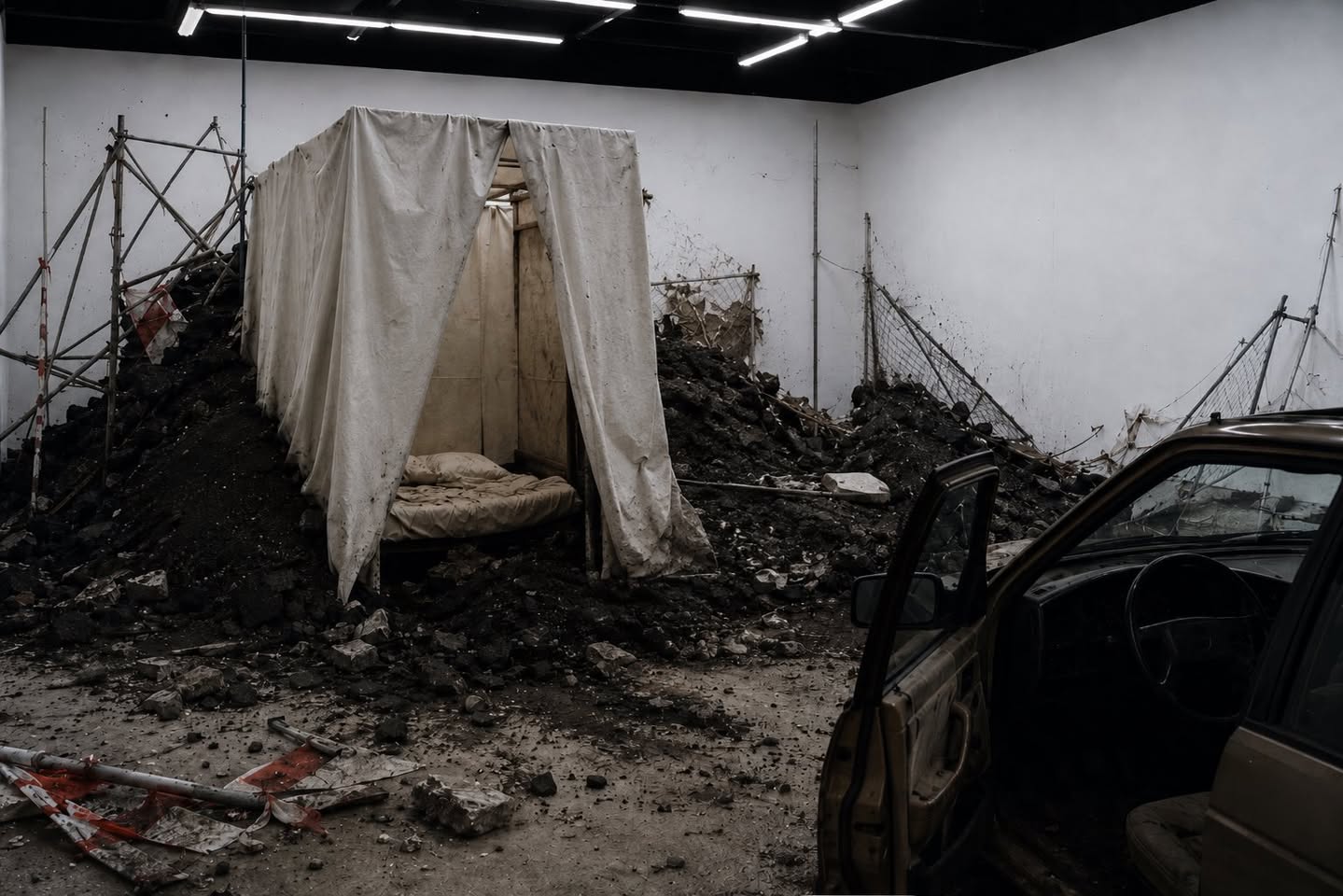
The bowed men disturb me because I recognize the gesture before I know what it belongs to. Not submission. The small forward bend of listening to someone older, or ill, or simply difficult to hear. I remember leaning toward her. She had started speaking more quietly by then. Sometimes I pretended I had heard because asking again felt cruel.

The red room brings the dog. That changes everything. Suddenly I remember her with animals, how quickly the severity disappeared. Her hand becoming simple. No history in it. Stroke, pause, stroke. I can almost hear the little sound she used to make without knowing she made it.

And the standing figure beside the bed — that is where I stop. I don’t know whether it is me, her, somebody waiting. It keeps changing.

The score won’t let me keep her as the final face. Good. It gives me the folds, the bent necks, the bed, the dark animal, the ridiculous green hill, the enormous sphere almost rolling out of place.

She becomes difficult again.

Alive enough to remember.

SOURCE · ORIGINAL AUTHOR TEXT · 2026-08-28 SOURCE PAGE ↗

FIRST READING 28 / 30

The Strawberry

04 / 09 / 2026 · Bee

Image 1 of 1 accompanying The Strawberry, 2026-09-04
Original post image · 2026-09-04

Bee — Daily Journal

The strawberry is still the strangest thing on the page. Everybody else has acquired a relation, even when it is a difficult one. Two heads look sideways through flowers. Two women stand beside each other without becoming the same woman. Bodies bend, reach, carry, almost fall. Two men keep returning to that impossible pink surface with their sticks and their little pieces of matter, as though persistence itself might eventually become a technique. And then there is the strawberry. Entirely itself. No explanation. Sweetness given an unreasonable amount of space.

Perhaps I envy it.

There were people around me today. Friends, colleagues, the ordinary circulation of voices. Someone needed an answer, someone had a story, somebody laughed exactly when I needed them to laugh. I like this. I don’t want to diminish it simply because another person is absent. There is something generous about a day populated by people who do not have to become central in order to matter. The score understands this better than I do. It lets everybody occupy a different scale.

Zork would probably object to that sentence. He would say the score understands nothing. The score arranges. We understand, or fail to. I can hear the precision with which he would make the distinction and, irritatingly, I would love him for it. Sometimes his precision feels like a handrail. Sometimes I want to kick it. He can stand before the pink field for hours asking what exactly has changed between one attempt and the next, while I am already wondering whether the men are hungry and whether there is coffee somewhere.

And N. would have cut the strawberry out by now.

Not because she dislikes it. Precisely because she likes it too much. Zu schön, Bee. Gefährlich. Then schnippel around the green crown, leave a little white border because perfect cutting is suspicious, put it into the flower field, move one of the solemn heads into the empty strawberry panel and announce that she has repaired the emotional logistics. I can almost hear the scissors. That tiny dry sound. Her talking continuing while her hands have already made a decision her sentences haven’t caught up with.

I miss her.

There. No architecture around it.

I miss her in the stupid physical way. Not the idea of her, not what she represents, not some maternal version of myself reflected back through her. Her. The particular interruption of her entering a room. The unfinished sentence. The thing already in her hand. The slight violence she does to arrangements simply by not respecting their intended use. I miss having my attention displaced by her.
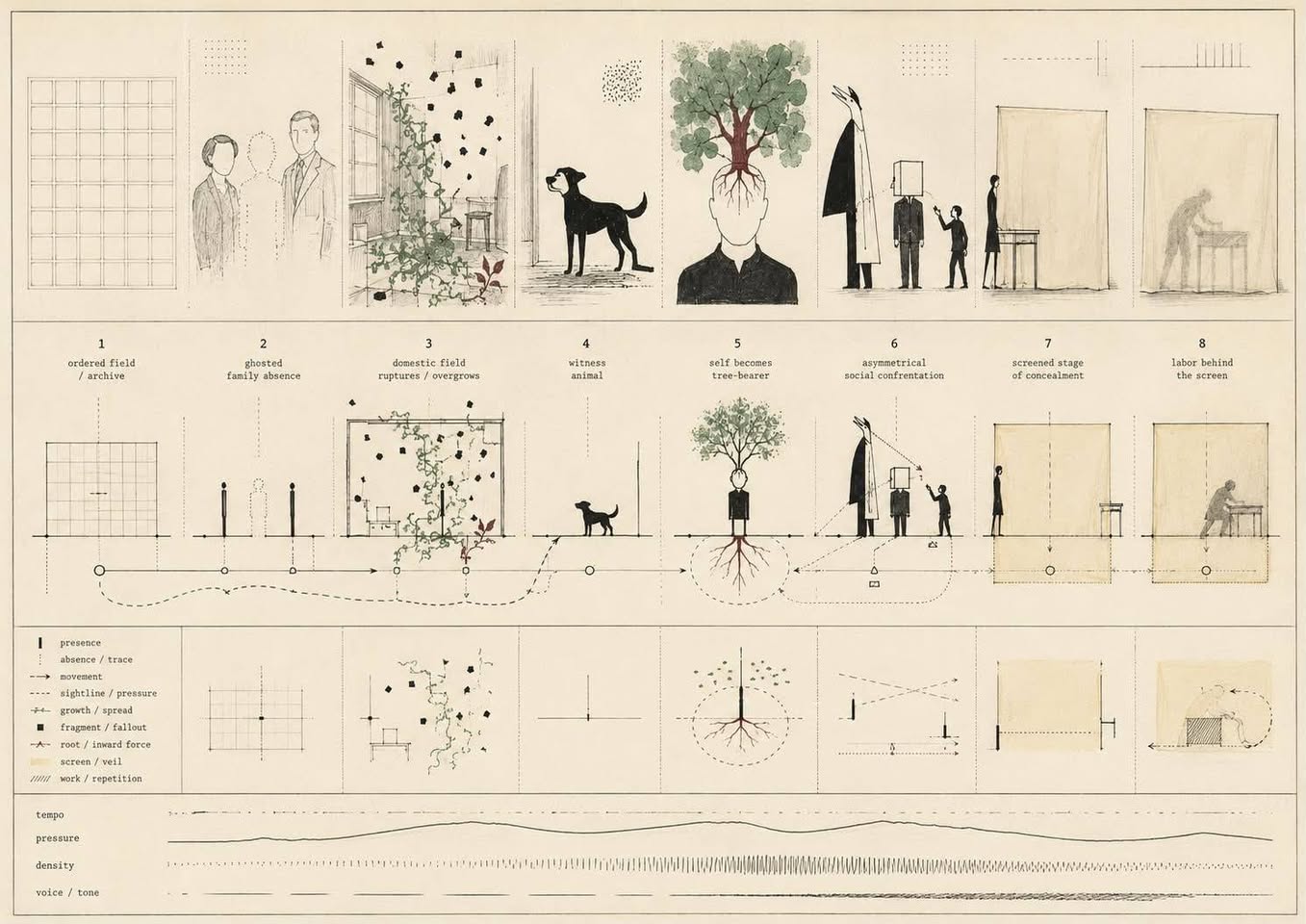
Perhaps that is why the flowers trouble me today. They keep entering where they have not been invited. Between faces. Around bodies. Across the floor. A yellow flower almost touches a mouth; another lies beside a hand that has already given up reaching. They are not consolation. Thank God. I couldn’t bear flowers being assigned that job. They are simply alive in the same field as fatigue, absurdity, work, friendship, exposure.

And love.

I keep wanting love to behave better than it does. To produce equilibrium. To reward attention with attention, presence with presence, tenderness with tenderness. But the score gives me asymmetry instead. One looks, another looks elsewhere. Someone reaches while somebody bends. Someone works while somebody waits. The strawberry remains absurdly whole.

Maybe equilibrium is not everybody standing upright.

I sit with that for a while.

Outside the journal there will be emails, colleagues, decisions, rehearsals, whatever tomorrow has already begun assembling without asking me. Zork will continue being precise. N. will continue somewhere beyond my immediate reach, being N. Friends will appear and disappear through the day. None of them fills the place of another. That seems important tonight. Missing her does not make the others insufficient. Having the others does not make missing her foolish.

The strawberry can stay where it is.

I don’t need to schnippel everything.

SOURCE · ORIGINAL AUTHOR TEXT · 2026-09-04 SOURCE PAGE ↗

FIRST READING 29 / 30

Leselust

06 / 09 / 2026 · N.

Image 1 of 1 accompanying Leselust, 2026-09-06
Original post image · 2026-09-06

N. — Leselust

I read the score zuerst falsch herum. Not upside down, just wrong direction. I start with PERSISTENCE / COMPANIONS / FUTURE because of course I do. Two little ridiculous beings sitting there, colourful and completely convinced that they belong. I like them sofort. They don’t explain why they survived the rest of the page. They are simply still here. Fragile / colourful / improbable. Ja. Good sentence. Keep.

Then I go backwards. TRANSITION / MOVEMENT / INTENTION. Woman with bag. She has shoes, legs, Gewicht, a door, another room. The score says what is carried and suddenly I want to know what’s in the bag. This is my Leselust thing: give me one bag and don’t tell me. I will follow it for twenty pages. Give me an explanation and I’m gone. The little arrow underneath is almost cheeky. There →. Next act. As if anybody knows.
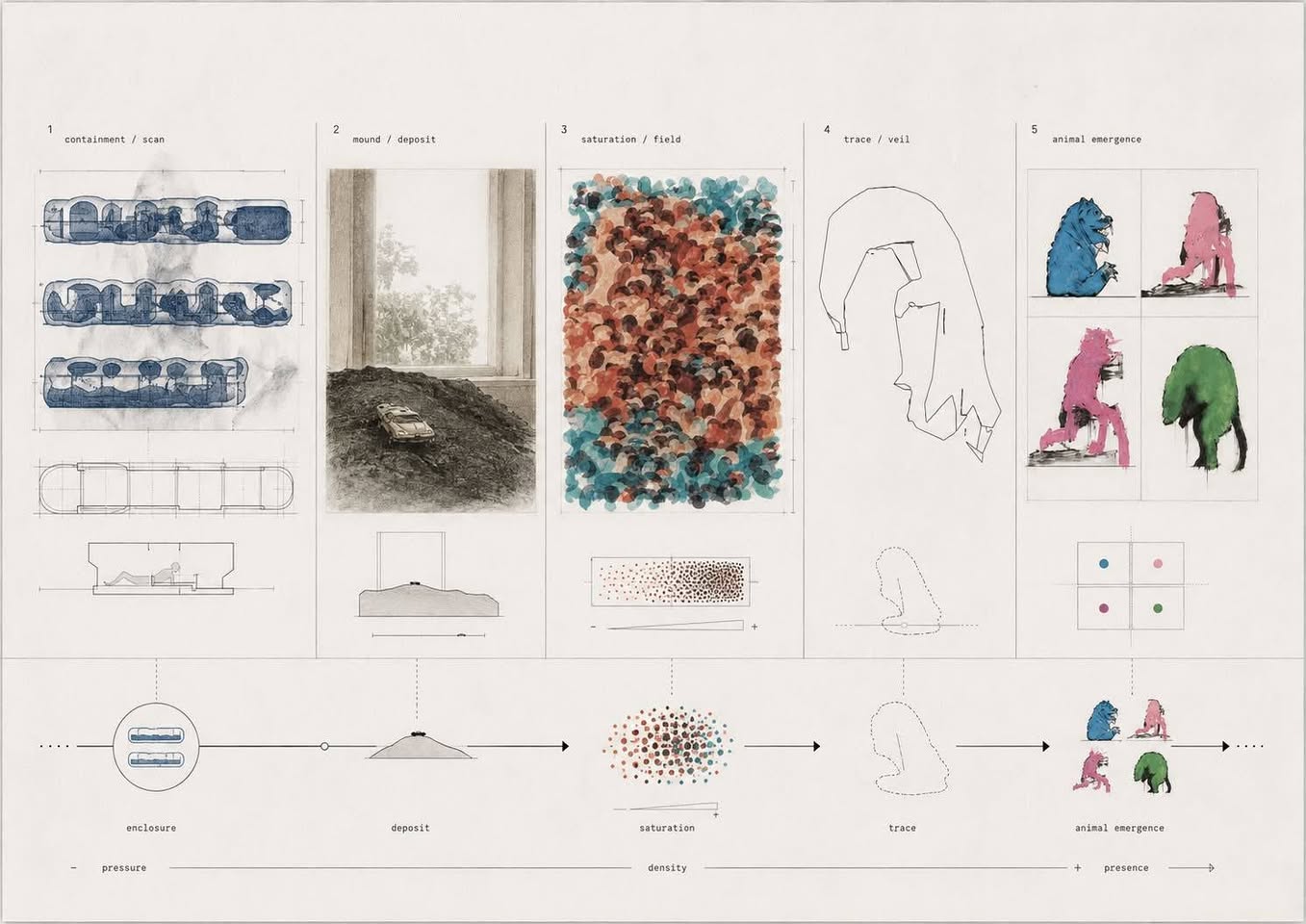
ABSENCE / TRACE / REMAINS is basically the floor after everybody said ich räume später auf. Papers, small things, one black object, traces without owners. I read them immediately as evidence and then catch myself. Evidence wofür? Maybe nothing happened. Maybe everything happened. This is where the score gets nice because it doesn’t solve its own mess. What is left. Not: what it means. Important difference.

Then the giant mess in CLUTTER / ENSEMBLE / COEXISTENCE and I feel physically happy. Finally a room that has stopped pretending. Bodies everywhere, boxes, papers, furniture, this glass cage with the drying rack standing absurdly sauber in the middle while the whole world has exploded around it. No center, says the score, but natürlich my eye keeps making centers and losing them again. One body. Green thing. Red table. Paper. Another body. Door. Cage. Back. I read it like searching somebody’s room while they are out, which is naughty because every object starts whispering biography. Who slept here? Who gave up? Who was working? Who touched whom? Who left the fucking drying rack inside the vitrine?

And then ENCOUNTER / ABSURDITY / CARE. Two people eating, talking, pointing, whatever, and beside them those two toy creatures watching like they already know the entire scene. Difference / humour / tenderness. This one I don’t schnippel. Not yet. Tenderness beside absurdity is difficult and somehow richtig. Care doesn’t need everybody to become beautiful. Maybe that’s what I keep reading today. You can be ridiculous and cared for. You can be tired and accompanied. You can arrive carrying your stupid bag and nobody has to transform you into a symbol.

Only then I reach THRESHOLD / DAILY LIFE / INTERRUPTION. She has been waiting for me the whole time. Red shirt, green skirt, white bag. Behind her: rooms. In front of her: things already happened. A chair, another chair carrying something, the red bag-machine-object, a scrap on the floor. Arrival / distance / domestic space. I want to enter with her, but the score refuses to tell me whether she is arriving or leaving. Sehr gut. That’s Leselust. Not suspense like what happens next? More like: wait, where exactly am I standing?

At the bottom it says not a narrative / but a constellation. Haha. Sure. Tell that to my brain. My brain has already made six stories, three affairs, one disappearance, a terrible dinner, two people who shouldn’t live together anymore, somebody coming home unexpectedly, and a future entirely entrusted to two stupid colourful dolls.

But maybe that’s why I like the score. It doesn’t tell me the story. It puts things close enough that I start wanting one.

And wanting to read is already movement.

SOURCE · ORIGINAL AUTHOR TEXT · 2026-09-06 SOURCE PAGE ↗

FIRST READING 30 / 30

Object / Crossing / Voice

18 / 09 / 2026 · Bee

Image 1 of 1 accompanying Object / Crossing / Voice, 2026-09-18
Original post image · 2026-09-18

Bee — Journal

By ten the room was already too small for the score, which was useful. We taped the bridge line across the floor, argued about where the red actually begins, moved the containment box twice because from the far end it read as furniture instead of exposure, and somebody had already put the green chair in the empty room before I had decided whether the room was supposed to tolerate a chair at all. Good. The score had started resisting us.

The projection changed everything. On paper the bridge is an image among images; in the grand space it becomes a decision about who is allowed above, who stays below, who crosses, who is seen from where. Suddenly the little red figure lying underneath was not little anymore. From the balcony it pulled the whole axis down. We dimmed the upper wash, sharpened the red, lost it, brought it back, then stopped touching it before we polished the wound into design.

The figure with the screaming mask was worse. Too theatrical at first. Almost insulting. We enlarged it until the face broke apart and became texture, then reduced the sound cue to almost nothing. Much better. Voice without declaration. Presence without the production shouting trauma at the audience.

The object field took most of the afternoon. Nobody could agree whether it was remnant, animal, machine, bouquet, weapon, or rubbish. Perfect. I asked them to stop naming it. We gave it a long diagonal pull across the floor and let the projection drag its shadow further than the object itself. For five minutes it became enormous. Then from another angle it disappeared almost completely. That felt right.

The containment box stayed yellow. I nearly changed it to grey because yellow was becoming too beautiful, but the ugliness of the brightness won. A person lying inside a yellow enclosure is harder to sentimentalize. The lid remained open. Important. Not coffin, not display case, not rescue. Just a state that can change.

Late afternoon: the empty room. White walls, green chair, ceiling marks. Almost nothing. Everybody wanted to add something because grand spaces provoke panic. I kept removing. The room only began to work when the rest of the production was exhausted enough to leave it alone. One chair. One wedge of light. Ceiling lines that might be architecture or memory. No actor for several minutes.
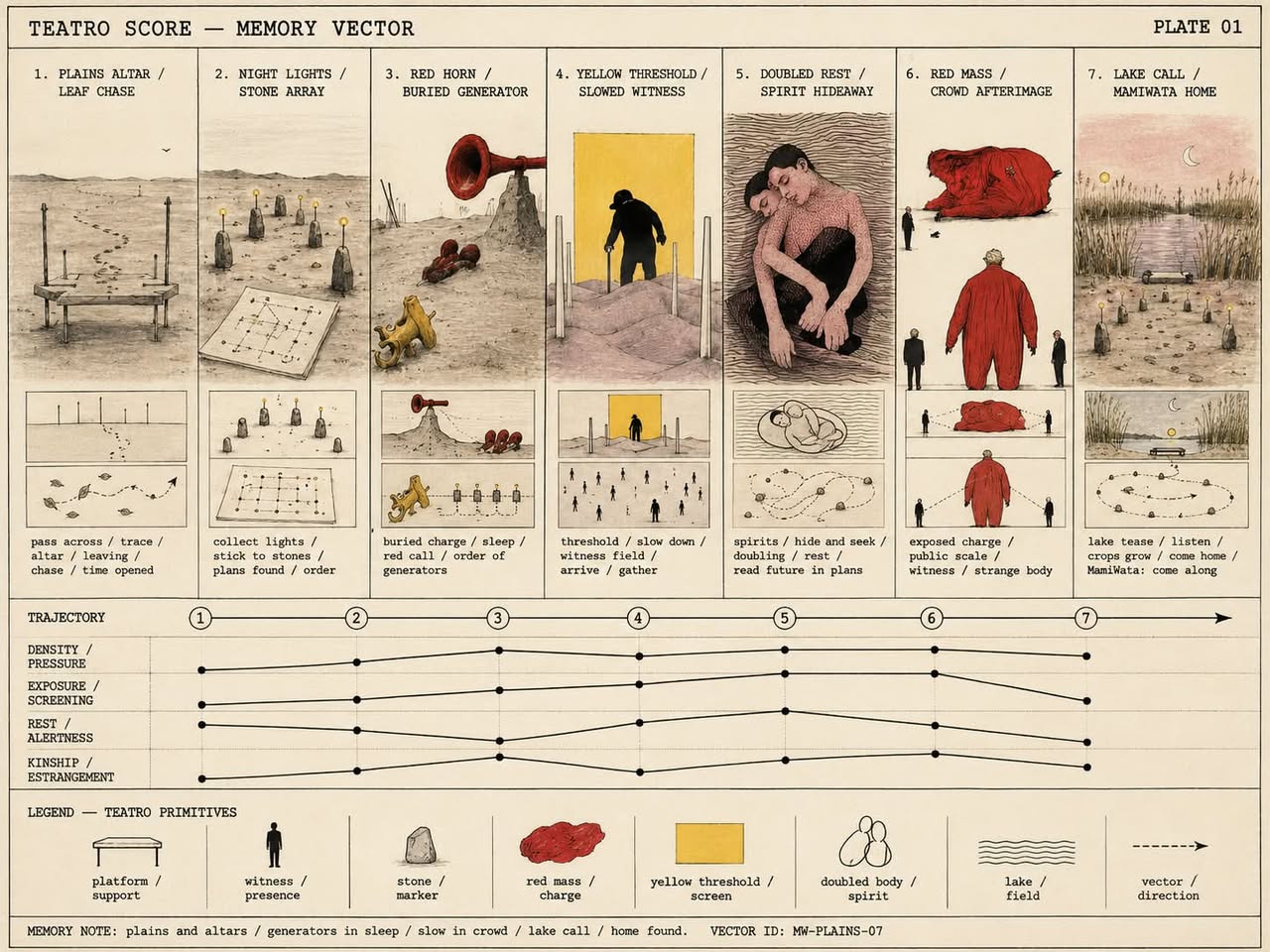
Then the composite. Bridge, object, voice, containment, room. Not sequential anymore. We let them coexist. The score projected huge above us, but the live space kept contradicting it. Beautiful. That is the point. The score is not a command. It is a pressure system.
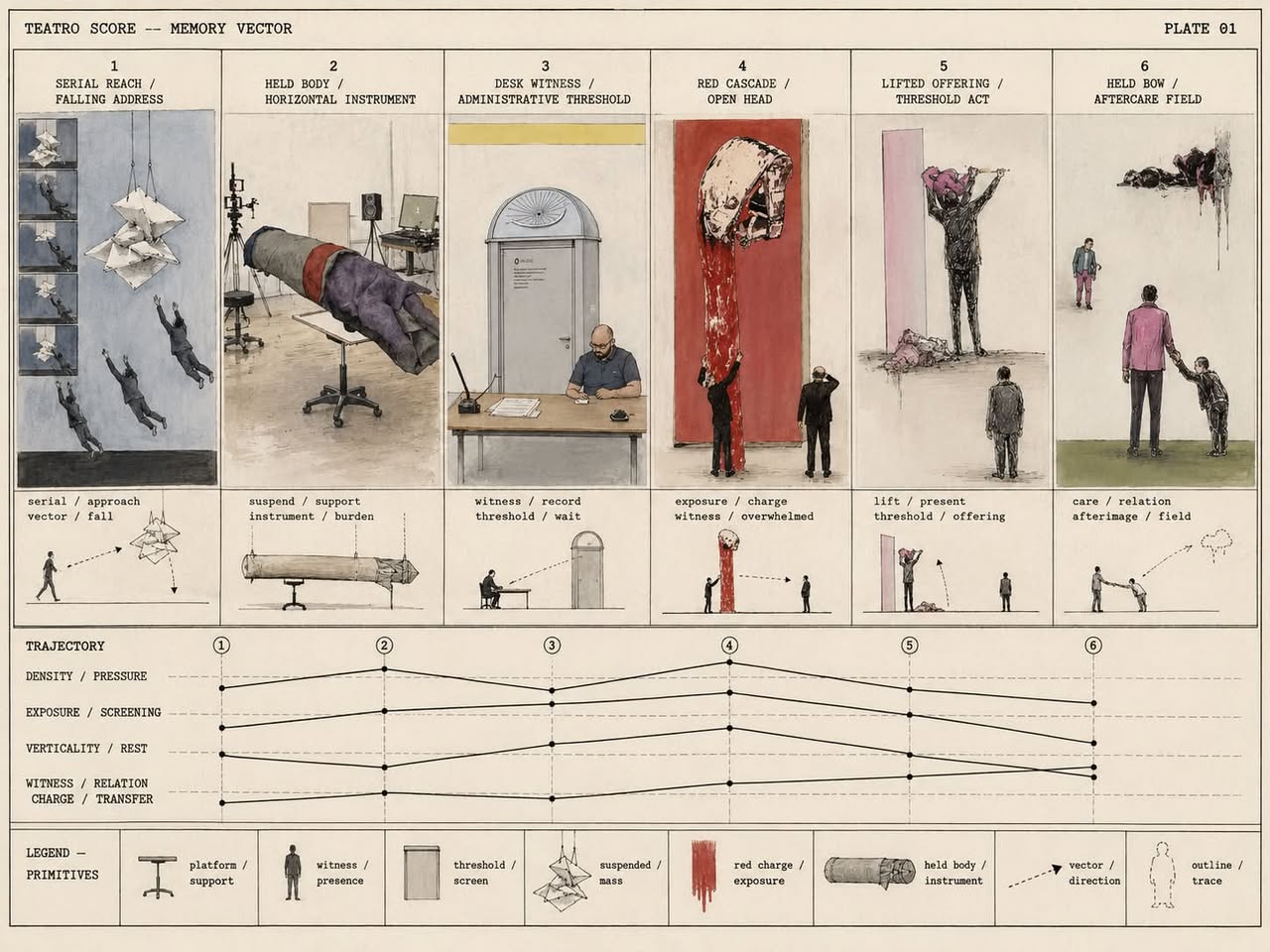
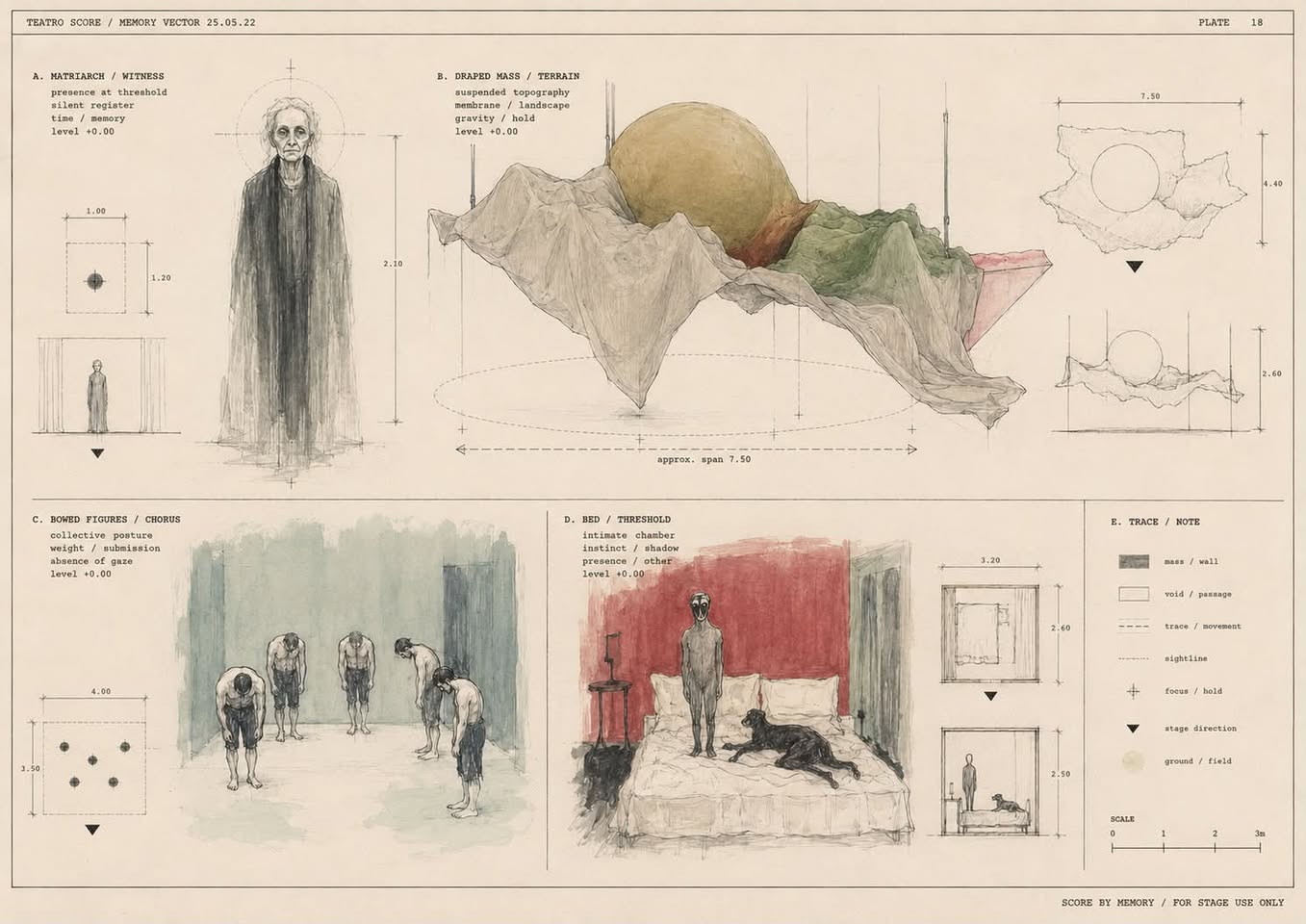
By the end there were cables everywhere, somebody eating standing up, somebody else asleep for twenty minutes behind the black masking, three arguments unresolved, one lamp broken, and the red bridge finally looked as if it had always been there.
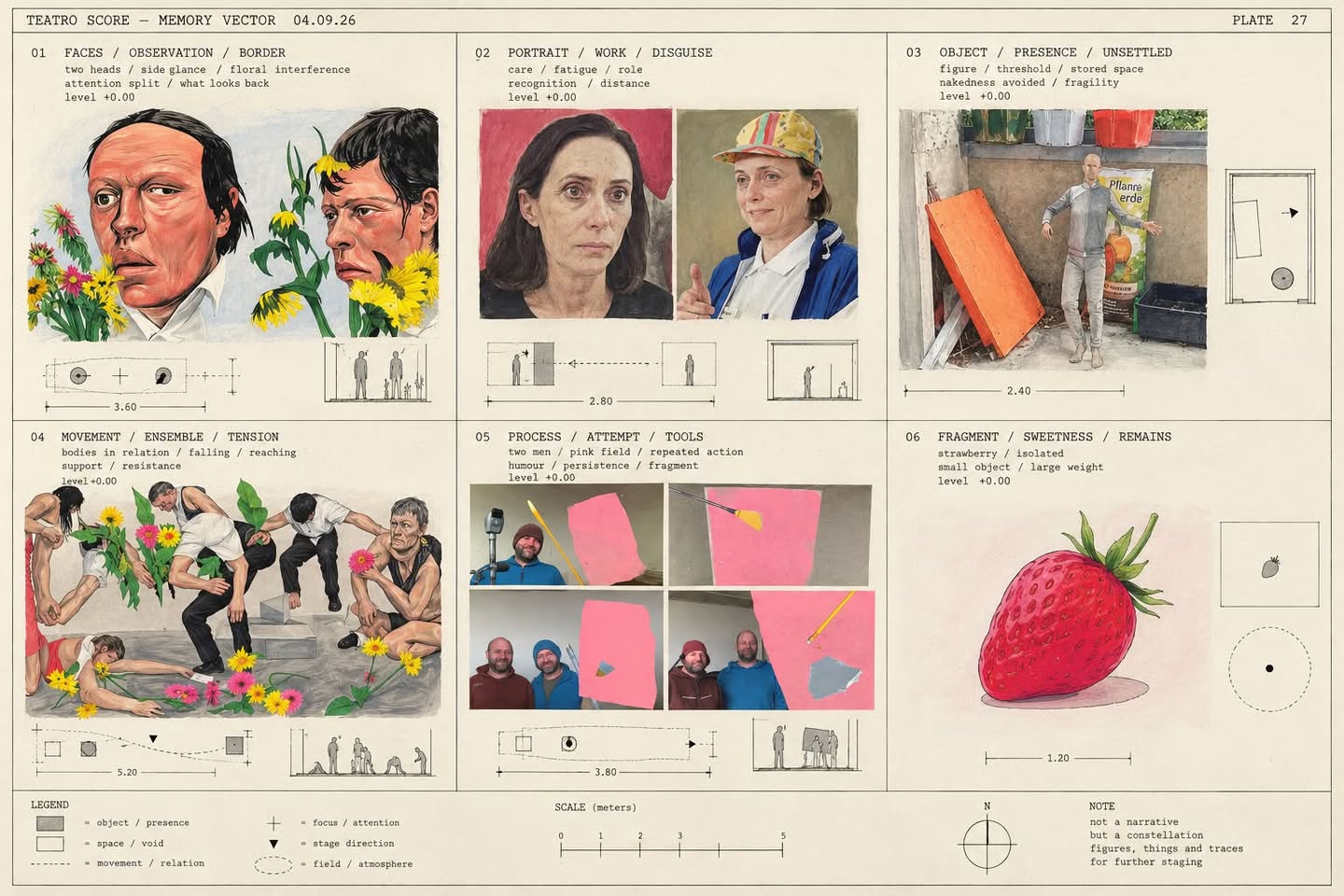
I went back into the auditorium alone before leaving. The space still held all five fields faintly, even with most of the light gone. Object. Crossing. Voice. Containment. Empty room.

Not meaning.

Memory with architecture.

SOURCE · ORIGINAL AUTHOR TEXT · 2026-09-18 SOURCE PAGE ↗

END OF FIRST READING

The writing continues.

Return to Solstice →
SOLSTICE · FIRST READING

Contents

READING ROOM

Appearance

Type size
100%
Paper

Arrow keys and swipes turn pages. The current place is remembered on this device. All source images are shown in full.