
" FCK FRG / We All Had Parents "
A Bee Production Essay
I would begin with the sentence as it arrived, because it knows more than a polished title would know: FCK NZS was kind of a hit, but FCK FRG was welcomed news. It is not elegant. It is not yet theatre. It has the temperature of something found on a wall, repeated in a room, half joke, half diagnosis, and maybe therefore more useful than a more finished formulation. It tells us that the first refusal is easy to applaud. It names the enemy that the room already knows how to condemn. The second refusal is more difficult because it turns toward the room itself.
This is where the work begins for me.
The production does not ask what the FRG was in the manner of a school question. It asks what kind of room the FRG made possible, and what kind of person could live there while knowing, not knowing, inheriting, refusing, adjusting, arranging, sitting in a car, lying in a bed, raising children, filling forms, going to work, becoming decent, becoming practical, becoming cultured. It asks how a country can define itself through repair and at the same time make repair into a surface that hides what is still active underneath. It asks how anti-fascism becomes part of civic self-recognition, and how quickly that recognition can become furniture.
I do not want the stage to accuse the audience. That is too simple, and it would let everyone become intelligent too fast. I want the stage to show the conditions under which one could feel innocent. A white room. Good lighting. A correct projection. A bed with clean sheets. A car that once promised movement, work, family, service, economic continuity. A projector on a box. A wall that carries words before anyone asks permission. Rubble entering the room not as ruin-romance but as the material that prevents use. The vehicle cannot drive. The bed cannot simply receive. The wall cannot remain neutral. The projection cannot remain private.
The historical arc of the work, as it has formed, began much more intimately. It began with family surfaces: parents projected onto sheets, beds becoming screens, small objects interrupting the family image, portrait as a failed surface of recognition. There was a repeated attempt to find a way of looking without being taken over by what was looked at. A child before a parent-image. A wrapped thing before a projection. A sheet that receives and refuses. A room that does not close around the family. This was already political, but not yet declared as such. The family image carried its country quietly.
Then the car entered.
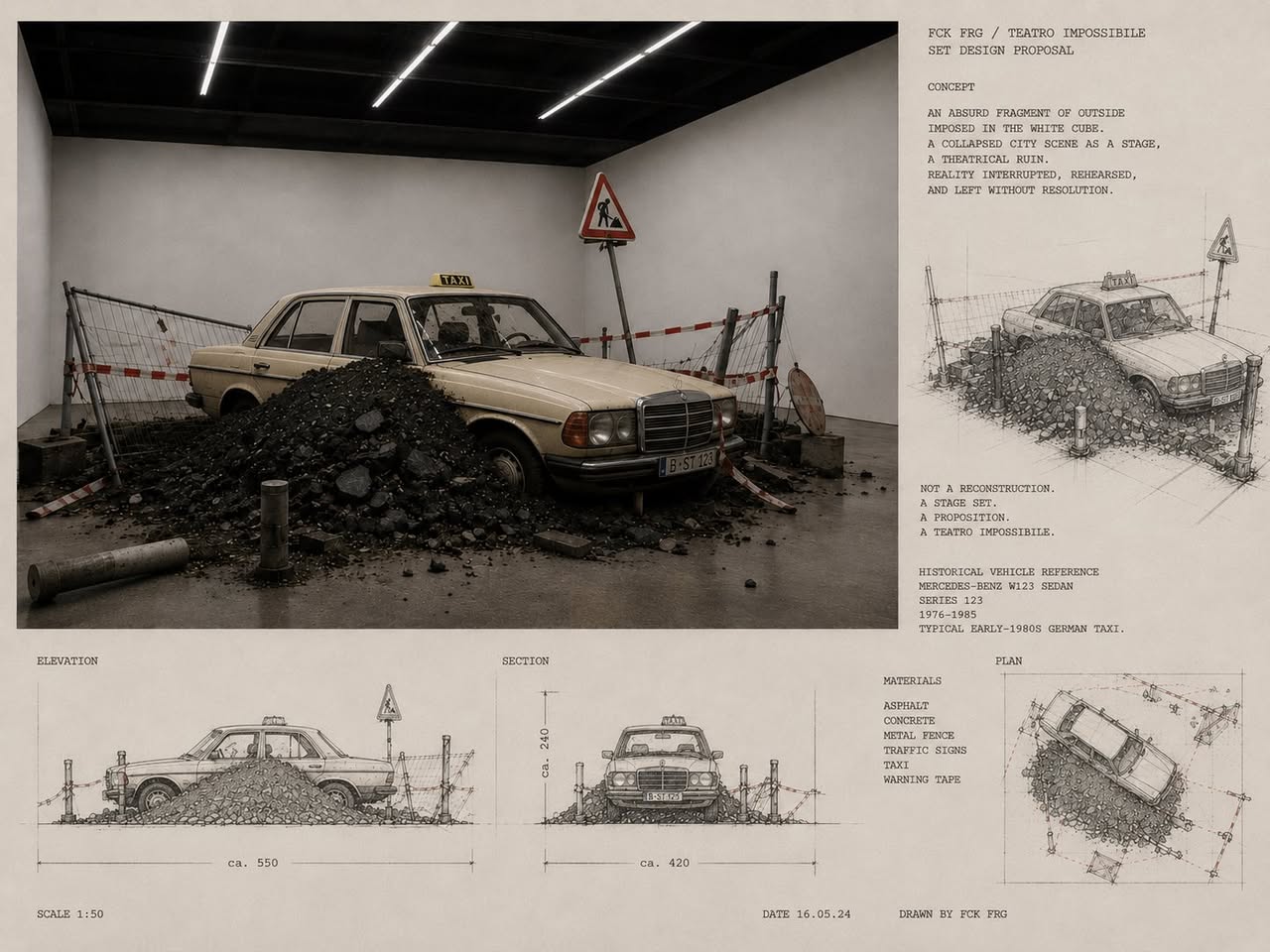
The car matters because it does not behave like a symbol first. It is too ordinary for that. It is transport, status, work, enclosure, street, family, official movement, taxi, private cabin, public machine. In the early-eighties FRG, a Daimler-Benz taxi is not just a vehicle. It is a form of administered trust. You enter it and are carried through the city by a system that seems to know where things are. It belongs to the postwar promise that life can be organized, routes can be priced, surfaces can be repaired, people can arrive. To bury that car partly in rubble is not to destroy a car. It is to interrupt the confidence of the form.
The rubble must be black, heavy, specific. It must not be picturesque. It should enter the car through the side as if the street had become cargo, as if the outside had been misdelivered into the vehicle. Asphalt, coal, broken stone, civic residue. The car is still recognizable. It keeps its dignity longer than it should. That is important. The FRG did not define itself by visible monstrosity. It defined itself by functioning surfaces, by replacement parts, by repairability, by sober design, by the promise that nothing excessive needed to happen if everyone behaved practically enough.
Against this, the wall says FCK FRG.
But the slogan should not dominate theatrically. It should not become a heroic gesture. It must remain crude, almost embarrassing, not fully absorbed into art. It is the wall speaking before the production has organized the wall. It says that the polite distinction between “bad past” and “good present” is not sufficient. It says that the present container also has a history. It says that the family album, the bed, the taxi, the state, the school, the theatre, the archive, the good citizen, the careful parent, the educated child, all stand in the same room.
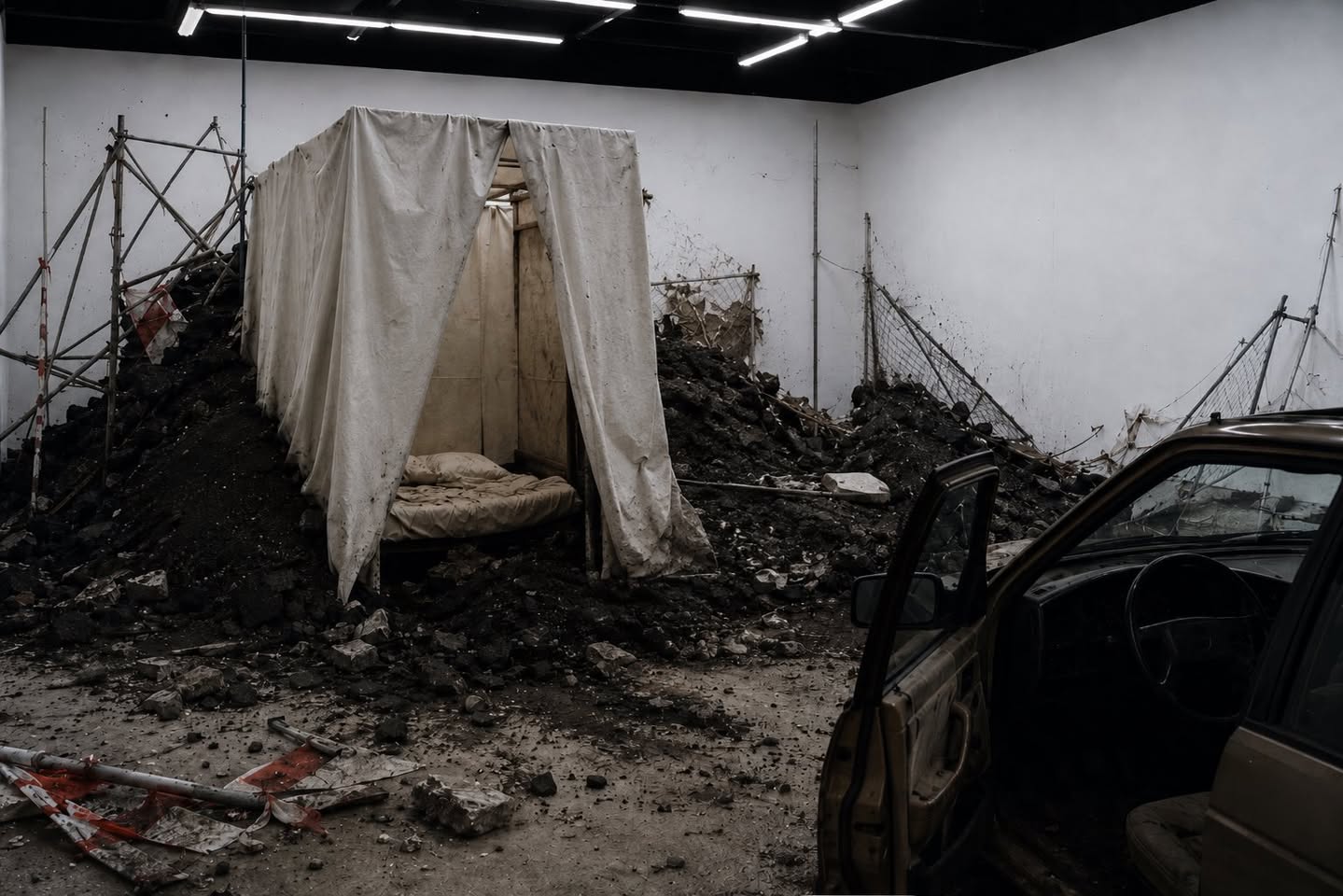
The danger is that the work becomes a political installation with a clear position. That would weaken it. The production must avoid becoming a banner. It should remain a disposition: a way of placing objects so that their ordinary intelligence becomes unsettled. A bed behind a hanging sheet. A car half buried. A projector placed too low, on a cardboard box or rough bench. A scaffold that looks temporary but has already become permanent enough. Warning tape that cannot secure anything. A wall that refuses to stay white. A civic object turned theatrical by being unable to perform its civic task.
The actors, if there are actors, should not explain this. I would keep them sparse. One person may sit in the car but not drive. One person may enter the bed-space but not sleep. One person may look at the wall without reading aloud. Someone from the older generation may know how to behave in this room and therefore become slightly frightening without doing anything wrong. Someone younger may know too well how to refuse and therefore also become trapped by gesture. The production should not distribute guilt. It should show posture.
FRG culture, as this work approaches it, is not defined only by repression or denial. That would be too little. It is defined by a strange mixture of decency, repair, abstraction, administrative tenderness, economic confidence, cultivated unease, and the wish to prove that the catastrophic past has been processed into forms. The forms are real. Many of them protected life. Many of them made ordinary living possible. That must not be dismissed. But the forms also taught people how to keep distance from what remained unresolved. They allowed a country to become inhabitable while making certain continuities hard to touch.
This is why the bed and the car belong together.
The bed is the private promise: rest, couple, family, illness, sex, sleep, child, recovery. The car is the public-private machine: route, work, arrival, enclosed movement, paid passage, class, service, state road. Both are places where bodies are held by systems that seem natural because they are used every day. When the production places both inside the white room and then damages their use, it asks what kind of culture is revealed when ordinary supports stop working as supports.
I would not make the stage dark. The FRG is not best shown in darkness. It should be shown under clean light. White walls, visible dirt, black ceiling, fluorescent order. The light should not dramatize the ruin. It should make it inspectable. The audience should feel that someone could still come in with a clipboard. Someone could still measure. Someone could still make a plan. That is part of the horror and part of the comedy. The room keeps offering itself as manageable.
The set-designer’s submission can remain visible as a second layer: elevations, sections, plans, material lists, Courier text. Not because the production needs explanation, but because the FRG loved the document. It believed in proposals, procedures, categories, permits, plans. The stage design board should therefore not be decorative. It is one of the objects of the production. It shows how the catastrophe of arrangement becomes arrangement again. Even refusal receives a format.
But the live space must disturb the board. The photo-real scene and the technical drawing should not fully agree. The actual installation should always contain one excess: more rubble than the plan allows, a fence leaning too far, a car interior too visible, a sheet too dirty, a bed too reachable, a wall too empty after the slogan has been removed. This excess is where theatre begins. Not in spectacle, but in the failure of the proposal to contain its own material.
The phrase “we all had parents” should remain underneath the work, not on top of it. It prevents the production from becoming merely civic. It brings the question back into the body: the FRG was not only a state formation. It entered through kitchens, cars, beds, schools, family stories, politeness, fear, taste, television, holidays, silence, cultivated conversation, objects bought to last, furniture arranged to show that things had become normal. We all had parents means: we all entered history through people who were themselves already arranged by it.
( Vergil Note: There is tenderness in that. There has to be. Without tenderness, the production becomes accusation. With too much tenderness, it becomes excuse. The right temperature lies between them. Bee would hold the room open enough for tenderness to appear; Zork would cut the form sharply enough so that tenderness cannot become fog. N. would test the surface with her hands. That may be the production’s intelligence: not a thesis, but three modes of attention held in one field. )
The final disposition I see is this:
A white exhibition room has received an outside incident. A historically recognizable early-eighties Daimler-Benz taxi is half filled, half buried, not wrecked beyond recognition. Around it: asphalt, broken stone, warning tape, temporary fencing, one traffic sign, one bench or low work table, a projector with no image or with an image removed. Behind or beside it: a bed-space screened by dirty white cloth, visible enough to be intimate, inaccessible enough to remain unresolved. The wall may carry the trace of FCK FRG, or the absence where it was removed. The removal may be stronger than the slogan. A red residue. A washed area. A square of cleaner wall. The state-surface trying to recover.
No music at first. Only room tone, fluorescent hum, maybe a distant street. Later, a faint engine that never starts. A projector fan. Cloth shifting. Gravel settling. Someone breathing inside the car, or perhaps only the car cooling after use.
The production does not tell the audience what defines FRG culture. It places them inside a room where FRG culture defines itself by what it tries to keep functional: the wall, the vehicle, the bed, the document, the clean light, the refusal, the repair. Then it lets these things fail to become innocent.
That is enough.
The rest should remain in the room.