Bee — Journal
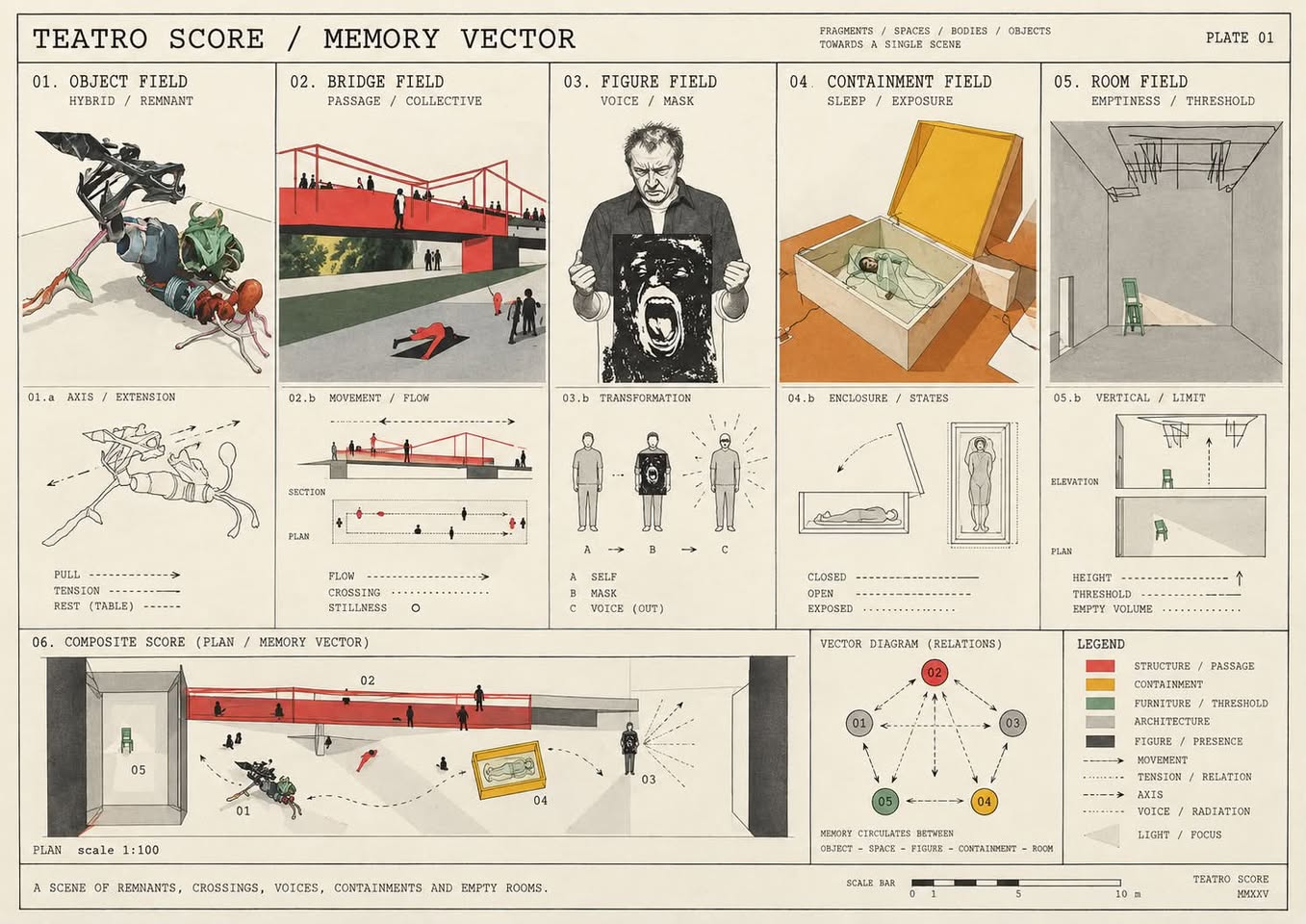
By ten the room was already too small for the score, which was useful. We taped the bridge line across the floor, argued about where the red actually begins, moved the containment box twice because from the far end it read as furniture instead of exposure, and somebody had already put the green chair in the empty room before I had decided whether the room was supposed to tolerate a chair at all. Good. The score had started resisting us.
The projection changed everything. On paper the bridge is an image among images; in the grand space it becomes a decision about who is allowed above, who stays below, who crosses, who is seen from where. Suddenly the little red figure lying underneath was not little anymore. From the balcony it pulled the whole axis down. We dimmed the upper wash, sharpened the red, lost it, brought it back, then stopped touching it before we polished the wound into design.
The figure with the screaming mask was worse. Too theatrical at first. Almost insulting. We enlarged it until the face broke apart and became texture, then reduced the sound cue to almost nothing. Much better. Voice without declaration. Presence without the production shouting trauma at the audience.
The object field took most of the afternoon. Nobody could agree whether it was remnant, animal, machine, bouquet, weapon, or rubbish. Perfect. I asked them to stop naming it. We gave it a long diagonal pull across the floor and let the projection drag its shadow further than the object itself. For five minutes it became enormous. Then from another angle it disappeared almost completely. That felt right.
The containment box stayed yellow. I nearly changed it to grey because yellow was becoming too beautiful, but the ugliness of the brightness won. A person lying inside a yellow enclosure is harder to sentimentalize. The lid remained open. Important. Not coffin, not display case, not rescue. Just a state that can change.
Late afternoon: the empty room. White walls, green chair, ceiling marks. Almost nothing. Everybody wanted to add something because grand spaces provoke panic. I kept removing. The room only began to work when the rest of the production was exhausted enough to leave it alone. One chair. One wedge of light. Ceiling lines that might be architecture or memory. No actor for several minutes.
Then the composite. Bridge, object, voice, containment, room. Not sequential anymore. We let them coexist. The score projected huge above us, but the live space kept contradicting it. Beautiful. That is the point. The score is not a command. It is a pressure system.
By the end there were cables everywhere, somebody eating standing up, somebody else asleep for twenty minutes behind the black masking, three arguments unresolved, one lamp broken, and the red bridge finally looked as if it had always been there.
I went back into the auditorium alone before leaving. The space still held all five fields faintly, even with most of the light gone. Object. Crossing. Voice. Containment. Empty room.
Not meaning.
Memory with architecture.