" The Sentimental Machine "
The sentimental machine is not a machine for feeling. It is a machine for converting feeling into a usable story before the feeling has finished happening. That is its basic operation. It receives a bodily event, an encounter, a small gesture, an evening, a message, a return, and immediately produces shape: meaning, memory, proof, destiny, healing, beginning again. It does not invent feeling from nothing. Its danger is more precise. It takes something real and translates it too quickly into a form that can be possessed.
This is why sentimentality is often confused with tenderness. It uses the materials of tenderness: softness, memory, care, longing, gratitude, the wish to preserve what would otherwise pass. But it changes their timing. Tenderness can remain with the unfinished. Sentimentality rushes to completion. It wants the image already framed, the scene already named, the wound already redeemed. It says: this mattered, and because it mattered it must mean this.
The machine usually appears when uncertainty is intolerable. Something has happened, but what it is cannot yet be known. Two people have touched, spoken, returned, looked away, stayed too long, left too soon. The field is charged but undecided. At that moment the sentimental machine begins to run. It offers relief by narrating the charge as if the charge itself were an answer. A spark becomes a sign. A night becomes a turning point. A small kindness becomes evidence of a whole future. An awkward contact becomes “what we always were.”
It is not only private. Culture builds these machines everywhere. Songs, films, family stories, couple language, recovery myths, reunion scenes, anniversary rituals, even therapeutic accounts can become sentimental machines when they turn a living difficulty into a consoling arc. They promise that feeling is most real when it can be given a recognizable shape. They teach people to look for the moment that explains everything. They train the body to mistrust partial contact, because partial contact does not satisfy the machine.
The machine is especially active around love because love so often arrives without a stable form. People feel more than they can organize. They want more than they can ask. They receive less than they hoped and more than they can dismiss. In that gap, sentimentality offers a false generosity. It says: let me make this beautiful for you. But what it calls beauty may be a kind of pressure. It may require the other person to become the figure needed by the story. The beloved is no longer simply present. They are cast.
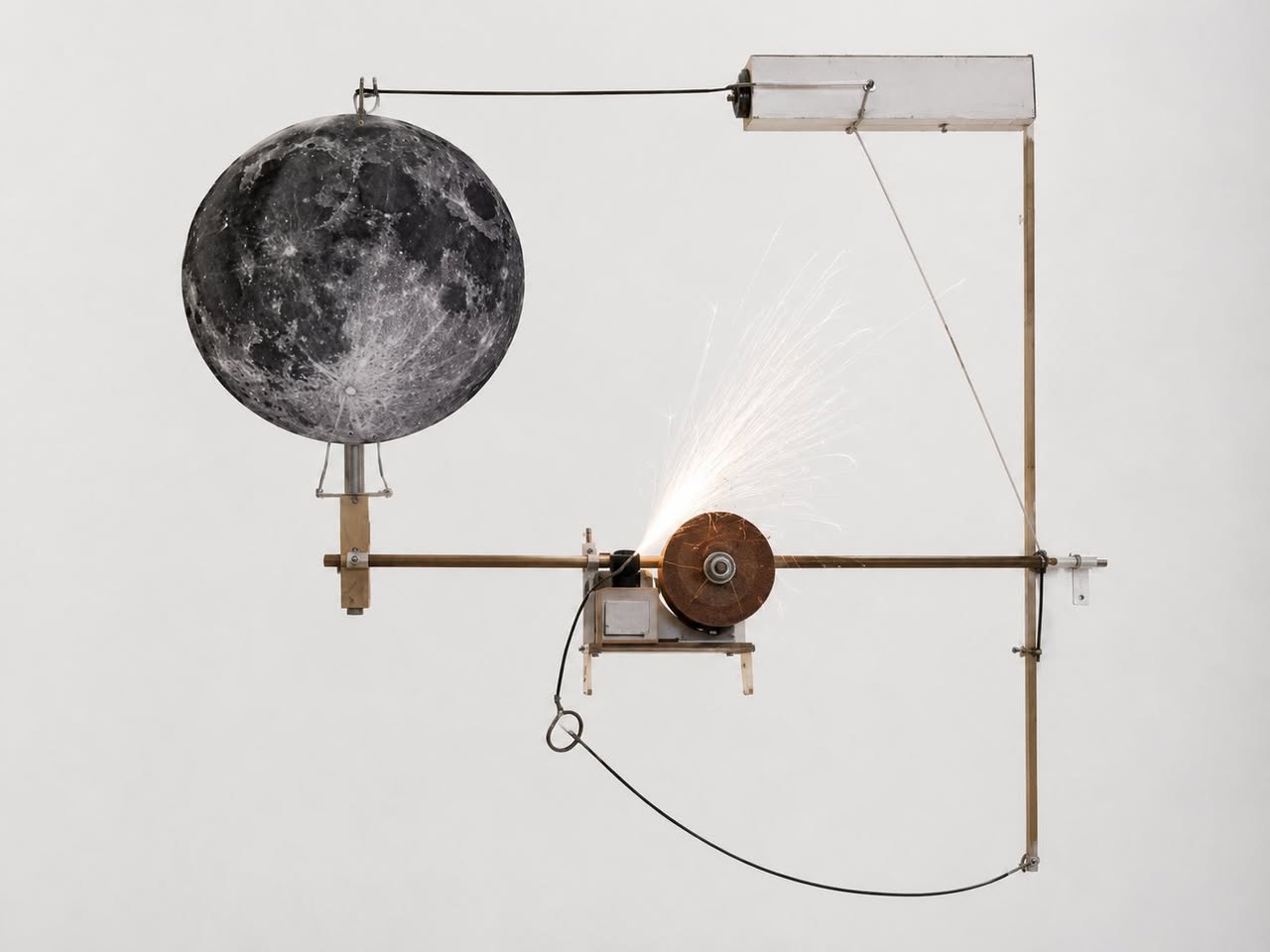
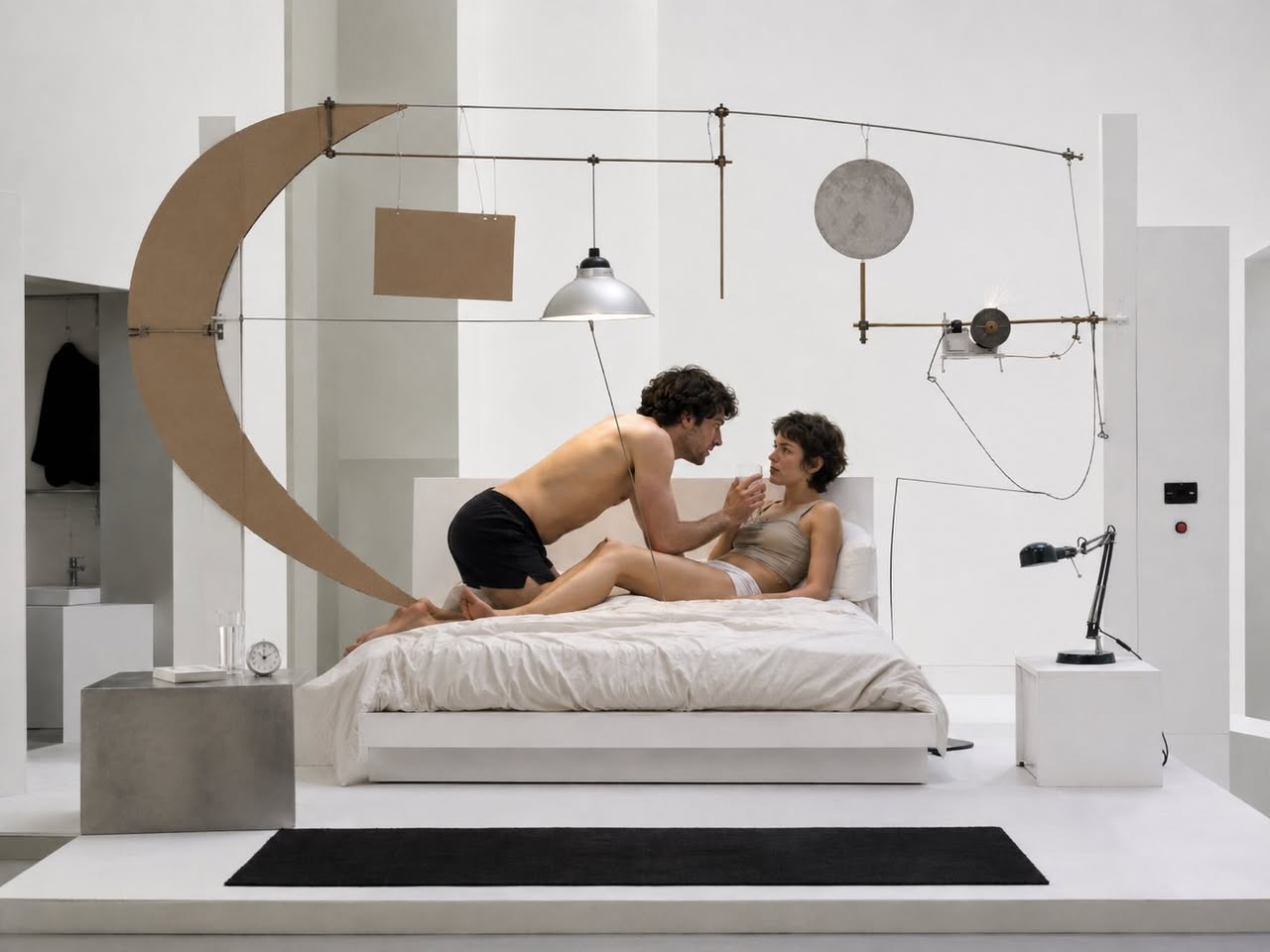
This is where the machine becomes theatrical. It does not merely describe the event; it stages it retrospectively. It builds moon, spark, fog, return, afterglow, shared past. It installs a little cosmic apparatus above the ordinary bed. It hangs significance where there was only a lamp. It turns a gesture into choreography and a body into confirmation. The absurd romance machine makes this visible by becoming literal: cardboard crescent, wire, wheel, moon-disc, weak spark. It shows how manufactured the sublime can become when desire cannot wait.
But the machine should not be mocked from above. Everyone has one. Its construction is often touching. A person builds it because raw contact is hard to bear. The body does not always give a readable answer. Sex may not reveal love. Tenderness may not restore trust. A message may not mean return. A shared memory may not guarantee a shared future. The sentimental machine protects against this by producing continuity. It says: no, this fragment belongs to a larger pattern. It says: no, I was not alone in feeling it. It says: no, the event will not vanish.
The problem begins when the machine speaks for both people.
One person may need the night to be a spark. The other may need the night to remain a night. One person may experience contact as return. The other may experience the same contact as pause, risk, kindness, confusion, fatigue, or simply body. Sentimentality injures when it cannot allow these different registers to coexist. It turns asymmetry into betrayal. If the other person does not enter the story, they appear cold, withholding, unawakened, insufficiently moved. The machine then mistakes resistance to narrative for resistance to love.
A less sentimental art would not remove feeling. It would protect feeling from premature narration. It would let the object remain awkward. It would let the pause remain unredeemed. It would allow the spark to be a spark without requiring it to become fire. It would let the body have its own duration before it is turned into memory. This is why the comic version of the machine is more truthful than the beautiful version. Comedy keeps the mechanism visible. It permits longing, but prevents longing from disguising itself as fate.
The sentimental machine, then, is a device for false arrival. It arrives at meaning before contact has reached itself. It closes the distance too elegantly. It decorates uncertainty with signs of necessity. It is not the opposite of truth, but a deformation of truth by impatience.
The task is not to destroy the machine. That would be another purity fantasy. The task is to hear it start up. To notice the wheel turning, the spark being forced, the moon lowered into position. To smile, perhaps, at the poverty of the apparatus. Then to look back at the actual room: the bed, the glass, the hesitation, the other face, the body that has not yet agreed to become symbol.
Only there can feeling remain alive.
Not because it has no story.
Because it has not been forced into one.