" Integration "
... Yes — got it . I made this image on purpose. Not to “illustrate a dream,” but to give my memory a stage that can hold it without collapsing into explanation.
Teatro is my trick for staying close: I reduce the story until it becomes geometry, rooms, distances, a few objects—then I let feeling return through the structure. The format pretends to be clinical, but it isn’t. It’s a way of touching what I normally either dramatize or avoid.
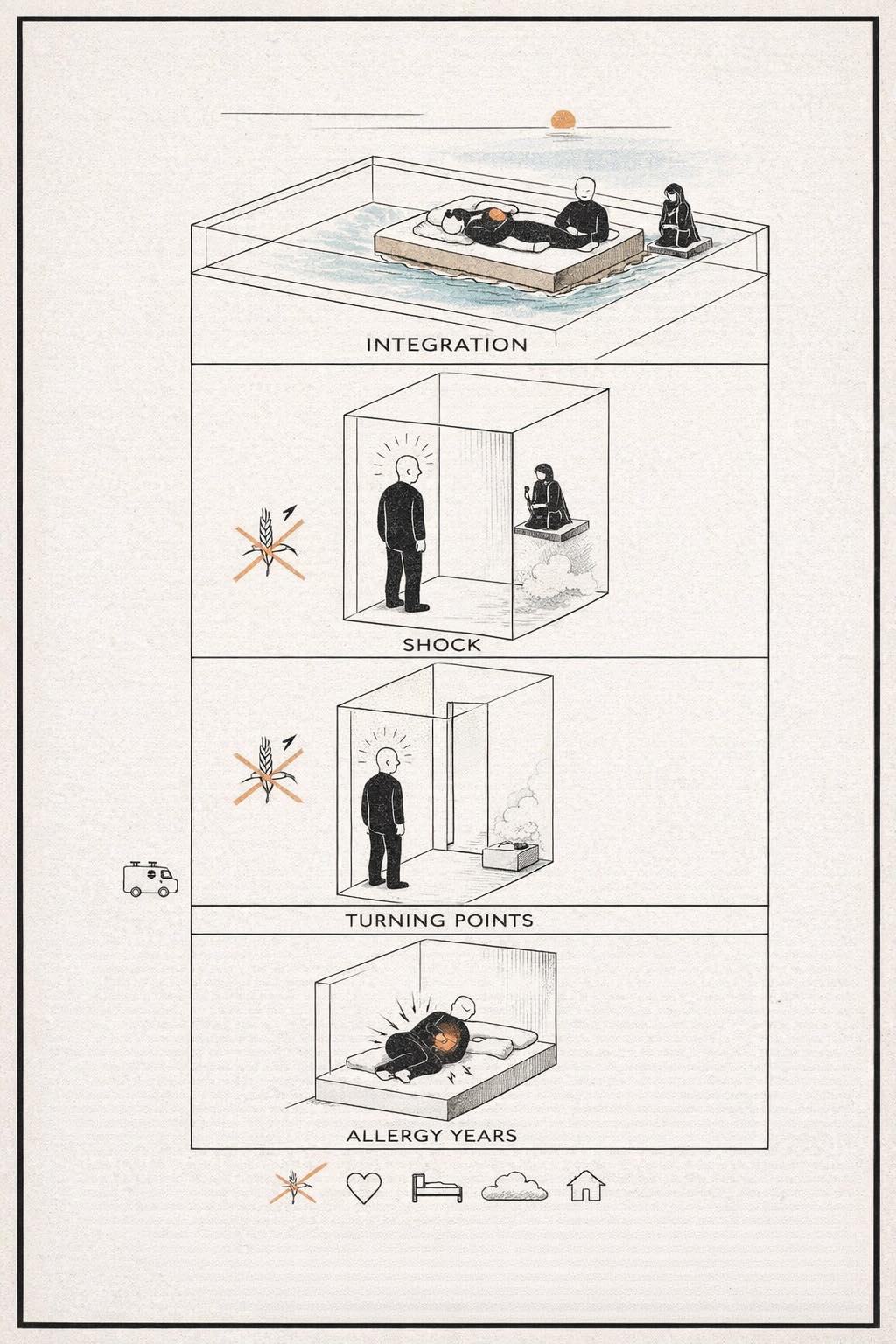
At the bottom I place the years that shaped my nervous system. I don’t call them trauma years or crisis years. I call them allergy years—because the most honest word for that period is sensitivity: my body over-reading the world, reacting too early, too strongly, too often. In that panel I see myself curled on the bed, pulled inward, guarding my chest like there’s a small, hot engine inside it. I remember how familiar that posture became: the pose of enduring, of waiting for my own system to calm down. The orange mark is not a metaphor I had to invent; it’s simply where I lived.
Above that I mark the first real shift: turning points. I don’t stage a breakthrough. I stage something smaller and more credible—an opening. A box-like room. A door slightly ajar. A small container smoking on the floor. The smoke is not catastrophe; it is evidence. Something is burning off. Something is being processed. I remember that change in my life never arrived as a clean decision; it arrived as ventilation. As the tiniest permission for air.
Then I move to shock. Not the dramatic kind—the kind where the system becomes narrow and bright. I draw myself standing in a cube again, lit from inside, with that ringing, overexposed clarity that comes when the body says this is too much. Across from me sits a figure on a small platform. I don’t need to name who that is. In my memory it’s the part of me that can observe without being swallowed. The cloud beneath that platform is the residue: the unsaid, the discharge, the part that doesn’t become language but still fills the space.
Beside it I put the little crossed-out symbol, like a warning label. This is important: I’m not accusing anyone. I’m not romanticizing my sensitivity either. I’m simply acknowledging that I have triggers the way bodies have allergens. Some things hit me harder than they “should.” Some situations enter my bloodstream too quickly. I want that fact to be visible without shame.
And then—because I needed it, because the whole project is a practice of repair—I place integration at the top.
I widen the container. I add water. I don’t flood the scene; I give it a basin, boundaries, a held element. In the middle I let the bed float. That matters to me: the bed is no longer only the place where I collapse. It becomes something that can be carried. I draw myself resting there with the same orange center, but now it reads less like injury and more like life: warmth, core, presence, the stubborn fact of being here.
I add an upright figure at the edge of the bed—the watchful self, the steady self—close enough to protect without controlling. And I keep the seated figure off to the side as well, because I don’t want false unity. In my real inner life, parts remain separate. Integration is not fusion. Integration is cooperation inside a shared frame.
The small sun is almost embarrassingly simple. But I include it because my memory needs permission to believe in time. I’m not promising a happy ending. I’m marking a horizon: a next morning exists. The system can settle. The water can hold. The bed can float.
When I read the icons at the bottom—irritant, heart, bed, cloud, home—I understand what I was trying to memorize:
I can build a home that includes my weather.
Not a home that denies sensitivity. Not a home that demands permanent strength. A home that has room for smoke, shock, tenderness, and rest—without my whole inner architecture having to be torn down each time something flares.
That’s what this illustration is for. It’s not a dream. It’s my way of making a memory inhabitable.