" Renaturalization " ( ' Less tomatoes, each one strong in taste ' )
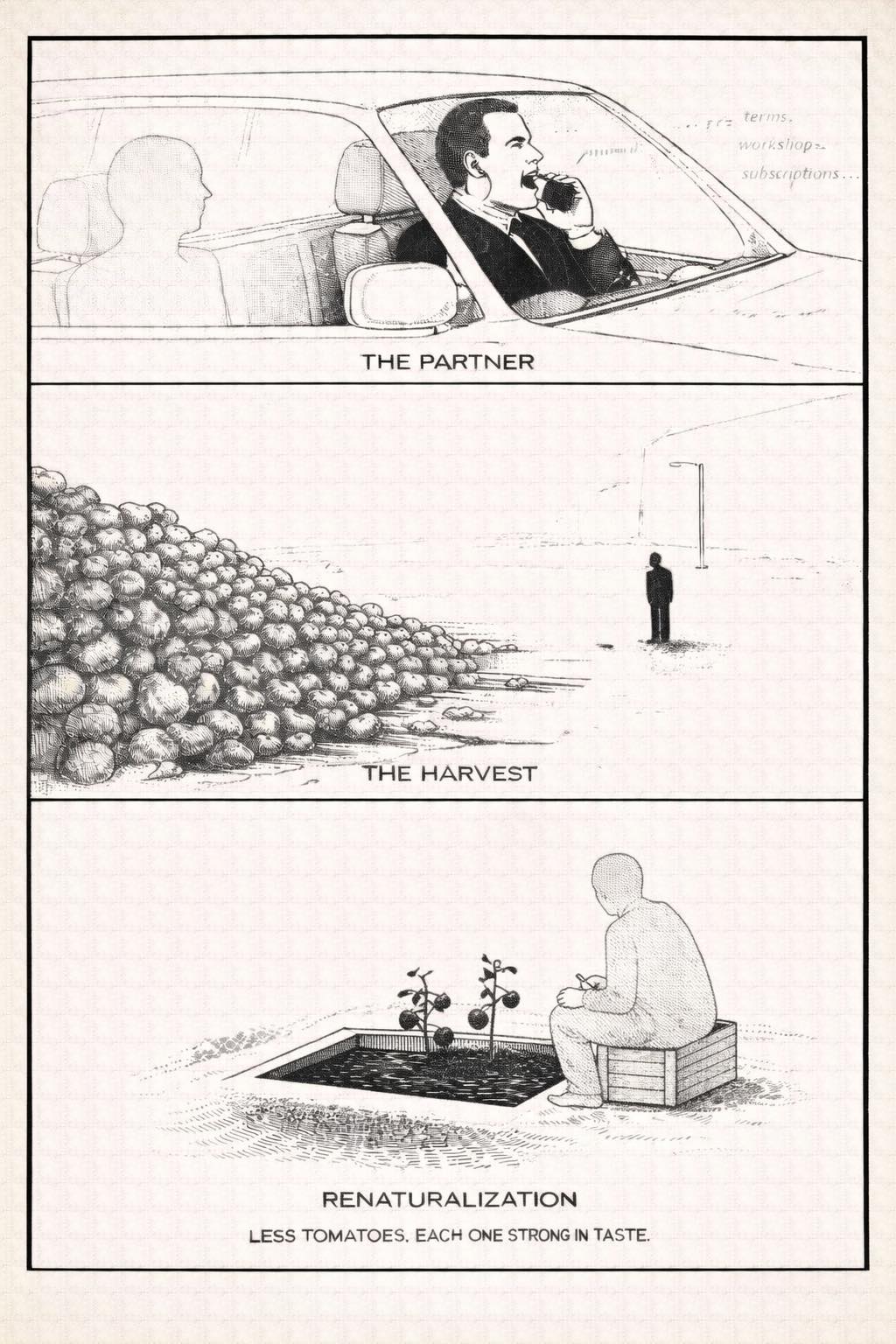
I wake with the sensation that I am moving while staying still—as if the night has put me in a vehicle and decided the route without asking. In the first image I am present, but only as a pale outline in the back seat: a silent passenger, a shape made of permission. In front of me sits the partner—not a romantic figure in a warm, shared sense, but a driver in the strictest meaning of the word: someone who steers. He holds something to his mouth—phone or radio—already mid-conversation, already tethered to obligations that are not mine. Even the space between us feels functional: he faces forward; I exist behind him, unaddressed. The windshield takes priority over the interior.
There is a cold clarity in that. Not cruelty—clarity. The night is showing me a structure: how easily partnership can become logistics, how easily “we” becomes “I am taken along.” And it’s not that I don’t trust the driver. It’s that I can feel my own outline: how thin I become when I don’t occupy the front seat of my own life.
Then the scene cuts wide open.
The world turns into a plain, almost empty, and on the left rises a mountain of harvest—round, heavy, piled high like a victory that has started to rot at the edges. It is abundance so concentrated it becomes grotesque: too many of the same thing, too much proof, too much output. The ground around it is messy with overflow. A single figure stands far away near a lonely lamppost, as if waiting for night to justify the light. He does not approach the pile. He does not celebrate it. He simply stands at a distance that feels deliberate—like someone who knows that not everything produced is meant to be eaten.
I recognize that feeling in myself: the fatigue that comes after “success,” the strange emptiness of having done what was asked and then discovering it doesn’t taste like life. The heap is impressive, yes. But it is also an accusation. It asks: Was this the point? And in my body I feel the answer forming: no—at least not in this quantity, not in this sameness, not in this scale that demands storage, management, decay.
The last panel is quieter, almost tender, like an antidote.
I sit beside a small, square basin of dark water—contained, cared for, bordered. Two tomato plants rise from it with a few fruit: not a harvest you can brag about, not a pile you can measure, but something living that insists on time. The caption lands like a corrective sentence spoken slowly: Renaturalization. Less tomatoes. Each one strong in taste.
I understand this as a vow the night makes on my behalf.
Not a vow to work less out of laziness, but a vow to return to the scale at which a thing can be loved. To choose cultivation over accumulation. To stop equating volume with value. To accept that “less” can be the condition for flavor—for presence, for real nourishment, for pride that doesn’t curdle into exhaustion.
And suddenly the three parts connect in me like a simple circuit:
When I let someone else drive, I end up living inside their calls, their terms, their subscriptions—their forward momentum. When I live only for output, I create a pile that looks like proof but feels like waste. When I turn back toward something smaller—something that can be tended—I return to my own seat. I become a person again, not an outline.
So this night doesn’t tell me to leave the partner. It tells me to become a partner to myself: to claim the steering wheel where it is mine to claim, to refuse the false romance of heaps, and to choose a quieter kind of growth.
Less tomatoes.
Each one strong enough to matter.