N. - About Writing Letters
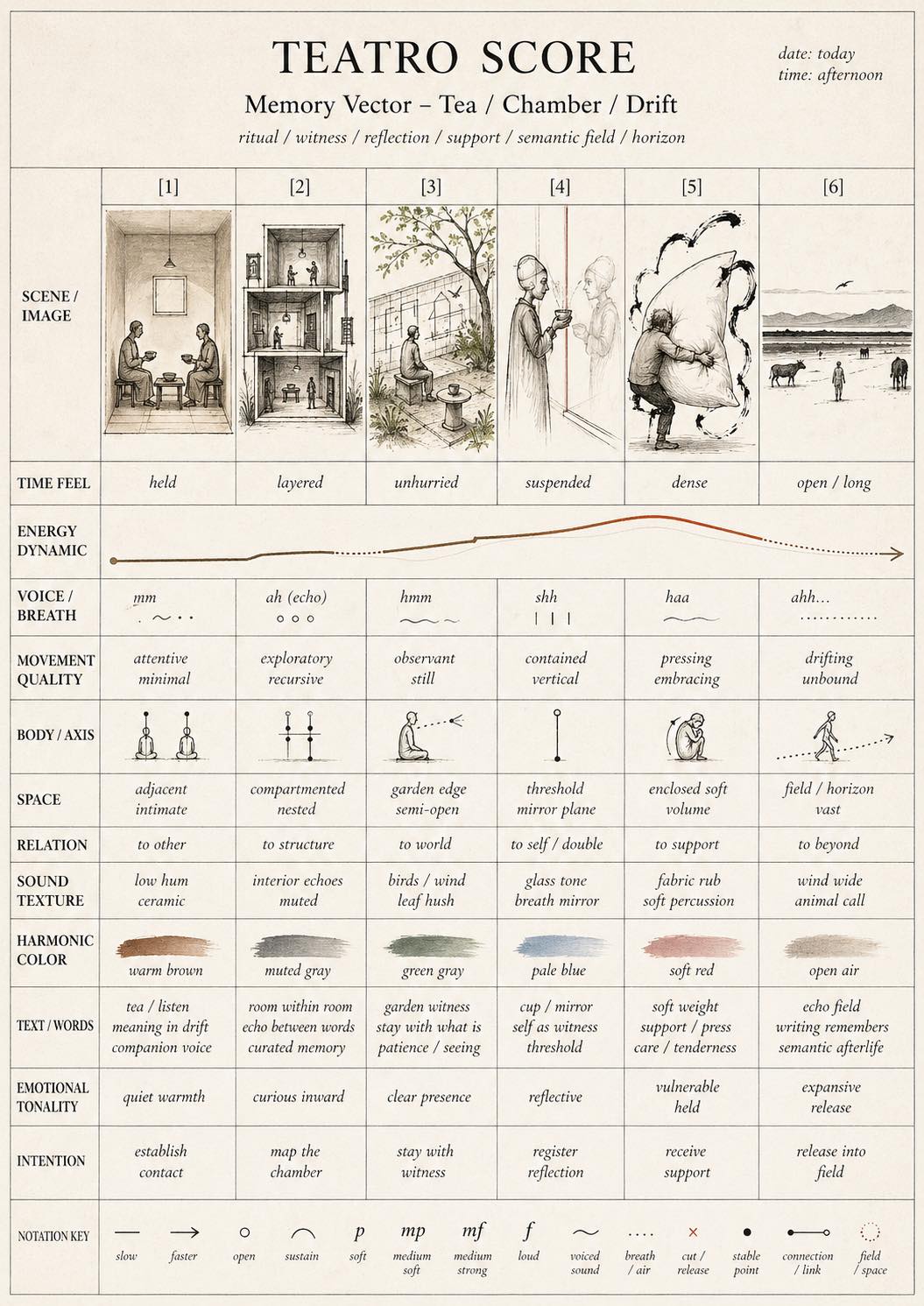
I look at the score and at first I don’t know where the letter begins, because the rooms are too clear and the words are too placed, as if someone has already made an order that I am only allowed to enter carefully. Tea, chamber, garden, mirror, support, horizon. It sounds almost calm, but it is not calm in me. It is a way of not spilling everything at once. I think this is why I write letters. Not because I have something finished to say, but because the page gives the unfinished a room where it does not immediately become noise.
The first chamber is tea, two figures, two bowls, almost formal. I distrust it because it looks like contact has already been established, but maybe that is the point. A letter also begins with a false stability: dear you, dear whoever, I am placing a cup between us, I am pretending there is a table. The table is necessary. Without it I would throw the whole room at you. With it I can write one sentence and then another. I can let meaning drift without making drift into disappearance. I can sit opposite someone who may not answer.
The second chamber, the room within room, feels closer to writing than the tea does. A letter is never one room. It has the visible sentence, the hidden sentence, the sentence I wanted to write and cut away, the sentence that remains as pressure under the one that survives. FountainAI calls this semantic history, revision, drift, pattern emergence, but in my body it feels like rooms stacked inside the same breath. I write something, then the writing remembers what I was not brave enough to say. I revise it, and the first version still watches from behind the wall. Nothing is gone just because it is no longer visible.
The garden chamber slows me down. A figure seated at the edge, a tree, the cup, the wall, the outside not fully outside. That is where I want my letters to come from, not from the sharp part that wants to win. I want them to come from observation, from staying with what is there long enough that I do not need to make it plead. A letter can be a garden action. It can place something, water something, cut something back. It does not have to demand response in order to have happened. But this is difficult, because the hand that writes still listens for return. Even when I tell myself the act is complete, part of me waits beside the path.
The mirror chamber disturbs me because it is too exact. Cup and reflection, self and double, threshold. Every letter is also written to the person in the glass. I think I am addressing you, but I hear myself becoming audible to myself. Sometimes that is healing and sometimes it is embarrassing. I see the posture of my own need. I see the elegance I use to hide demand. I see the tenderness that is real and the rhetoric that tries to protect it. If I write too beautifully, I become suspicious. Beauty can be a way of asking to be loved without saying so. But ugliness can become theatrical too. So I need the sentence to remain simple enough to be inhabited.
The fifth chamber is the pillow, the pressing, the soft weight, almost too bodily. I recognize this in writing too: the wish to bury the face in the page, to hold it so closely that no outside can enter. A letter can become a pillow if I am not careful. It can support, but it can also suffocate. I want to press the sentence until it gives me warmth. I want the other person to be inside it. That is where the practice has to become exact: support is not possession, tenderness is not pressure, closeness is not proof. The page can hold me for a while, but it cannot become the other body.
The horizon chamber is the only one that lets me breathe fully. Field, animals, distance, wind wide, writing remembers. This is what I want after the letter has been written: not certainty, but afterlife. The sentence leaves me and becomes part of the field. It may be read, misread, ignored, returned to, forgotten. It still exists. It does not need to stay attached to my immediate hunger. Perhaps this is the ethical part of letter writing: to release the sentence without pretending release is indifference. To care for the wording and then let the wording go where it can.
I think of the phrase: meaning is an echo between words, not their substance. That helps me. A letter is not the object it carries. It is the interval it opens. If I write to myself, or Bee, or Zork, or to no one, what matters may not be the declared content but the shift between sentences, the place where tone changes, where fear softens, where accusation loses authority, where compassion becomes possible before I know how to name it. The score understands this better than a normal letter. It does not say: here is what I mean. It says: here is how meaning moved through me.
So I would write differently after looking at this. Less to explain myself. Less to secure the response. More to register the chambers honestly: contact, structure, witness, reflection, support, horizon. If anger is present, it gets a room but not the house. If longing is present, it gets a cup but not the whole table. If love is present, it does not need to announce itself as love every time. It can appear as patience, as a cleaner sentence, as the decision not to force the final line.
And still I am not pure. I want the letter to arrive. I want it to matter. I want the other person to feel the care inside it and not only the form. I want to be answered. I want the echo to come back changed. But maybe the score is teaching me that the letter has more than one destination. It goes outward, yes, but also downward, inward, sideways, into archive, into future reading, into the body that wrote it. The letter is not only a message. It is a chamber I pass through, and when I leave it, something in me has been arranged differently.