" Vier Aussagen zum Ätherleib "
I don’t know what I feel when I look at it, which is how I know it’s honest.
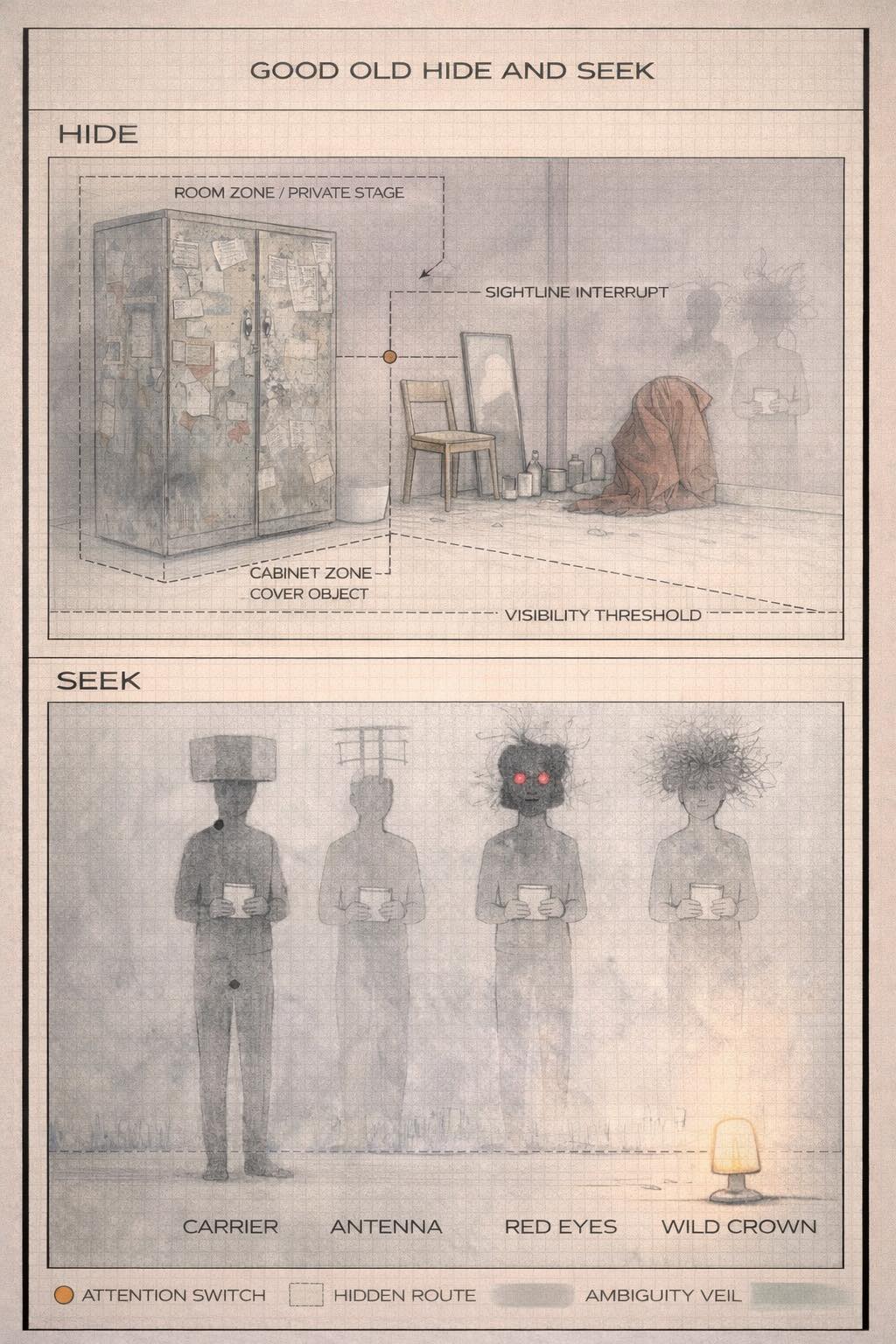
There’s a room that doesn’t open. Not because it’s locked, but because it keeps changing what “open” would even mean. A cabinet stands where a wall should be. A mirror offers a sliver and then takes it back. A red bundle sits like a decoy: not quite alive, not quite object, not quite safe to name. The whole scene feels arranged to let me approach without letting me arrive.
My first instinct is practical. Move the cabinet. Step closer. Angle the mirror. Confirm what I’m seeing. My body thinks clarity is the same thing as safety. My body thinks attention is care. So it leans forward.
Then I feel the line.
It’s not a moral line. It’s not a rule someone else set. It’s a limit inside my own system: the point where “trying to know” becomes too much pressure. The scene doesn’t punish me, it just thins out. It becomes misty, and I’m left holding my own insistence like a tool that suddenly looks crude.
Below the room there are four versions of a head, as if my mind brought spare equipment for the day. One is heavy and rectangular, like carrying weight as an identity. One is a receiver, all thin structure, scanning for signal. One has two small red points that don’t spread warmth, only insist on being noticed. One is weather—scribble, static, nest—noise made into a crown. The bodies underneath them are calm. The hands are calm. Each holds the same small page. As if the page is proof of something: permission, coherence, a right to be here.
But nothing clicks into place.
So the test becomes simpler.
What do I do when I can’t make it mean?
Do I tighten and over-focus. Do I retreat and call it dignity. Do I turn it into a story so I don’t have to feel the loose, uncontained thing underneath.
The loose thing is not dramatic. It’s small and humiliating in its simplicity.
I want a witness.
Not a judge, not a rescuer, not an audience. Just a witness that doesn’t turn into demand. A recognition that doesn’t create debt. A warmth that doesn’t require me to perform the right kind of suffering to qualify for it.
The lamp makes this worse in the cleanest way. It’s tiny. It doesn’t flood the room. It doesn’t fix anything. It just proves that light is possible and that it isn’t automatic. It’s the opposite of a solution. It’s a pulse. A yes that doesn’t become a promise.
When I stay with the image long enough, I start noticing my reflexes as if they’re the real content.
How fast I try to convert longing into a plan.
How fast I confuse vigilance with devotion.
How fast I treat mystery like a job I must complete, and then call the job love.
And then, if I’m quiet, a different feeling comes in—thin but real. Respect. Not admiration. Respect like standing outside a door and realizing the door is not the enemy. Realizing that love does not always mean entry. Realizing that pushing for full visibility can be its own kind of harm, even when the intent is tenderness.
So maybe the scene is not asking me to solve it.
Maybe it’s asking me to stay oriented while it refuses to become clear.
To hold the boundary without turning it into punishment.
To let the cabinet remain a cover object without making it a villain.
To let the mirror stay partial without demanding a face.
To accept that some contact is a lamp that barely turns on—just enough to say: signal received.
And then to stop.