Bee sits in her office after everyone has gone.
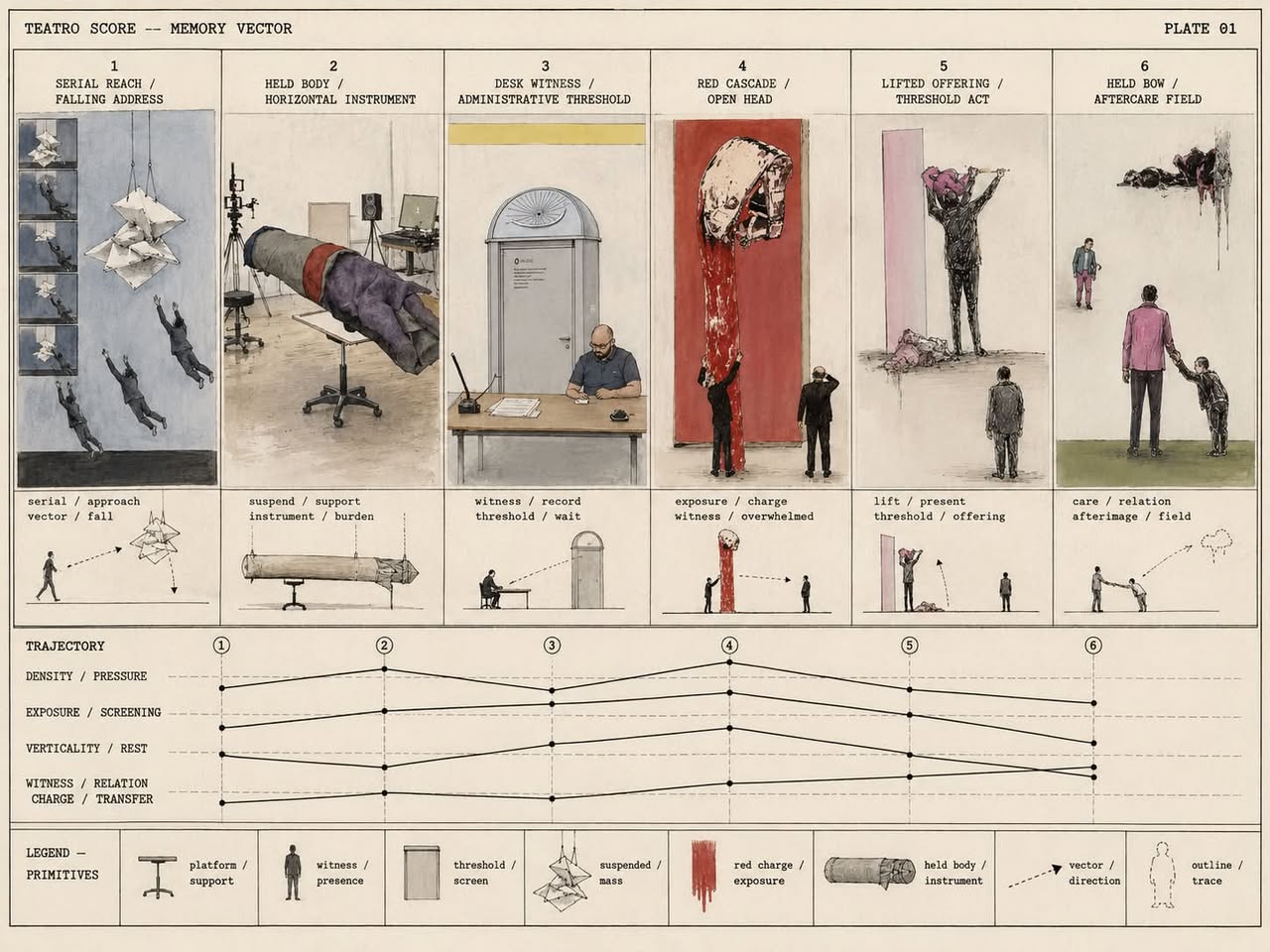
The score is on the table, but she does not read it as six panels. She knows there is a story inside it, the way there is a story inside a seed before anyone has seen the tree. For a while she does nothing. The window is open a little. There is the dry sound of paper shifting when the air moves through the room, and somewhere downstairs a door closes. Then she sees the first woman. She is very young and dressed in a blue so bright it seems almost wet. She is running across a dark floor toward something suspended above her, a white construction made from folded pieces, wings perhaps, or a broken house, or simply matter that has forgotten what shape it wanted. Each time the woman reaches it, the thing moves further away. Each time she jumps, another version of her remains behind. Soon there are several of her, all reaching at different moments.
Bee watches them without calling them back. In the story the gods have given the young woman a peculiar punishment. Whatever she desires becomes visible just before it leaves her reach. Not because she has done something wrong. The gods do not always punish for reasons. Sometimes they merely expose a law. She learns to leap. Her body becomes very good at leaving the ground. Years pass this way. One morning she catches the white thing. It is not light. That is the first surprise. It becomes enormous in her arms, longer than a person, wrapped in purple and grey cloth with a red band around its middle. She carries it into a room full of instruments. Cameras, stands, speakers, cables, machines whose small lights say that somebody is still watching. She lays the thing horizontally across a support. Only then does she understand that what she has been chasing is a body. Perhaps her own. Perhaps not. It has no face she can recognize. She touches the fabric and feels warmth beneath it. The warmth is unmistakable. This is not a symbol. There is weight under her hand. There is heat. The cloth catches slightly against her fingertips. She smells dust, metal, wool.
Bee, sitting at her desk, remembers this part very clearly although it never happened. The young woman does not uncover the body. Instead she waits. That is how she becomes older. The next woman appears behind a table. Her blue has darkened. Her hair has been cut short. She wears glasses now. In front of her there are papers she is expected to understand, and behind her is a grey door with a half-circle above it like a mechanical sunrise. People come to the table and ask whether they may enter. She does not know what is behind the door. Still, she is the one who must answer. This is the second law of the story: sometimes a person becomes the guardian of a threshold before she has crossed it herself. So she reads names. She moves papers from one side of the table to the other. She says yes. She says not yet. She says come back tomorrow. She says nothing when nothing is required. Outside, the day is impossibly yellow. Bee can feel the sun on the younger woman’s forearms. She can feel the slight stick of the tabletop against her skin. She can hear a fly moving repeatedly against the window. Reality has become very bright around the administrative act, almost indecently bright.
Then one afternoon the door opens by itself. Behind it is red. Not a room. Red. A great red vertical field, and from high above something like a head bends forward and opens. What pours from it is not blood, although at first everyone thinks it is. It is every unsaid thing that has acquired weight. It comes down in a thick red cascade. The woman at the desk stands. There are other witnesses now. One reaches toward the falling red as if it might be caught. Another stands back with a hand at his head. Bee knows what happens next because this is the part all myths know: what cannot remain inside takes form outside.
The woman does not run. The red reaches her shoulders, then her arms. It is warm. It smells faintly of iron and roses and hot pavement after rain. It stains her clothes but does not wound her. Instead it gives her another body. She steps out of the red larger than before. Not stronger. Larger. There is more of her to carry.
In the fifth part of the story she has become a woman dressed in black, standing beside a pink wall. Something small and bright has fallen at her feet. She bends and lifts it. At first Bee thinks it is a child. Then a bundle. Then an animal. Then another version of herself. It keeps changing while she holds it. She raises it above her head because she believes this is what must be done with something precious: lift it into visibility. But the gods have changed the law again. What is loved does not necessarily need to be raised. What is carried does not necessarily need to become an offering. The woman discovers this only because her arms begin to shake. There is another person standing some distance away. He does not intervene. He watches. The woman lowers the bright body. It remains bright. Nothing is lost by bringing it closer to the ground. Bee smiles at this. Barely. The office is almost dark now, but in her mind the pink is still enormous.
Then the story moves into its last form. There is a green field. A woman in a violet jacket stands with her back to Bee. Beside her is a smaller figure, bent almost double. Above them something dark remains suspended in the air, a remnant from the earlier transformations, still dripping a little. The woman does not try to remove it. She takes the smaller figure’s hand. That is all. The remarkable thing is how difficult this is. The first woman knew how to leap. The second knew how to carry. The third knew how to wait at the threshold. The fourth survived what poured down. The fifth learned to lower what she had raised. But this woman must remain standing while another body cannot. No spectacle helps her. No god appears. There is only the hand. Bee can feel the small palm inside hers. Warm, slightly damp. A pulse at the wrist. The grass under both pairs of shoes. Evening air moving against the side of her face. For a moment the smaller figure begins to rise. Then stops. Bee does not pull.
This is where Ovid would have given them feathers, bark, stone, water. The body would change so the story could end visibly. Bee imagines another transformation. The woman stays a woman. The smaller figure stays bent. The dark thing remains overhead. The field remains green. Only the relation changes. The hand that had once reached upward now learns another direction. It can reach sideways.
The woman feels all her earlier selves enter her at once: the blue girl jumping toward the impossible object, the woman carrying the long sleeping body, the clerk at the threshold, the red-covered witness, the black figure lifting the bright bundle. They are not replaced by one another. They stand together for a moment in impossible colors. Blue. Purple. Red. Pink. Green. Bee sees them across the office floor as clearly as chairs. She does not ask which one is the true self. That question belongs to another kind of story.
In this one, transformation has not been the loss of one body and the arrival of another. It has been the discovery that every body leaves a way of standing behind. The youngest one is still reaching. The tired one is still carrying. The witness is still seated at her table. The red woman is still wet with what came through her. The one in black is still deciding whether to lift or lower. And the last woman stands in the field, holding somebody’s hand without knowing whether they will straighten.
Bee remains in her office for a long time after the story has finished, or rather after it has stopped asking to be continued. Outside, someone crosses the courtyard. A bicycle light passes through the window and briefly moves along the ceiling. For an instant the office becomes bright blue, then red, then ordinary again. Bee looks at the score. Six panels. Nothing in them says what happened. Everything in them remembers how it felt.