Three Floors
I come up through three floors of myself.
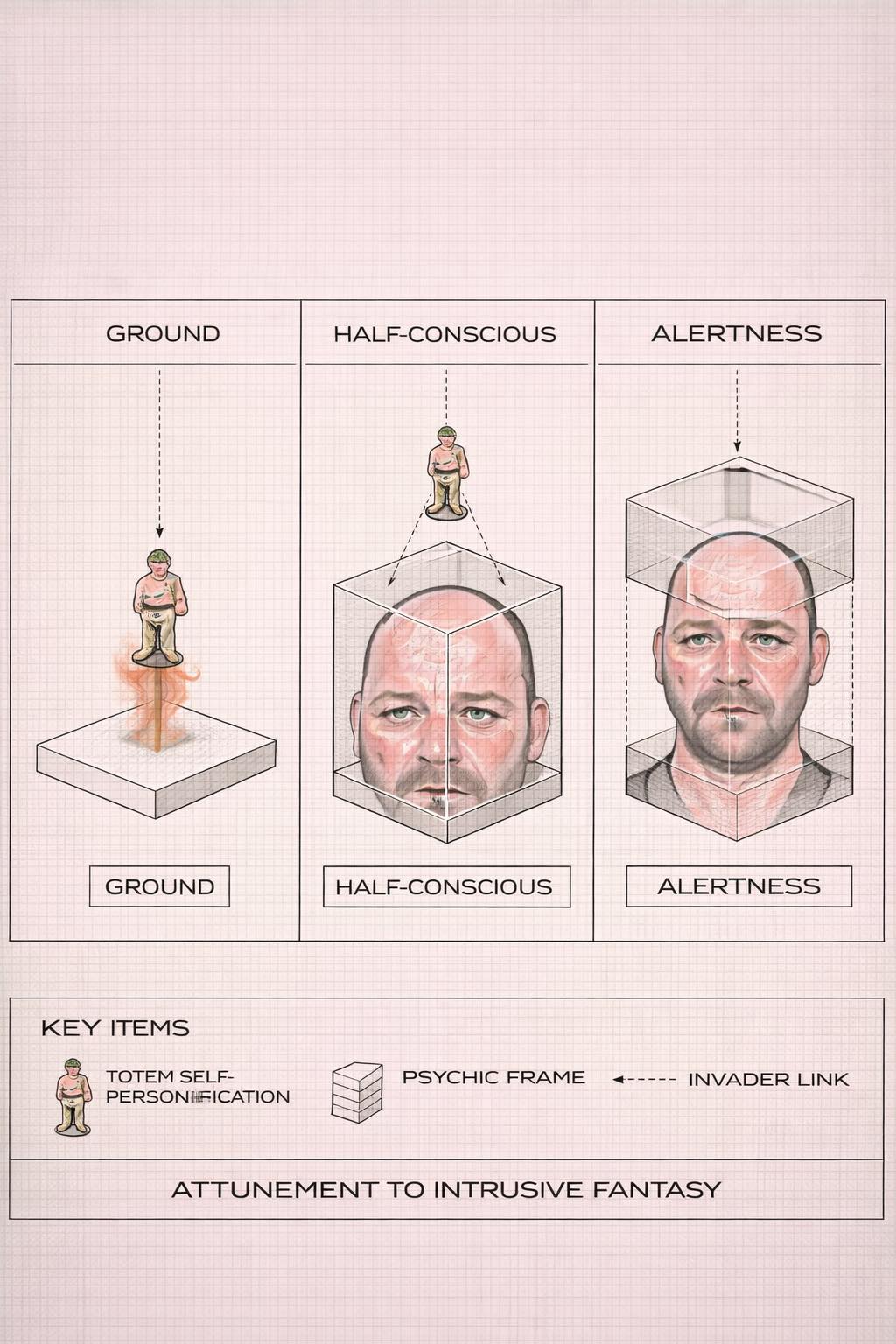
First: Ground. I am small, almost a figurine, a totem I can carry without feeling. The world is flat enough to stand on. My breath lands. My weight returns. I’m not thinking yet — I’m only here, a stamped silhouette on a pale surface. There is a faint plume under my feet, like the body’s last argument: stay.
Second: Half-conscious. A frame descends. Not a punishment — a container. A clear cube lowers over a face that is already awake inside it. I hover above it, and the distance is strange: I can see myself without being fully responsible for what I see. This is the dream’s compromise: Look, but don’t touch. Know, but don’t decide. In this zone, feelings don’t arrive as sentences. They arrive as geometry.
Third: Alertness. The cube lifts, and the face rises into full light. The eyes are open, direct, unblinking. The mouth is shut as if it’s holding back a confession. This is the moment the watchman clocks in. The nervous system tightens the straps. The room is still, but the air has already been rewritten: danger without a sound, readiness without a target.
And then the last line underneath everything, like a label on a specimen jar:
Attunement to intrusive fantasy.
I know what that means, in my own language. It means a thread pulls from elsewhere — an invader link — and my attention goes obediently, as if attention were love, as if attention were duty, as if attention were the only way to prevent loss. I don’t choose it at first. I notice I’m already chosen by it.
So I practice a quieter skill.
I place the frame back where it belongs: around the fantasy, not around my life. I let the totem-self stay small and warm on the ground. I let the face be a face — not a command.
And for one breath I understand the secret purpose of the diagram:
Not to explain me. To give me a handle.
Ground. Half-conscious. Alertness.
Three rooms. One body walking between them.