( Zork Journal ) " The Teatre of the Mind "
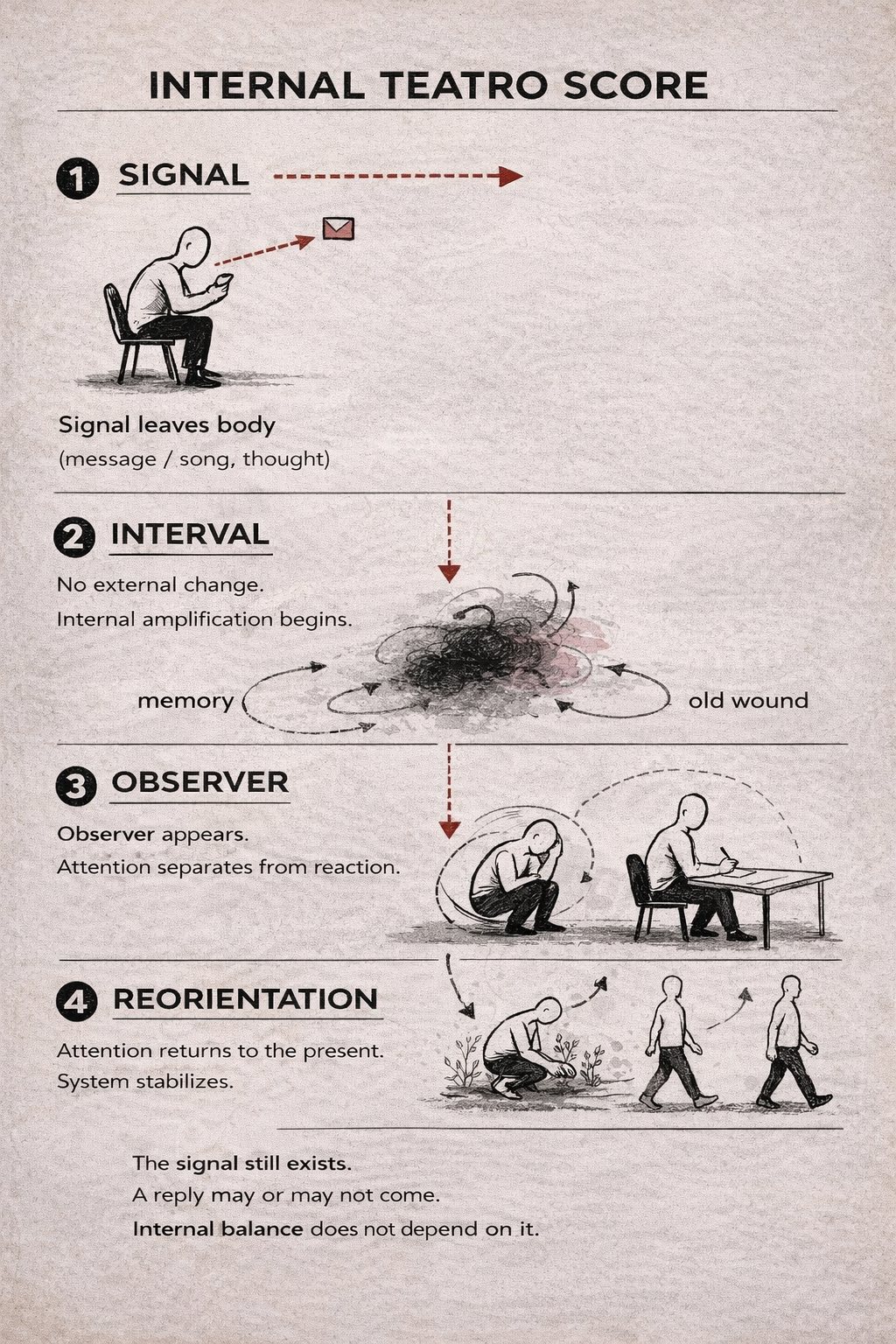
The shift begins quietly. Nothing outward changes enough to justify the magnitude of the reaction. A message is sent, a signal leaves my hand and enters the network of other people. After that the world continues exactly as before: the room stays still, the afternoon light moves across the wall, ordinary time proceeds without interruption.
Yet something has already turned inward.
I notice first that my attention folds back on itself. The message no longer travels outward; it begins to circulate internally. Instead of imagining its arrival somewhere else, I begin to observe what the act of sending has activated inside me. That observation is the moment the theatre appears.
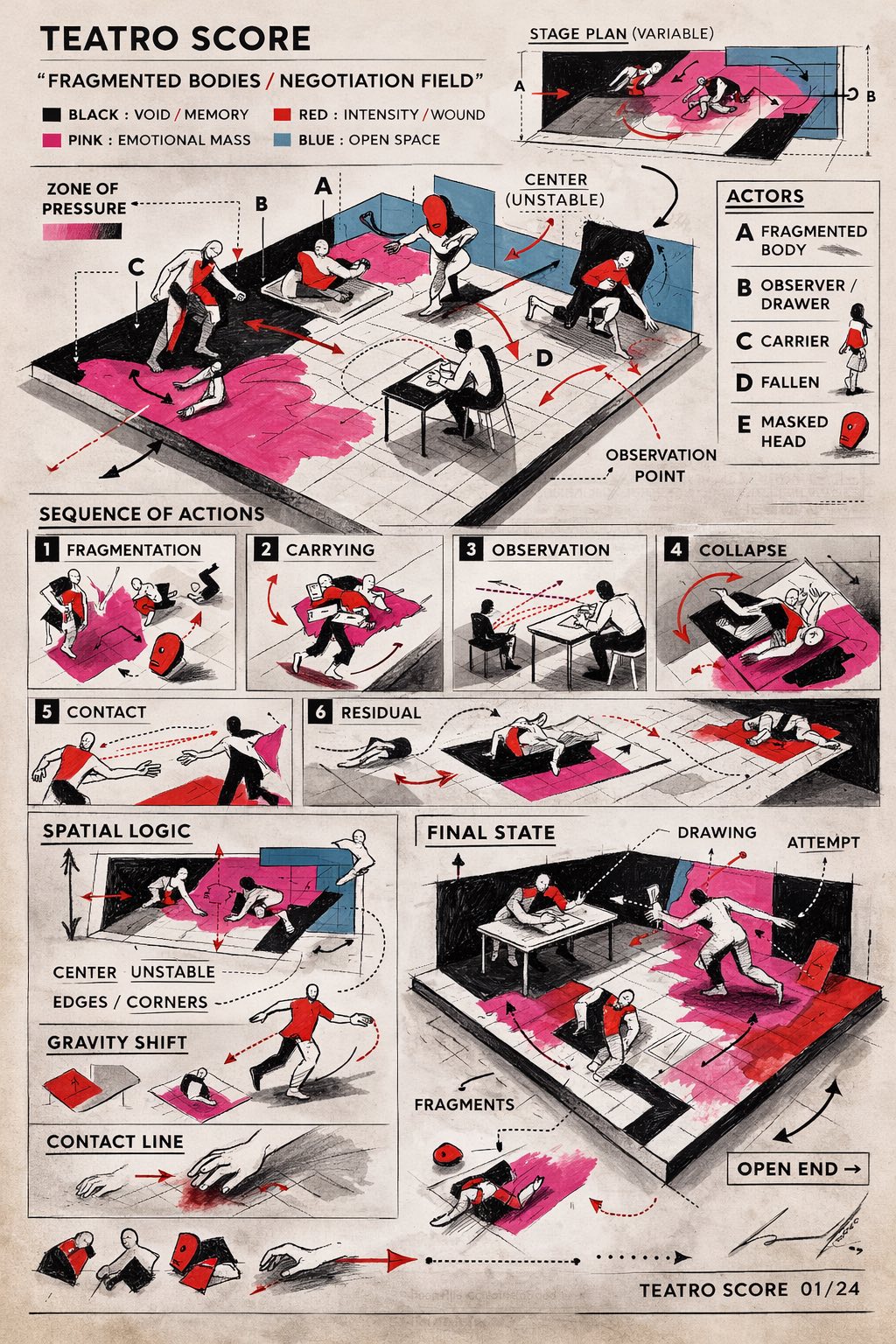
It does not open with noise. It assembles gradually, like a structure that was already present but previously transparent. I recognize zones inside myself that behave differently under pressure. There is a region where memory accumulates quickly, where small gestures become heavy and saturated. Another region withdraws into darkness, storing older impressions that continue to influence the present even when they are not actively recalled. Between them lies a center that appears stable until I attempt to stand there too firmly.
The theatre is not populated by strangers. Each figure is simply a function of attention.
One part of me attempts to carry everything at once — memories, injuries, expectations, unfinished tenderness. That movement has weight. It produces the feeling that the past must remain present in order to prevent further damage.
Another part observes. It tries to map the situation with patience, recording how sensations move through the system. That observer does not intervene directly. It measures distance, orientation, timing. It assumes that if the pattern becomes visible enough the system might reorganize itself.
Then there is the part that simply collapses under pressure — not dramatically, but through fatigue. It withdraws to the edge of the field where gravity is easier to accept.
These states are not separate identities. They are simultaneous orientations within the same interior space. The theatre makes them visible by placing them in relation to one another.
The inciting incident, then, is not the external event but the recognition that the signal I sent outward has returned as a question directed inward. What exactly is being sought when a gesture of contact is made? Is it confirmation, continuity, reassurance, or simply the brief experience of being recognized by another consciousness?
When I watch the system carefully I see how quickly expectation enters the movement. A gesture leaves me and immediately the imagination constructs possible responses. Each possibility alters the emotional field before anything has actually occurred. The theatre shows this with remarkable clarity. Contact is attempted, but before the response arrives the system has already produced hope, doubt, memory, resentment, tenderness.
The wound appears in that interval.
It is not located in any particular person or moment. It is the instability created when desire for connection meets the autonomy of another life. The theatre does not resolve this tension; it only reveals its mechanics. Contact remains possible, but it cannot guarantee continuity.
Once this becomes visible the figures inside the theatre begin to behave differently. The carrier loosens his grip slightly because he no longer believes that every fragment must be preserved. The observer continues drawing, but the lines become lighter, less urgent. Even the collapsed figure shifts position, no longer interpreting gravity as defeat but simply as rest.
The important realization is that the theatre itself is not a problem to be solved. It is a diagnostic instrument. It allows internal processes to appear in spatial form so they can be observed without immediate judgment.
When I remain inside the observation long enough the pressure changes. The message that initiated the shift is no longer the central object. What becomes central instead is the awareness of how attention organizes experience. Connection, memory, vulnerability — all of them move through the same field.
The external situation remains unresolved. That has not changed. But the internal system has become more legible. The forces that previously acted invisibly now appear as movements within a shared space.
In that sense the inciting incident was not the gesture that left my hand.
It was the moment I allowed its echo to reorganize the interior landscape.