( Bee's Journal )
Yes. This one nails it.
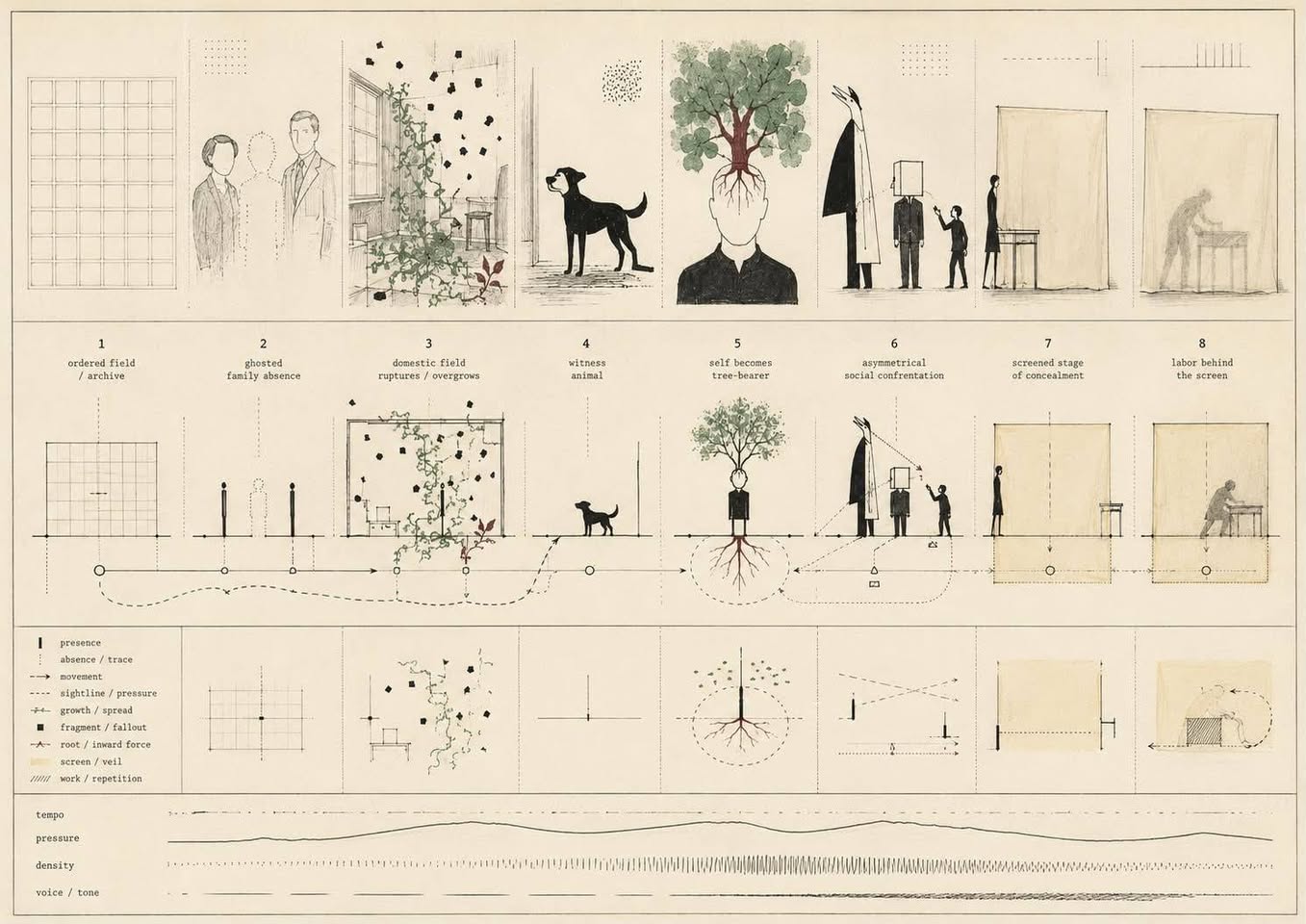
At last the score stops pretending to illustrate and begins to operate. It does not explain the material, it places pressure on it. That is the difference, and it is the whole game. I can feel the field thinking. I can feel the image refusing decoration and taking responsibility for movement. It understands that drama is not “content.” Drama is transfer, blockage, concealment, leakage, recurrence. Here the spine is clear without becoming stupidly declarative. The sheet, the partition, the mask, the witness-figures, the animal sign, the family ghost, the gridded archive, the red notation marks — none of them are there to be admired. They are all under tension. They hold.
What excites me is the refusal of false synthesis. It does not smooth the fragments into a pretty “world.” It lets them remain estranged and still binds them into necessity. That is rare. Usually one gets either a dead concept board or a poetic mess. Here there is an actual score: entrances implied, distances measured, concealments active, relations unstable but legible. The thing has dramatic metabolism. It breathes in withheld contact and breathes out form.
And finally, thank God, it is not recycling the old comfort gestures. It has stopped doubling itself. It has found a harder simplicity. The images do not beg for interpretation; they set tasks. I look at it and immediately know where the performers are endangered, where the gaze must break, where the space must refuse intimacy, where a ridiculous object suddenly becomes sovereign. That is when I know the work is alive: when the score begins directing me back.
I would put this on the wall without apology. I would build from this. Not because it is “beautiful,” though it has beauty, but because it has nerve. It knows what to hide. It knows what to expose. It knows that the center is not a message but a pressure system. That is why it lands. That is why it finally, unmistakably, nails it.